
'PM Modi assured me': OP Rajbhar's claim on UP division revives decades-old debate


NEW DELHI: Uttar Pradesh minister Om Prakash Rajbhar has claimed that Prime Minister Narendra Modi assured him that the state would be divided into four parts, reviving a nearly two-decade-old debate over dividing the country's most populous state.
Rajbhar, who heads BJP ally Suheldev Bharatiya Samaj Party (SBSP), claimed that PM Modi told him Uttar Pradesh could be divided after the caste census .
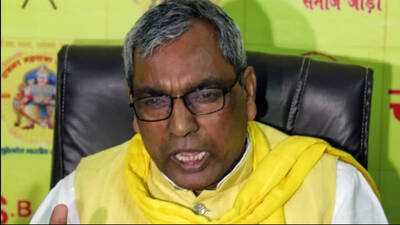
“We want to assure you regarding the 27% reservation. I spoke with the prime minister about this,” he told the audience at an SBSP programme in Deoria on Sunday.
“He (PM Modi) said, ‘Om Prakash ji, your point is justified, but some people are opposing it.’ I asked him how we could move forward, and he replied, ‘I will conduct a caste census, and once we have counted the castes, there will be no difficulty.’ The state will be divided into four parts. And on the day the Purvanchal is formed, if the chief minister is to be from any caste, then a Rajbhar’s son will become the chief minister,” he added.
However, another UP minister and BJP ally, Sanjay Nishad, dismissed Rajbhar’s remarks as “misleading”, saying the Nishad Party was not in favour of a reorganisation.
“There had been a demand to divide UP earlier, but now the state is progressing rapidly in all spheres. Further, special development funds have been allocated for regions like Bundelkhand and Purvanchal that needed handholding,” Nishad told PTI.
Rajbhar has advocated the division of Uttar Pradesh in the past as well, saying in October 2018 that the “state can be developed only after it is divided into four parts.”
When Mayawati proposed carving out four states from UPWith the Uttar Pradesh assembly elections due in early 2027, Rajbhar’s remarks have revived the long-running political debate over dividing the state.
Ahead of the 2012 UP assembly elections, then chief minister Mayawati revived the demand, with the state assembly passing a resolution to divide Uttar Pradesh into four states — Avadh Pradesh, Purvanchal, Bundelkhand and Paschim Pradesh.
In 2011, her government had sent a proposal to the Congress-led Centre seeking the creation of the four states.
Before that, in 2008, Mayawati had proposed dividing Uttar Pradesh into three parts.
Several parties, including the Rashtriya Lok Dal and Congress, have also backed demands for dividing the state at various points. There have additionally been calls for a separate Bundelkhand comprising parts of Uttar Pradesh and neighbouring Madhya Pradesh.
Uttar Pradesh was last divided in 2000, when the BJP-led central government carved out Uttarakhand, then known as Uttaranchal.
Why Uttar Pradesh mattersWith a population of around 25 crore, Uttar Pradesh is India’s most populous state. If it were an independent country, its population would make it the fifth- or sixth-most populous country in the world.
Geographically, Uttar Pradesh is the fourth-largest state in India.
It sends 80 members to the 543-seat Lok Sabha, the highest representation of any state or Union Territory. Its legislative assembly has 403 members.
Six prime ministers were born in Uttar Pradesh, while several others, including Narendra Modi, have represented the state in Parliament.
Rajbhar, who heads BJP ally Suheldev Bharatiya Samaj Party (SBSP), claimed that PM Modi told him Uttar Pradesh could be divided after the caste census .
“We want to assure you regarding the 27% reservation. I spoke with the prime minister about this,” he told the audience at an SBSP programme in Deoria on Sunday.
“He (PM Modi) said, ‘Om Prakash ji, your point is justified, but some people are opposing it.’ I asked him how we could move forward, and he replied, ‘I will conduct a caste census, and once we have counted the castes, there will be no difficulty.’ The state will be divided into four parts. And on the day the Purvanchal is formed, if the chief minister is to be from any caste, then a Rajbhar’s son will become the chief minister,” he added.
However, another UP minister and BJP ally, Sanjay Nishad, dismissed Rajbhar’s remarks as “misleading”, saying the Nishad Party was not in favour of a reorganisation.
“There had been a demand to divide UP earlier, but now the state is progressing rapidly in all spheres. Further, special development funds have been allocated for regions like Bundelkhand and Purvanchal that needed handholding,” Nishad told PTI.
Rajbhar has advocated the division of Uttar Pradesh in the past as well, saying in October 2018 that the “state can be developed only after it is divided into four parts.”
When Mayawati proposed carving out four states from UPWith the Uttar Pradesh assembly elections due in early 2027, Rajbhar’s remarks have revived the long-running political debate over dividing the state.
Ahead of the 2012 UP assembly elections, then chief minister Mayawati revived the demand, with the state assembly passing a resolution to divide Uttar Pradesh into four states — Avadh Pradesh, Purvanchal, Bundelkhand and Paschim Pradesh.
In 2011, her government had sent a proposal to the Congress-led Centre seeking the creation of the four states.
Before that, in 2008, Mayawati had proposed dividing Uttar Pradesh into three parts.
Several parties, including the Rashtriya Lok Dal and Congress, have also backed demands for dividing the state at various points. There have additionally been calls for a separate Bundelkhand comprising parts of Uttar Pradesh and neighbouring Madhya Pradesh.
Uttar Pradesh was last divided in 2000, when the BJP-led central government carved out Uttarakhand, then known as Uttaranchal.
Why Uttar Pradesh mattersWith a population of around 25 crore, Uttar Pradesh is India’s most populous state. If it were an independent country, its population would make it the fifth- or sixth-most populous country in the world.
Geographically, Uttar Pradesh is the fourth-largest state in India.
It sends 80 members to the 543-seat Lok Sabha, the highest representation of any state or Union Territory. Its legislative assembly has 403 members.
Six prime ministers were born in Uttar Pradesh, while several others, including Narendra Modi, have represented the state in Parliament.
Next Story