
Rahi's native land seek recognition for literary legacy


GHAZIPUR:Rahi’s work may have won hearts and acclaim in literary circles and Bollywood, but those in his native village feel he deserves more especially in the places linked to him.
In Baghui Buzurg , the village where Rahi Masoom Raza was born, pride in his legacy comes with a wish for greater recognition.
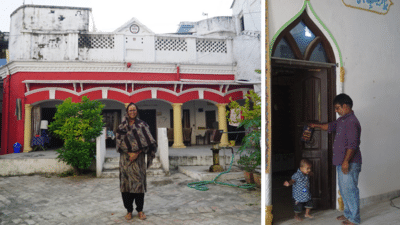
“This is Rahi’s maternal home. He was born in this very room,” said his nephew, Mohd Shakeeb, as he showed us around the house and the neem tree that Rahi personified in Neem Ka Ped to tell a larger story of ordinary lives, social change and a nation in transition. For the family, the house is more than a link to the past; it is a reminder of the place that shaped the writer and his imagination.
 Preserving his memory, they believe, must go beyond remembering him on special occasions. His nephew Wasi Asghar feels the district should formally acknowledge Rahi’s contribution to literature.
“Successive governments have yet to take an initiative to recognise his contribution to the literary world. The district could at least have a degree college dedicated to him,” he said. Such an institution, the family hopes, would introduce younger generations to a writer whose work drew deeply from the region and its people.
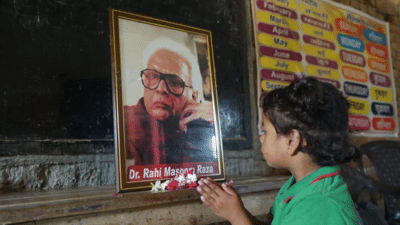
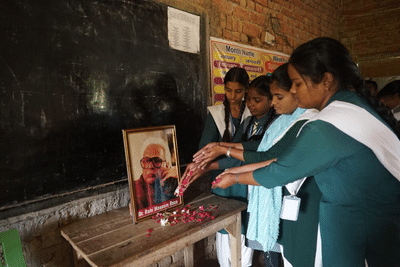
His daughter Mariyam has made a beginning of her own by setting up an English-medium school in his name. On Saturday, around 700 children at the school remembered Rahi.
“Access to education was the foundation of his evolution as a person. So, we thought of making this humble beginning,” she said.
The school is one way of keeping his name alive while extending the opportunity that helped shape his own intellectual journey.
About 15 kilometres away, Gangauli, Rahi’s paternal village, shares this sense of belonging.
“This is his dadihal (paternal home),” said Syed Abuzar Husain, a relative who looks after the family home, now an imambara that comes alive during Muharram. Visitors often come here to learn more about the writer, he said.
But recognition remains uneven. Neighbour Anwar Ansari, a retired weaver who read Aadha Gaon and watched Neem Ka Ped out of curiosity, offered a less celebratory view.
“People who love Rahi may be proud of him, but many locals, particularly those from his own community, are not. They resent him because he exposed them in his books,” he said demanding that at least a road in his name must be sanctioned.
His observation points to a complicated legacy: the same writing that made Rahi an important chronicler of his society also unsettled people who saw themselves reflected in its unflattering portraits.
 At Peeli Kothi, also known as Bashir Manzil, where Rahi spent his early years, family memories offer a glimpse of the experiences that shaped his imagination. His niece Samar Rizwi recalled how polio restricted the six-year-old’s life for months.
His attendant, Kallu Kaka, kept him company with stories, including tales from Hindu mythology. “We believe those years came in handy when he later wrote dialogues for Mahabharat,” she said. Rahi also took to reading during this period.
His nephew and filmmaker Asif Jah recalled that Rahi’s father, Bashir Saab, often hosted poets at home, exposing him to the literary world and nurturing his early interest in Urdu poetry.
“People are taking up PhDs on his work even today which speaks volumes for his stature. He deserves more,” he said.
In Baghui Buzurg , the village where Rahi Masoom Raza was born, pride in his legacy comes with a wish for greater recognition.
“This is Rahi’s maternal home. He was born in this very room,” said his nephew, Mohd Shakeeb, as he showed us around the house and the neem tree that Rahi personified in Neem Ka Ped to tell a larger story of ordinary lives, social change and a nation in transition. For the family, the house is more than a link to the past; it is a reminder of the place that shaped the writer and his imagination.
“Successive governments have yet to take an initiative to recognise his contribution to the literary world. The district could at least have a degree college dedicated to him,” he said. Such an institution, the family hopes, would introduce younger generations to a writer whose work drew deeply from the region and its people.
His daughter Mariyam has made a beginning of her own by setting up an English-medium school in his name. On Saturday, around 700 children at the school remembered Rahi.
“Access to education was the foundation of his evolution as a person. So, we thought of making this humble beginning,” she said.
The school is one way of keeping his name alive while extending the opportunity that helped shape his own intellectual journey.
About 15 kilometres away, Gangauli, Rahi’s paternal village, shares this sense of belonging.
“This is his dadihal (paternal home),” said Syed Abuzar Husain, a relative who looks after the family home, now an imambara that comes alive during Muharram. Visitors often come here to learn more about the writer, he said.
But recognition remains uneven. Neighbour Anwar Ansari, a retired weaver who read Aadha Gaon and watched Neem Ka Ped out of curiosity, offered a less celebratory view.
“People who love Rahi may be proud of him, but many locals, particularly those from his own community, are not. They resent him because he exposed them in his books,” he said demanding that at least a road in his name must be sanctioned.
His observation points to a complicated legacy: the same writing that made Rahi an important chronicler of his society also unsettled people who saw themselves reflected in its unflattering portraits.
His attendant, Kallu Kaka, kept him company with stories, including tales from Hindu mythology. “We believe those years came in handy when he later wrote dialogues for Mahabharat,” she said. Rahi also took to reading during this period.
His nephew and filmmaker Asif Jah recalled that Rahi’s father, Bashir Saab, often hosted poets at home, exposing him to the literary world and nurturing his early interest in Urdu poetry.
“People are taking up PhDs on his work even today which speaks volumes for his stature. He deserves more,” he said.
Next Story