
Selling Gold Jewellery Or ETFs? Here's What Every Investor Should Understand First

In a significant move to streamline taxation policies, the government has revised the capital gains tax rules applicable to gold and related investments. These changes, implemented from July 23, 2024, aim to unify the treatment of various asset classes and offer greater clarity to taxpayers. Investors in gold jewellery, mutual funds, and exchange-traded funds (ETFs) need to familiarise themselves with the new framework, as it directly affects how profits from these assets are taxed.
Revised Holding Periods and New Tax Rates for Gold Jewellery
Under the updated regime, the period of holding gold jewellery becomes the key factor in determining how gains are taxed. When gold ornaments are sold after being held for more than three years, the profit is treated as a long-term capital gain (LTCG) and taxed at 20% with indexation benefits. This provision is designed to encourage individuals to retain their assets over longer periods, promoting stability and long-term investment behaviour.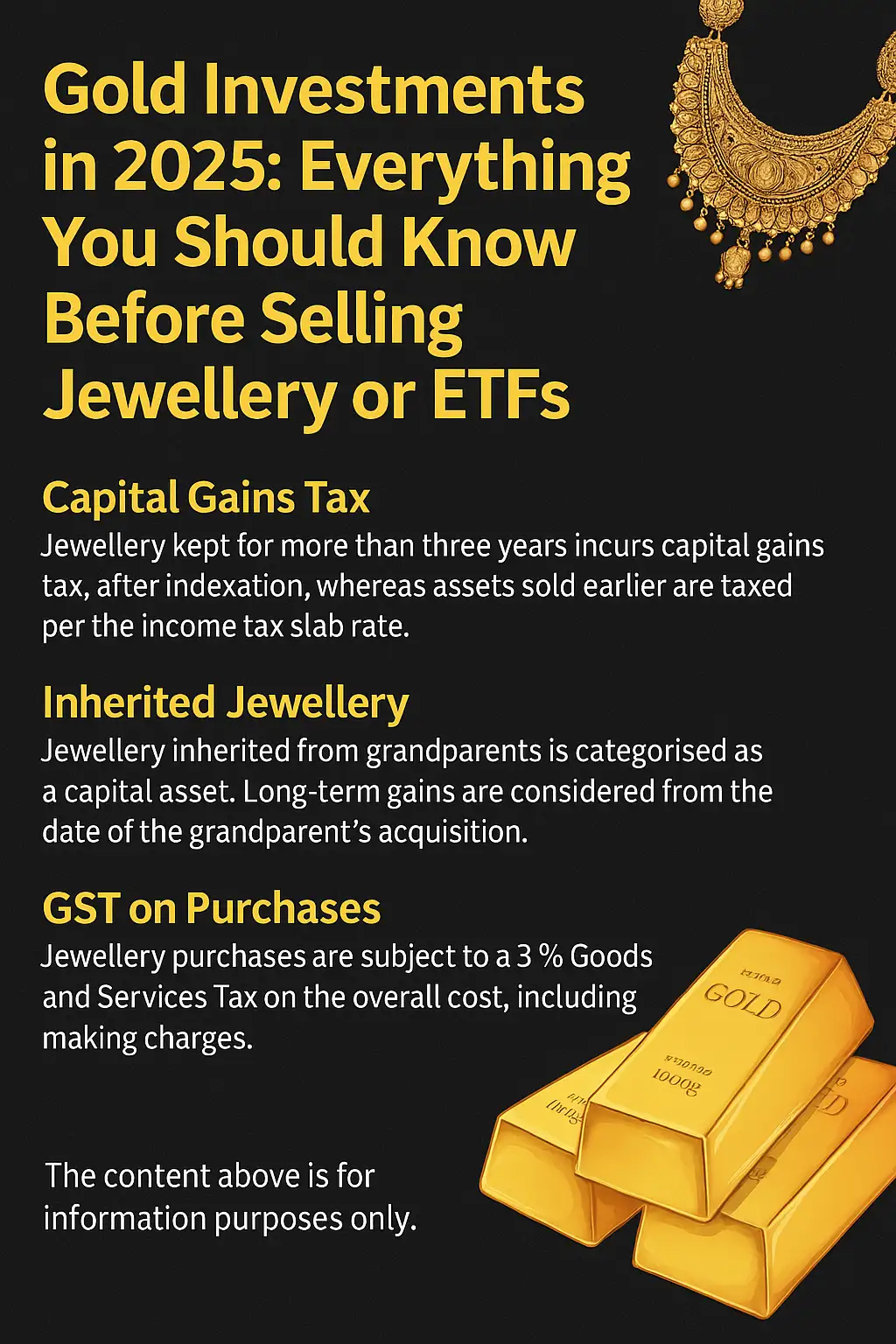
However, if the jewellery is sold within a three-year timeframe, the resulting profit is considered a short-term capital gain (STCG) and taxed according to the individual’s applicable income tax slab. The objective here is to bring uniformity across various forms of capital assets and ensure fair treatment, regardless of whether the asset is physical or financial.
Treatment of Inherited Gold Gets More Clarity
Gold inherited from family members—such as parents or grandparents—has also received specific treatment under the updated rules. Inherited gold jewellery is recognised as a capital asset. If it was originally acquired before 1 April 2001, the cost of acquisition is based on its fair market value (FMV) as of that date. This FMV can be ascertained through a valuation by a government-registered valuer if original purchase documents are unavailable.
Moreover, the holding period in such cases is calculated from the date of purchase by the original owner (e.g., a grandparent), not the date of inheritance. If the asset has been held for more than three years, it qualifies for long-term capital gains, offering a more favourable tax outcome.
Gold Mutual Funds and ETFs Brought Under the Same Umbrella
Starting 1 April 2025, the same capital gains tax principles will apply to gold mutual funds and gold exchange-traded funds (ETFs). If these investments are held for more than 24 months, the gains will be treated as long-term capital gains and taxed at a flat rate of 12.5% without the benefit of indexation. Gains from sales before the 24-month period will fall under short-term capital gains and will be taxed according to the investor’s income tax slab.
For listed gold ETFs, however, a shorter threshold of 12 months is applicable. Gains from ETFs held for over a year are considered long-term and taxed at the same rate of 12.5% without indexation, while profits from ETFs sold within a year are treated as STCG and taxed as per income slabs.
These rules align with the redefinition of what qualifies as a debt mutual fund. According to the updated guidelines, a fund investing more than 65% of its assets in debt instruments or money market securities will now be categorised as a debt fund. This change impacts how mutual funds, including those focused on gold, are taxed.
GST on Purchases and Other Charges
While the income tax department does not levy any tax on the purchase of gold jewellery, Goods and Services Tax (GST) is applicable. Buyers are required to pay 3% GST on the total value, which includes making charges. This tax is separate from any capital gains tax that may apply during the eventual sale of the jewellery.
Record-Keeping and Valuation Practices Are Crucial
One of the essential takeaways for gold investors is the importance of documentation. In the absence of purchase invoices—particularly for inherited assets—seeking a valuation from a certified valuer can help determine the correct cost of acquisition. This will be instrumental when calculating gains during a future sale and ensures compliance with current tax laws.
What Investors Should Do Now
With these revised tax rules coming into full effect from 1 April 2025, individuals holding gold assets—whether in the form of jewellery or financial instruments—should consider reviewing their portfolios. Understanding the holding period, keeping proper documentation, and being aware of applicable rates will help avoid surprises at the time of sale.
Financial planners recommend aligning investment decisions with the updated tax landscape to maximise post-tax returns. Holding gold for longer durations and staying informed about capital gains implications could translate to better financial outcomes.
Disclaimer: This article is intended for informational purposes only and should not be considered financial or tax advice. Please consult a certified tax advisor or financial planner for guidance tailored to your individual situation.
Revised Holding Periods and New Tax Rates for Gold Jewellery
Under the updated regime, the period of holding gold jewellery becomes the key factor in determining how gains are taxed. When gold ornaments are sold after being held for more than three years, the profit is treated as a long-term capital gain (LTCG) and taxed at 20% with indexation benefits. This provision is designed to encourage individuals to retain their assets over longer periods, promoting stability and long-term investment behaviour.
However, if the jewellery is sold within a three-year timeframe, the resulting profit is considered a short-term capital gain (STCG) and taxed according to the individual’s applicable income tax slab. The objective here is to bring uniformity across various forms of capital assets and ensure fair treatment, regardless of whether the asset is physical or financial.
Treatment of Inherited Gold Gets More Clarity
Gold inherited from family members—such as parents or grandparents—has also received specific treatment under the updated rules. Inherited gold jewellery is recognised as a capital asset. If it was originally acquired before 1 April 2001, the cost of acquisition is based on its fair market value (FMV) as of that date. This FMV can be ascertained through a valuation by a government-registered valuer if original purchase documents are unavailable.
Moreover, the holding period in such cases is calculated from the date of purchase by the original owner (e.g., a grandparent), not the date of inheritance. If the asset has been held for more than three years, it qualifies for long-term capital gains, offering a more favourable tax outcome.
Gold Mutual Funds and ETFs Brought Under the Same Umbrella
Starting 1 April 2025, the same capital gains tax principles will apply to gold mutual funds and gold exchange-traded funds (ETFs). If these investments are held for more than 24 months, the gains will be treated as long-term capital gains and taxed at a flat rate of 12.5% without the benefit of indexation. Gains from sales before the 24-month period will fall under short-term capital gains and will be taxed according to the investor’s income tax slab.
You may also like
- 42-year-old man beaten to death in Hyderabad's Falaknuma
- BEL Invites Applications for 14 Deputy Engineer Positions Until September 23
- Bhiwandi Man Gets Life Term For Setting Wife On Fire After Argument Over Chicken
- IIT Bombay Replaces Ceiling Fans In Some Hostels During Renovation; Institute Says Move Not Linked To Recent Student Death
- Watch Mysaa Teaser: Rashmika Mandanna Turns Fearless Warrior In Rawindra Pulle Intense Action Drama
For listed gold ETFs, however, a shorter threshold of 12 months is applicable. Gains from ETFs held for over a year are considered long-term and taxed at the same rate of 12.5% without indexation, while profits from ETFs sold within a year are treated as STCG and taxed as per income slabs.
These rules align with the redefinition of what qualifies as a debt mutual fund. According to the updated guidelines, a fund investing more than 65% of its assets in debt instruments or money market securities will now be categorised as a debt fund. This change impacts how mutual funds, including those focused on gold, are taxed.
GST on Purchases and Other Charges
While the income tax department does not levy any tax on the purchase of gold jewellery, Goods and Services Tax (GST) is applicable. Buyers are required to pay 3% GST on the total value, which includes making charges. This tax is separate from any capital gains tax that may apply during the eventual sale of the jewellery.
Record-Keeping and Valuation Practices Are Crucial
One of the essential takeaways for gold investors is the importance of documentation. In the absence of purchase invoices—particularly for inherited assets—seeking a valuation from a certified valuer can help determine the correct cost of acquisition. This will be instrumental when calculating gains during a future sale and ensures compliance with current tax laws.
What Investors Should Do Now
With these revised tax rules coming into full effect from 1 April 2025, individuals holding gold assets—whether in the form of jewellery or financial instruments—should consider reviewing their portfolios. Understanding the holding period, keeping proper documentation, and being aware of applicable rates will help avoid surprises at the time of sale.
Financial planners recommend aligning investment decisions with the updated tax landscape to maximise post-tax returns. Holding gold for longer durations and staying informed about capital gains implications could translate to better financial outcomes.
Disclaimer: This article is intended for informational purposes only and should not be considered financial or tax advice. Please consult a certified tax advisor or financial planner for guidance tailored to your individual situation.






Loving Newspoint? Download the app now
