
The OGs reunite: SAD gets 'bada bhai' tag in Punjab, but BJP has bigger ambitions


NEW DELHI: Two of Punjab's oldest political allies are back together, six years after a bitter parting over the contentious farm laws. The Bharatiya Janata Party ( BJP ) and the Shiromani Akali Dal ( SAD ) on Tuesday announced the revival of their alliance for the 2027 Punjab assembly elections , seeking to revive a partnership that once governed the state for 15 years across three terms.
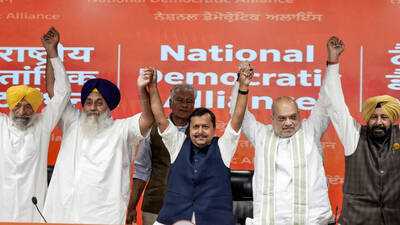
The reunion, announced on the Parkash Purab of Guru Nanak Dev, brings together parties whose relationship was famously described by former Punjab chief minister Parkash Singh Badal as "nau-maas da rishta", the bond between the nail and the flesh.
Prime Minister Narendra Modi welcomed the development, saying the alliance would put Punjab and the welfare of Punjabis first.
"Ours is a natural alliance that will ensure Punjab gets pro-people governance that takes the state to new heights of progress," he said in a post on X, adding that the partnership, nurtured by Atal Bihari Vajpayee, LK Advani and Parkash Singh Badal, had "stood the test of time".
Union home minister Amit Shah, who announced the reunion alongside BJP president Nitin Nabin and SAD chief Sukhbir Singh Badal, called the Akali Dal the NDA's "oldest ally" and said PM Modi had described the development by saying the "NDA is now complete".
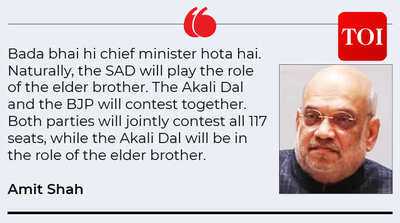
Shah also said SAD would retain its senior-partner status, adding that the "big brother" would get the chief minister's post. "Big brother will be Akali Dal. We will contest all 117 seats. Bada bhai hi chief minister hota hai (The elder brother becomes the chief minister)," the Union minister said at the joint press conference.
The two parties will contest all 117 assembly seats together, although the seat-sharing arrangement is yet to be finalised.
The reunion comes after months of political manoeuvring, including Sukhbir Badal's meeting with PM Modi in August and a shift in SAD's position on the Centre's delimitation proposal. It also brings together two parties whose electoral fortunes have declined sharply since their separation.
However, Punjab is no longer the state in which the old alliance enjoyed its strongest run. AAP has emerged as the dominant force, Congress remains a significant contender, and the BJP and SAD have both undergone changes in their support bases and political strategies.
Why SAD-BJP patched up
The partnership actually predates the BJP. Its predecessor, the Bharatiya Jana Sangh, shared power with the Akalis in Punjab as far back as 1967 and 1969. The modern alliance, however, was forged in 1996, when SAD's Moga Declaration pivoted from purely Panthic politics to a broader pitch of "Punjab, Punjabi and Punjabiyat."
The partnership brought together the Akalis' predominantly rural Sikh support base and the BJP's largely urban Hindu constituency. It also helped both parties build a political coalition in the aftermath of militancy in Punjab.
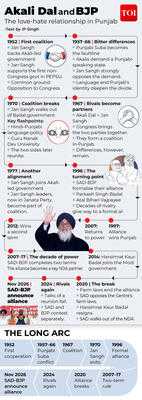
The alliance won 93 of 117 assembly seats in 1997, with SAD securing 75 and the BJP 18. After losing power to Congress in 2002, the combine returned to office in 2007 and retained power in 2012, winning 67 and 68 seats respectively.
ALSO READ: From 'nau-mass da rishta' to bitter rivals and back; how BJP-SAD relations played out over the years
But the emergence of AAP, coupled with public anger over incidents of sacrilege and the drug menace, weakened the alliance. In 2017, SAD was reduced to 15 seats and the BJP to three.
The final rupture came in September 2020, when SAD walked out of the NDA over the Centre's three farm laws. Harsimrat Kaur Badal resigned as Union food processing industries minister on September 17, and the Akali Dal formally ended its 24-year-old electoral partnership with the BJP nine days later.
The laws were repealed in November 2021, but the political damage endured.
The alliance's decline is evident from its electoral record. In 2007, SAD won 48 seats and the BJP 19, taking their combined tally to 67. They improved to 68 seats in 2012, with SAD winning 56 and the BJP 12. But the numbers fell sharply thereafter. In 2017, SAD was reduced to 15 seats and the BJP to three. By the 2022 assembly elections, the two parties managed just five seats between them, with SAD winning three and the BJP two.
In 2022, SAD secured 18.38% of the vote and the BJP 6.60%, while AAP swept the election with 92 seats and a 42.01% vote share.
Their separate performance in the 2024 Lok Sabha elections provided another reason to reconsider the alliance. The BJP failed to win any of Punjab's 13 seats despite securing 18.56% of the vote. SAD won one seat, Bathinda, with 13.42%.
ALSO READ: From 9.63% to 18.56% - BJP’s saving grace after drawing a blank in Punjab
Together, their vote shares added up to nearly 32%, compared with 26.30% for Congress and 26.02% for AAP.
The numbers make a case for pooling their support bases, although the combined vote share does not automatically translate into transferable votes or assembly seats.
For the BJP, the alliance offers access to SAD's traditional rural and Sikh support networks. For the Akali Dal, it brings back a national ally and an opportunity to rebuild its electoral machinery, which is the BJP's strong suit.
Sukhbir Singh Badal described the reunion as more than an electoral arrangement.
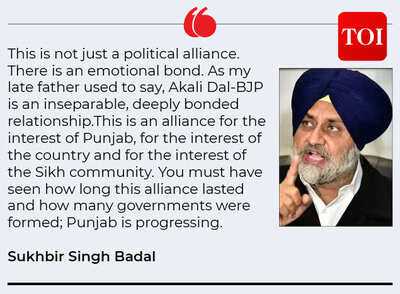
"This is not just a political alliance. There is an emotional bond. As my late father used to say, Akali Dal-BJP is an inseparable, deeply bonded relationship," he said.
Six years later, a very different Punjab
The old partners are back again, but the state the BJP and SAD are returning to is markedly different from the one they left behind in 2020.
The 2027 assembly election will be the alliance's first major state-level electoral test without Parkash Singh Badal, the five-time CM who died in April 2023. A towering figure in the Akali Dal, he was also a key bridge between the SAD and the BJP. Though Sukhbir Badal was already leading the party before his father's death, he now has to rebuild the party's standing without his political stature and influence.
Another factor the alliance must keep in mind is that the farm issue has not disappeared. The repeal of the three farm laws did not automatically undo the distrust they created. Farmers' demands, including a legal guarantee for minimum support price, remain unresolved, keeping the issue politically alive in an agrarian state like Punjab. The BJP-SAD alliance will have to reckon with that trust deficit, particularly in the rural Malwa belt, which is the largest and most populous region covering major farming districts like Bathinda, Mansa, Sangrur, Patiala, Ludhiana and Muktsar.
This is why the choice of Gurpurab for the reunion announcement is rich in symbolism. PM Modi had announced the repeal of the farm laws on the occasion in November 2021. The two parties have now chosen the same religious occasion to announce their political reconciliation. Whether that symbolism can translate into renewed trust among farmers is a different question.
Another thing that has changed is that the Akali Dal can no longer assume that it commands the entire Panthic vote. In the 2024 Lok Sabha election, independent candidates Amritpal Singh and Sarabjeet Singh Khalsa won from Khadoor Sahib and Faridkot, respectively. Between them, they also led in 15 assembly segments.
ALSO READ: 'O Captain, My Captain' - Should Congress make room for Amarinder Singh again?
This makes the party's return to its traditional Panthic space more difficult. The SAD has tried to reconnect with its core constituency through issues of Sikh identity and historical memory. The controversy surrounding 'Satluj', a film based on activist Jaswant Singh Khalra's work documenting alleged extrajudicial killings in Punjab, offered one such opportunity. After the film was taken down from an OTT platform, Sukhbir Badal announced screenings across the state, saying young people should know about the events it depicts.
The bigger, bolder BJP
Six years on its own have transformed the BJP from a junior partner that contested just 23 of Punjab's 117 assembly seats into a more assertive player. Under the old arrangement, the SAD contested 94 assembly seats and the BJP 23, largely in urban constituencies. For the Lok Sabha elections, the split was 10 seats for the Akalis and three for the BJP.
Its vote share in the 2024 Lok Sabha election rose to 18.56 per cent, up from 9.63 per cent in 2019. The BJP contested all 13 seats in 2024, compared with just three under the old seat-sharing arrangement in 2019. Though it won no seats, the saffron party's vote share was higher than the SAD's 13.42 per cent. In the 2022 assembly election, the BJP had polled 6.60 per cent and won two seats.
The party has also strengthened its ranks through a steady stream of defections. In April 2026, AAP Rajya Sabha MP Raghav Chadha led six other MPs into the BJP which included Sandeep Pathak, Ashok Mittal, Harbhajan Singh, Vikramjit Singh Sahney, Rajinder Gupta and Swati Maliwal. Six of these seven were Rajya Sabha members from Punjab. The exits dealt a major blow to the AAP's parliamentary strength and brought into the BJP leaders who had been closely associated with the party's Punjab strategy. Chadha and Pathak, in particular, had played key roles in the AAP's political and electoral planning.
The BJP has since moved to put these former AAP leaders to work against their old party. Chadha and Harbhajan Singh have been named to its Punjab manifesto committee, while Pathak, Mittal, Sahney and other former AAP MPs have been assigned roles in the party's chargesheet committee, which will prepare its case against the Bhagwant Mann government.
Earlier, in March 2024, AAP's then Jalandhar MP Sushil Kumar Rinku and Jalandhar West MLA Sheetal Angural had also joined the BJP. In November 2026, three more AAP legislators, Harmeet Singh Pathanmajra, Chetan Singh Jouramajra and Kunwar Vijay Pratap Singh, crossed over. The BJP has also inducted senior Akali leaders, including Surinder Singh Chauhan and Jaswinderpal Sohal, as well as AAP functionaries from Moga led by spokesperson Navdeep Singh Sangha.
The BJP's recruitment drive has not been limited to the AAP and SAD. Its Punjab ranks also include former Congress leaders such as Sunil Jakhar, Manpreet Singh Badal, Ravneet Singh Bittu and Preneet Kaur.
That changes the terms of the reunion. The BJP returns with a larger vote share, a wider organisational footprint and experienced leaders. The SAD, meanwhile, needs the alliance to recover lost ground and reconnect with rural voters. Amit Shah has announced that the BJP is okay with the junior-partner label in the alliance. It is, however, unlikely that the BJP will settle for the old seat-sharing formula.
Can the alliance unsettle AAP?
The immediate target of the alliance is the AAP government, which swept to power in 2022 with 92 seats and 42.01 per cent of the vote. Its vote share fell to 26.02 per cent in the 2024 Lok Sabha election, when it won three seats, but it remains a formidable player.
The SAD-BJP reunion gives the opposition a potentially stronger combination of urban and rural networks. It could also help consolidate voters who want an alternative to the AAP government. The drug problem, in particular, is likely to be a central campaign issue.
At his press conference, Amit Shah listed three priorities for a future NDA government: eliminating drugs, eliminating corruption and strengthening nationalist forces. He promised that Punjab would be "completely drug-free" by December 31, 2029. He also targeted Congress, recalling Rahul Gandhi's 2017 promise that drugs would be eliminated within one term and accusing the party of doing nothing when it was in power.
The attack gives the alliance a ready-made campaign plank. But it also puts the BJP and SAD on the spot, as both parties have been part of Punjab's political establishment for decades. The voters, thus, will judge their record as well as their promises.
There is another complication. The Congress remains a strong third front and could split the anti-incumbency vote. Rural Sikh voters who continue to view the BJP through the lens of the farm agitation may also be reluctant to back the reunited partners. The AAP could benefit if opposition votes remain divided.
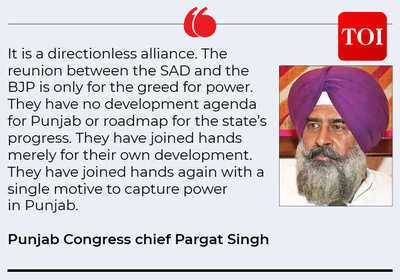
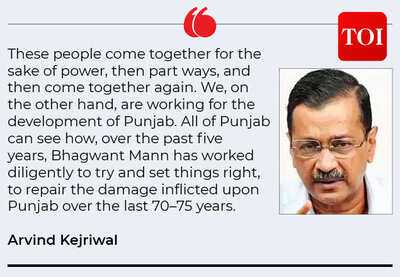
The BJP-SAD reunion also complicates the Congress's position. With an established opposition pole, the contest for voters dissatisfied with the AAP government will now intensify. Amit Shah's attack on the Congress over its record on drugs made it clear that the alliance intends to take on both the ruling party and its principal rival.
The Congress can still draw on its independent support base, but it will have to navigate a more crowded opposition space, as well as its own internal factional differences.
Six years after a split that left both allies on the margins, the BJP and the Shiromani Akali Dal have chosen pragmatism over past grievances to challenge AAP and Congress. The 2027 election, however, will not be a simple replay of the coalition's past victories. And tough seat-sharing talks are yet to be held.
The OGs may be back together, but winning over a changed Punjab will require more than old chemistry.
The reunion, announced on the Parkash Purab of Guru Nanak Dev, brings together parties whose relationship was famously described by former Punjab chief minister Parkash Singh Badal as "nau-maas da rishta", the bond between the nail and the flesh.
Prime Minister Narendra Modi welcomed the development, saying the alliance would put Punjab and the welfare of Punjabis first.
"Ours is a natural alliance that will ensure Punjab gets pro-people governance that takes the state to new heights of progress," he said in a post on X, adding that the partnership, nurtured by Atal Bihari Vajpayee, LK Advani and Parkash Singh Badal, had "stood the test of time".
Union home minister Amit Shah, who announced the reunion alongside BJP president Nitin Nabin and SAD chief Sukhbir Singh Badal, called the Akali Dal the NDA's "oldest ally" and said PM Modi had described the development by saying the "NDA is now complete".
Shah also said SAD would retain its senior-partner status, adding that the "big brother" would get the chief minister's post. "Big brother will be Akali Dal. We will contest all 117 seats. Bada bhai hi chief minister hota hai (The elder brother becomes the chief minister)," the Union minister said at the joint press conference.
The two parties will contest all 117 assembly seats together, although the seat-sharing arrangement is yet to be finalised.
The reunion comes after months of political manoeuvring, including Sukhbir Badal's meeting with PM Modi in August and a shift in SAD's position on the Centre's delimitation proposal. It also brings together two parties whose electoral fortunes have declined sharply since their separation.
However, Punjab is no longer the state in which the old alliance enjoyed its strongest run. AAP has emerged as the dominant force, Congress remains a significant contender, and the BJP and SAD have both undergone changes in their support bases and political strategies.
Why SAD-BJP patched up
The partnership actually predates the BJP. Its predecessor, the Bharatiya Jana Sangh, shared power with the Akalis in Punjab as far back as 1967 and 1969. The modern alliance, however, was forged in 1996, when SAD's Moga Declaration pivoted from purely Panthic politics to a broader pitch of "Punjab, Punjabi and Punjabiyat."
The partnership brought together the Akalis' predominantly rural Sikh support base and the BJP's largely urban Hindu constituency. It also helped both parties build a political coalition in the aftermath of militancy in Punjab.
The alliance won 93 of 117 assembly seats in 1997, with SAD securing 75 and the BJP 18. After losing power to Congress in 2002, the combine returned to office in 2007 and retained power in 2012, winning 67 and 68 seats respectively.
ALSO READ: From 'nau-mass da rishta' to bitter rivals and back; how BJP-SAD relations played out over the years
But the emergence of AAP, coupled with public anger over incidents of sacrilege and the drug menace, weakened the alliance. In 2017, SAD was reduced to 15 seats and the BJP to three.
The final rupture came in September 2020, when SAD walked out of the NDA over the Centre's three farm laws. Harsimrat Kaur Badal resigned as Union food processing industries minister on September 17, and the Akali Dal formally ended its 24-year-old electoral partnership with the BJP nine days later.
The laws were repealed in November 2021, but the political damage endured.
The alliance's decline is evident from its electoral record. In 2007, SAD won 48 seats and the BJP 19, taking their combined tally to 67. They improved to 68 seats in 2012, with SAD winning 56 and the BJP 12. But the numbers fell sharply thereafter. In 2017, SAD was reduced to 15 seats and the BJP to three. By the 2022 assembly elections, the two parties managed just five seats between them, with SAD winning three and the BJP two.
In 2022, SAD secured 18.38% of the vote and the BJP 6.60%, while AAP swept the election with 92 seats and a 42.01% vote share.
Their separate performance in the 2024 Lok Sabha elections provided another reason to reconsider the alliance. The BJP failed to win any of Punjab's 13 seats despite securing 18.56% of the vote. SAD won one seat, Bathinda, with 13.42%.
ALSO READ: From 9.63% to 18.56% - BJP’s saving grace after drawing a blank in Punjab
Together, their vote shares added up to nearly 32%, compared with 26.30% for Congress and 26.02% for AAP.
]]>
The numbers make a case for pooling their support bases, although the combined vote share does not automatically translate into transferable votes or assembly seats.
For the BJP, the alliance offers access to SAD's traditional rural and Sikh support networks. For the Akali Dal, it brings back a national ally and an opportunity to rebuild its electoral machinery, which is the BJP's strong suit.
Sukhbir Singh Badal described the reunion as more than an electoral arrangement.
"This is not just a political alliance. There is an emotional bond. As my late father used to say, Akali Dal-BJP is an inseparable, deeply bonded relationship," he said.
Six years later, a very different Punjab
The old partners are back again, but the state the BJP and SAD are returning to is markedly different from the one they left behind in 2020.
The 2027 assembly election will be the alliance's first major state-level electoral test without Parkash Singh Badal, the five-time CM who died in April 2023. A towering figure in the Akali Dal, he was also a key bridge between the SAD and the BJP. Though Sukhbir Badal was already leading the party before his father's death, he now has to rebuild the party's standing without his political stature and influence.
Another factor the alliance must keep in mind is that the farm issue has not disappeared. The repeal of the three farm laws did not automatically undo the distrust they created. Farmers' demands, including a legal guarantee for minimum support price, remain unresolved, keeping the issue politically alive in an agrarian state like Punjab. The BJP-SAD alliance will have to reckon with that trust deficit, particularly in the rural Malwa belt, which is the largest and most populous region covering major farming districts like Bathinda, Mansa, Sangrur, Patiala, Ludhiana and Muktsar.
This is why the choice of Gurpurab for the reunion announcement is rich in symbolism. PM Modi had announced the repeal of the farm laws on the occasion in November 2021. The two parties have now chosen the same religious occasion to announce their political reconciliation. Whether that symbolism can translate into renewed trust among farmers is a different question.
Another thing that has changed is that the Akali Dal can no longer assume that it commands the entire Panthic vote. In the 2024 Lok Sabha election, independent candidates Amritpal Singh and Sarabjeet Singh Khalsa won from Khadoor Sahib and Faridkot, respectively. Between them, they also led in 15 assembly segments.
ALSO READ: 'O Captain, My Captain' - Should Congress make room for Amarinder Singh again?
This makes the party's return to its traditional Panthic space more difficult. The SAD has tried to reconnect with its core constituency through issues of Sikh identity and historical memory. The controversy surrounding 'Satluj', a film based on activist Jaswant Singh Khalra's work documenting alleged extrajudicial killings in Punjab, offered one such opportunity. After the film was taken down from an OTT platform, Sukhbir Badal announced screenings across the state, saying young people should know about the events it depicts.
The bigger, bolder BJP
Six years on its own have transformed the BJP from a junior partner that contested just 23 of Punjab's 117 assembly seats into a more assertive player. Under the old arrangement, the SAD contested 94 assembly seats and the BJP 23, largely in urban constituencies. For the Lok Sabha elections, the split was 10 seats for the Akalis and three for the BJP.
Its vote share in the 2024 Lok Sabha election rose to 18.56 per cent, up from 9.63 per cent in 2019. The BJP contested all 13 seats in 2024, compared with just three under the old seat-sharing arrangement in 2019. Though it won no seats, the saffron party's vote share was higher than the SAD's 13.42 per cent. In the 2022 assembly election, the BJP had polled 6.60 per cent and won two seats.
]]>
The party has also strengthened its ranks through a steady stream of defections. In April 2026, AAP Rajya Sabha MP Raghav Chadha led six other MPs into the BJP which included Sandeep Pathak, Ashok Mittal, Harbhajan Singh, Vikramjit Singh Sahney, Rajinder Gupta and Swati Maliwal. Six of these seven were Rajya Sabha members from Punjab. The exits dealt a major blow to the AAP's parliamentary strength and brought into the BJP leaders who had been closely associated with the party's Punjab strategy. Chadha and Pathak, in particular, had played key roles in the AAP's political and electoral planning.
The BJP has since moved to put these former AAP leaders to work against their old party. Chadha and Harbhajan Singh have been named to its Punjab manifesto committee, while Pathak, Mittal, Sahney and other former AAP MPs have been assigned roles in the party's chargesheet committee, which will prepare its case against the Bhagwant Mann government.
Earlier, in March 2024, AAP's then Jalandhar MP Sushil Kumar Rinku and Jalandhar West MLA Sheetal Angural had also joined the BJP. In November 2026, three more AAP legislators, Harmeet Singh Pathanmajra, Chetan Singh Jouramajra and Kunwar Vijay Pratap Singh, crossed over. The BJP has also inducted senior Akali leaders, including Surinder Singh Chauhan and Jaswinderpal Sohal, as well as AAP functionaries from Moga led by spokesperson Navdeep Singh Sangha.
The BJP's recruitment drive has not been limited to the AAP and SAD. Its Punjab ranks also include former Congress leaders such as Sunil Jakhar, Manpreet Singh Badal, Ravneet Singh Bittu and Preneet Kaur.
That changes the terms of the reunion. The BJP returns with a larger vote share, a wider organisational footprint and experienced leaders. The SAD, meanwhile, needs the alliance to recover lost ground and reconnect with rural voters. Amit Shah has announced that the BJP is okay with the junior-partner label in the alliance. It is, however, unlikely that the BJP will settle for the old seat-sharing formula.
Can the alliance unsettle AAP?
The immediate target of the alliance is the AAP government, which swept to power in 2022 with 92 seats and 42.01 per cent of the vote. Its vote share fell to 26.02 per cent in the 2024 Lok Sabha election, when it won three seats, but it remains a formidable player.
The SAD-BJP reunion gives the opposition a potentially stronger combination of urban and rural networks. It could also help consolidate voters who want an alternative to the AAP government. The drug problem, in particular, is likely to be a central campaign issue.
At his press conference, Amit Shah listed three priorities for a future NDA government: eliminating drugs, eliminating corruption and strengthening nationalist forces. He promised that Punjab would be "completely drug-free" by December 31, 2029. He also targeted Congress, recalling Rahul Gandhi's 2017 promise that drugs would be eliminated within one term and accusing the party of doing nothing when it was in power.
The attack gives the alliance a ready-made campaign plank. But it also puts the BJP and SAD on the spot, as both parties have been part of Punjab's political establishment for decades. The voters, thus, will judge their record as well as their promises.
There is another complication. The Congress remains a strong third front and could split the anti-incumbency vote. Rural Sikh voters who continue to view the BJP through the lens of the farm agitation may also be reluctant to back the reunited partners. The AAP could benefit if opposition votes remain divided.
The BJP-SAD reunion also complicates the Congress's position. With an established opposition pole, the contest for voters dissatisfied with the AAP government will now intensify. Amit Shah's attack on the Congress over its record on drugs made it clear that the alliance intends to take on both the ruling party and its principal rival.
The Congress can still draw on its independent support base, but it will have to navigate a more crowded opposition space, as well as its own internal factional differences.
Six years after a split that left both allies on the margins, the BJP and the Shiromani Akali Dal have chosen pragmatism over past grievances to challenge AAP and Congress. The 2027 election, however, will not be a simple replay of the coalition's past victories. And tough seat-sharing talks are yet to be held.
The OGs may be back together, but winning over a changed Punjab will require more than old chemistry.
Next Story