
Vice President Emphasizes Water Management for National Security at International Water Week


New Delhi, September 22 (Daily Kiran) : In New Delhi, Vice President C.P. Radhakrishnan inaugurated the 9th India International Water Week (IIWW) 2026 on Tuesday at the Bharat Mandapam. The event, organized by the Ministry of Jal Shakti, runs from September 22 to 26 and focuses on "Climate-Resilient Water Management." During his address, Radhakrishnan stressed that water is fundamental to life and civilization.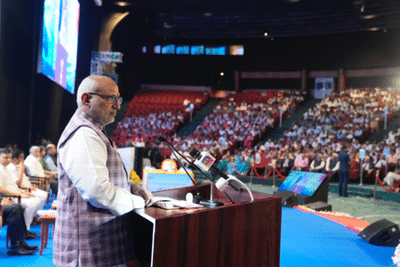 He underscored the need for its prudent use, conservation, and effective management. Reflecting on his childhood experiences in Tamil Nadu, he recounted witnessing water scarcity and the critical importance of ensuring access to drinking water. He stated that preserving water is essential for humanity and the planet. The Vice President recalled a 19,000-kilometer journey he undertook in Tamil Nadu two decades ago. One of the goals of this journey was to raise awareness about river interlinking, water conservation, and the proper management of water resources.He noted that interlinking rivers could help mitigate the effects of floods in some areas and droughts in others. Radhakrishnan highlighted India's deep-rooted connection to its rivers, stating that communities have developed rich traditions and practices for water conservation, sharing, and management over centuries. He emphasized that traditional knowledge offers valuable insights for addressing contemporary water challenges. He pointed out that India holds only 4% of the world's freshwater resources while accounting for about 18% of the global population.He stressed that India's water needs cannot be compared to countries with more abundant resources and smaller populations. The Vice President urged citizens to adopt simple water-saving practices in their daily lives. He suggested that people can choose to take shorter showers and turn off taps while brushing their teeth. These small actions, he noted, contribute significantly to the greater good. Addressing the challenges of climate change, rapid urbanization, and population growth, Radhakrishnan called for a comprehensive strategy that includes river basin management, groundwater replenishment, rainwater harvesting, and improved irrigation techniques.He also emphasized the importance of collaboration among states to resolve water-sharing issues. Praising Prime Minister Narendra Modi's leadership, he mentioned that ten agreements have been reached between states regarding water distribution. He specifically highlighted the Kishau Multipurpose Project agreement among six states as an important example of cooperation. As India aims to become a developed economy by 2047, Radhakrishnan stressed the necessity of efficient and sustainable water management.He recalled Modi's call for "Jan Bhagidari" in water conservation and urged people to make it a public movement. He pointed out the increasing demands for water in agriculture and industry, advocating for greater water-use efficiency, recycling, and reuse. He called for a shift from reactive to predictive, technology-enabled water management. Radhakrishnan urged a multi-stakeholder and multi-dimensional approach to tackle water-related challenges, asserting that no single institution, sector, or state can address these issues alone.He expressed confidence that the discussions at the International Water Week 2026 would lead to innovative technologies, policies, and socio-economic and environmental perspectives for climate-resilient and integrated water management. He launched the framework for Sustainable Urban River Management (SURM) and an AI/ML-driven integrated reservoir sediment management initiative, marking significant steps toward technology-enabled and climate-friendly water management.The event was attended by Union Minister of Jal Shakti C.R. Patil, Minister of State for Jal Shakti V. Somanna, Secretary of the Ministry of Jal Shakti Archana Verma, and representatives and experts from both India and abroad.
Next Story