
6 Fridge Storage Habits in Indian Kitchens That Let Bacteria Grow Faster in Your Food


Storing hot food directly, or waiting too long to refrigerate itMost Indian households let cooked food sit out until it reaches room temperature before putting it in the fridge. The logic is reasonable: hot containers fog up the fridge, raise internal temperature, and can damage older compressors. The problem is the window this creates. Between 5°C and 60°C, what food scientists call the danger zone, bacteria like Bacillus cereus and Staphylococcus aureus double roughly every 20 minutes. A pot of dal left on the counter for two hours can carry a bacterial load high enough to cause illness by the time it's refrigerated. A 2019 study in the Journal of Food Protection confirmed that cooked rice stored at room temperature for two hours before refrigeration reached counts of Bacillus cereus that exceeded safe thresholds. The fix is portioning: split the pot into shallow containers so heat escapes faster, and refrigerate within an hour.
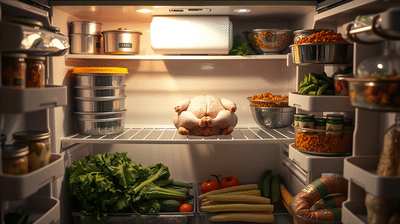 Keeping raw meat on shelves above cooked food or vegetablesRaw chicken, mutton, and fish drip. Even a sealed packet sweats condensation that carries Salmonella and Campylobacter downward onto whatever sits below. In most Indian refrigerators, the bottom shelf is the coldest and the most logical place for raw meat, but it's also where vegetables, curd containers, and leftover sabzi end up when the fridge is full. Cross-contamination from raw meat to ready-to-eat food is one of the most documented causes of foodborne illness in home kitchens. The FSSAI's food safety guidelines specifically flag raw meat storage as a top household contamination risk. Raw meat belongs on the lowest shelf, always, in a sealed container or tray that catches any liquid.
Leaving leftovers uncovered or loosely wrappedAn uncovered bowl of rice or a plate of roti with a lid balanced on top is not sealed storage. Moisture evaporates, the food dries unevenly, and more critically, it picks up odours and bacteria from other items in the fridge. Refrigerators recirculate air, which means an open container of yesterday's chicken curry is exchanging air, and microbial load, with your curd, your cut fruit, and your drinking water bottle. Airtight containers or cling wrap pressed directly against the food surface are the minimum. Stainless steel tiffin boxes without rubber seals are not airtight, regardless of how tightly the lid closes.
Washing vegetables and then storing them wetWashing produce before storage feels hygienic. The result is the opposite. Excess moisture on the surface of tomatoes, coriander, methi, and spinach accelerates mould growth and creates conditions where bacteria multiply faster than they would on dry produce. A damp bunch of coriander stuffed into the fridge will turn slimy within two days. The same bunch, dried with a kitchen towel and wrapped loosely in newspaper or a dry cloth, lasts four to five days. Wash vegetables just before use, not before storage. The one exception is root vegetables like carrots and radishes, which can be stored in water to maintain crispness, but that water should be changed daily.
Overpacking the fridge so cold air cannot circulateA refrigerator cools by circulating cold air through vents along the back and sides. When shelves are packed with containers, steel vessels, and plastic bags pressed against the back wall, that circulation is blocked. The result is uneven cooling: the front of the shelf stays warmer than the back, and the temperature in the fridge overall rises. A 2020 analysis by the UK's Food Standards Agency found that overpacked domestic refrigerators routinely operated 2 to 4°C above their set temperature, putting perishables into the danger zone without any visible sign of spoilage. Indian refrigerators, often running at near capacity because of weekly vegetable purchases and batch cooking, are particularly vulnerable to this. A half-empty fridge is not wasted space; it is the fridge doing its job.
Storing curd, milk, and dairy in the door compartmentsThe fridge door is the warmest part of the refrigerator. It opens and closes multiple times a day, exposing those compartments to room-temperature air repeatedly. Most Indian households store curd, buttermilk, and sometimes milk in the door because the compartments are the right size for those containers. Curd is already a fermented product with active bacterial cultures; at slightly elevated temperatures, those cultures keep working, souring the curd faster and altering its texture. Milk stored in the door spoils faster than milk stored on the main shelves. Move dairy to the middle or lower main shelves, where temperature is most stable. The door is suitable for condiments, pickles, and achar, foods with high salt or acid content that tolerate temperature fluctuation.
The fridge does not neutralise poor storage, it slows it down. Every one of these habits exploits the same gap: the assumption that cold means safe, when what cold actually means is slower. Bacteria that entered the food during handling, cooking, or cross-contamination are still in there, multiplying at a reduced rate. The fridge only wins if the food arrives in it quickly, sealed, and correctly placed.
Next Story