
6 Things a Teleconsultation Cannot Diagnose However Good the Doctor Is


Teleconsultation has genuinely changed how people access care in India. A dermatologist in Mumbai, a cardiologist in Chennai, a psychiatrist in Bengaluru, reachable in minutes from a phone. But the screen is a tool with a fixed edge, and that edge matters more for some conditions than others. These six are the ones where even a skilled, experienced doctor cannot give you a reliable answer without being in the same room.
Abdominal Pain That Needs a Physical ExaminationThe abdomen holds the stomach, liver, gallbladder, pancreas, intestines, kidneys, and in women, the reproductive organs. When something goes wrong in there, the location of the pain, whether it is tender to touch, whether the abdomen is rigid or soft, and whether the pain radiates to the back or shoulder are all things a doctor finds by pressing, not by asking. Rebound tenderness, the sharp pain that comes when pressure is released, is a sign of peritoneal irritation that cannot be described reliably over a call. A doctor can listen to your description of the pain, but they cannot palpate your abdomen through a screen. Appendicitis, an ectopic pregnancy, a perforated ulcer, the conditions that urgently matter, are all diagnosed in part by hands on skin.
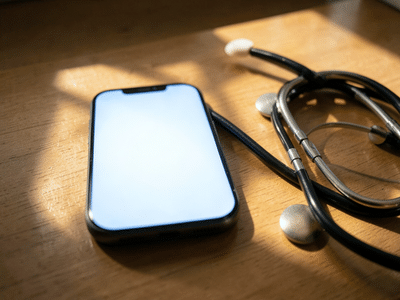
 Understanding teleconsultation limitations means knowing when to see a doctor in person.
Ear Infections and Anything Inside the Ear CanalThe eardrum is not visible without an otoscope. A doctor examining your ear is looking at the colour, the light reflex, whether the membrane is bulging or retracted, and whether there is fluid behind it. A child saying their ear hurts and pulling at it tells a doctor something, but it does not tell them whether there is acute otitis media, a foreign body, wax impaction, or a perforated drum. Treating an ear infection with antibiotics when the drum has already perforated is a different clinical decision from treating one where it has not. That distinction requires a look inside. A teleconsultation cannot provide it.
Skin Conditions That Depend on Texture, Border, and FeelDermatology is one of the most teleconsultation-friendly specialties for straightforward presentations, a photograph of a rash can travel well. But there are skin findings that a photograph flattens. A mole that needs to be assessed for melanoma requires dermoscopy, a technique that uses magnification and light to examine the subsurface structure of the lesion. The ABCDE criteria, asymmetry, border, colour, diameter, evolution, include elements a photograph can capture, but border irregularity at the microscopic level and surface texture do not survive a phone camera. A lesion that feels raised, indurated, or scaly in a way that changes its clinical significance cannot communicate that quality through a screen. The Indian Association of Dermatologists, Venereologists and Leprologists has noted that teledermatology works best as a triage and follow-up tool, not as a primary diagnostic tool for lesions with malignant potential.
 These tools highlight the limitations of teleconsultation, reminding us when to see a doctor in person.
Blood Pressure and Heart Rhythm AbnormalitiesA doctor can ask whether you have a headache, blurred vision, or a feeling of pressure behind your eyes. They cannot measure your blood pressure. A reading taken on a home device is useful context, but home devices carry measurement error, cuff sizing affects accuracy, and a reading taken by the patient in a moment of anxiety is not the same as a resting measurement taken by a trained hand. More critically, an irregular heartbeat detected on auscultation, a doctor listening to the rhythm of the heart through a stethoscope, is not something a patient can report accurately. Atrial fibrillation, for instance, can be asymptomatic or present as vague fatigue. The diagnosis is made by hearing the irregularity and confirming it on an ECG, neither of which a teleconsultation can provide.
Neurological Signs That Require Observation and Reflex TestingA neurological examination is built from things a doctor watches and tests: the way a person walks, whether their reflexes are brisk or absent, whether there is drift in an outstretched arm, whether the eyes move symmetrically, whether grip strength is equal on both sides. A patient describing numbness or weakness over a call gives the doctor a starting point, not a finding. The difference between a peripheral nerve issue and a central nervous system lesion, between something that can wait and something that cannot, often sits in the examination findings, not in the symptom description. A sudden headache described as the worst of someone's life, a facial droop, slurred speech, or arm weakness are symptoms that should prompt an in-person emergency assessment, not a teleconsultation.
Gynaecological Complaints That Require Examination or ImagingPelvic pain, unusual bleeding, a lump in the breast, or a change in vaginal discharge are all things a doctor can hear about over a call. None of them can be assessed without a physical examination or imaging. Cervical motion tenderness, a finding in pelvic inflammatory disease, requires an internal examination. A breast lump requires palpation to assess its size, consistency, mobility, and whether there are changes in the overlying skin. An ovarian cyst may produce symptoms identical to other causes of pelvic pain and is identified on ultrasound. A teleconsultation in these cases can appropriately triage, establishing urgency, ruling out red flags in the history, and directing the patient to the right next step, but it cannot replace the examination that leads to a diagnosis.
The value of a teleconsultation is real: it lowers the barrier to reaching a doctor, it is appropriate for follow-ups, for reviewing results, for managing stable chronic conditions, and for situations where the history alone guides the next step. The limit is not the doctor's skill. It is what medicine requires that a screen cannot carry. Knowing which side of that line your symptoms sit on is the most useful thing you can take from this.
Abdominal Pain That Needs a Physical ExaminationThe abdomen holds the stomach, liver, gallbladder, pancreas, intestines, kidneys, and in women, the reproductive organs. When something goes wrong in there, the location of the pain, whether it is tender to touch, whether the abdomen is rigid or soft, and whether the pain radiates to the back or shoulder are all things a doctor finds by pressing, not by asking. Rebound tenderness, the sharp pain that comes when pressure is released, is a sign of peritoneal irritation that cannot be described reliably over a call. A doctor can listen to your description of the pain, but they cannot palpate your abdomen through a screen. Appendicitis, an ectopic pregnancy, a perforated ulcer, the conditions that urgently matter, are all diagnosed in part by hands on skin.
Ear Infections and Anything Inside the Ear CanalThe eardrum is not visible without an otoscope. A doctor examining your ear is looking at the colour, the light reflex, whether the membrane is bulging or retracted, and whether there is fluid behind it. A child saying their ear hurts and pulling at it tells a doctor something, but it does not tell them whether there is acute otitis media, a foreign body, wax impaction, or a perforated drum. Treating an ear infection with antibiotics when the drum has already perforated is a different clinical decision from treating one where it has not. That distinction requires a look inside. A teleconsultation cannot provide it.
Skin Conditions That Depend on Texture, Border, and FeelDermatology is one of the most teleconsultation-friendly specialties for straightforward presentations, a photograph of a rash can travel well. But there are skin findings that a photograph flattens. A mole that needs to be assessed for melanoma requires dermoscopy, a technique that uses magnification and light to examine the subsurface structure of the lesion. The ABCDE criteria, asymmetry, border, colour, diameter, evolution, include elements a photograph can capture, but border irregularity at the microscopic level and surface texture do not survive a phone camera. A lesion that feels raised, indurated, or scaly in a way that changes its clinical significance cannot communicate that quality through a screen. The Indian Association of Dermatologists, Venereologists and Leprologists has noted that teledermatology works best as a triage and follow-up tool, not as a primary diagnostic tool for lesions with malignant potential.
Blood Pressure and Heart Rhythm AbnormalitiesA doctor can ask whether you have a headache, blurred vision, or a feeling of pressure behind your eyes. They cannot measure your blood pressure. A reading taken on a home device is useful context, but home devices carry measurement error, cuff sizing affects accuracy, and a reading taken by the patient in a moment of anxiety is not the same as a resting measurement taken by a trained hand. More critically, an irregular heartbeat detected on auscultation, a doctor listening to the rhythm of the heart through a stethoscope, is not something a patient can report accurately. Atrial fibrillation, for instance, can be asymptomatic or present as vague fatigue. The diagnosis is made by hearing the irregularity and confirming it on an ECG, neither of which a teleconsultation can provide.
Neurological Signs That Require Observation and Reflex TestingA neurological examination is built from things a doctor watches and tests: the way a person walks, whether their reflexes are brisk or absent, whether there is drift in an outstretched arm, whether the eyes move symmetrically, whether grip strength is equal on both sides. A patient describing numbness or weakness over a call gives the doctor a starting point, not a finding. The difference between a peripheral nerve issue and a central nervous system lesion, between something that can wait and something that cannot, often sits in the examination findings, not in the symptom description. A sudden headache described as the worst of someone's life, a facial droop, slurred speech, or arm weakness are symptoms that should prompt an in-person emergency assessment, not a teleconsultation.
Gynaecological Complaints That Require Examination or ImagingPelvic pain, unusual bleeding, a lump in the breast, or a change in vaginal discharge are all things a doctor can hear about over a call. None of them can be assessed without a physical examination or imaging. Cervical motion tenderness, a finding in pelvic inflammatory disease, requires an internal examination. A breast lump requires palpation to assess its size, consistency, mobility, and whether there are changes in the overlying skin. An ovarian cyst may produce symptoms identical to other causes of pelvic pain and is identified on ultrasound. A teleconsultation in these cases can appropriately triage, establishing urgency, ruling out red flags in the history, and directing the patient to the right next step, but it cannot replace the examination that leads to a diagnosis.
The value of a teleconsultation is real: it lowers the barrier to reaching a doctor, it is appropriate for follow-ups, for reviewing results, for managing stable chronic conditions, and for situations where the history alone guides the next step. The limit is not the doctor's skill. It is what medicine requires that a screen cannot carry. Knowing which side of that line your symptoms sit on is the most useful thing you can take from this.
Next Story