
7 Famous Dishes and the Fascinating Stories Behind Their Names

Food names often sound so familiar that we stop questioning them. Why is a Caesar salad called Caesar when it has nothing to do with Julius Caesar? Why does Pavlova share its name with a Russian ballerina? And who exactly was Reuben? Behind many famous dishes are stories involving hotels, chefs, celebrities, rival claims and sometimes a healthy amount of uncertainty. Their names reveal something fascinating about how food travels through cultures and how ordinary meals become part of history.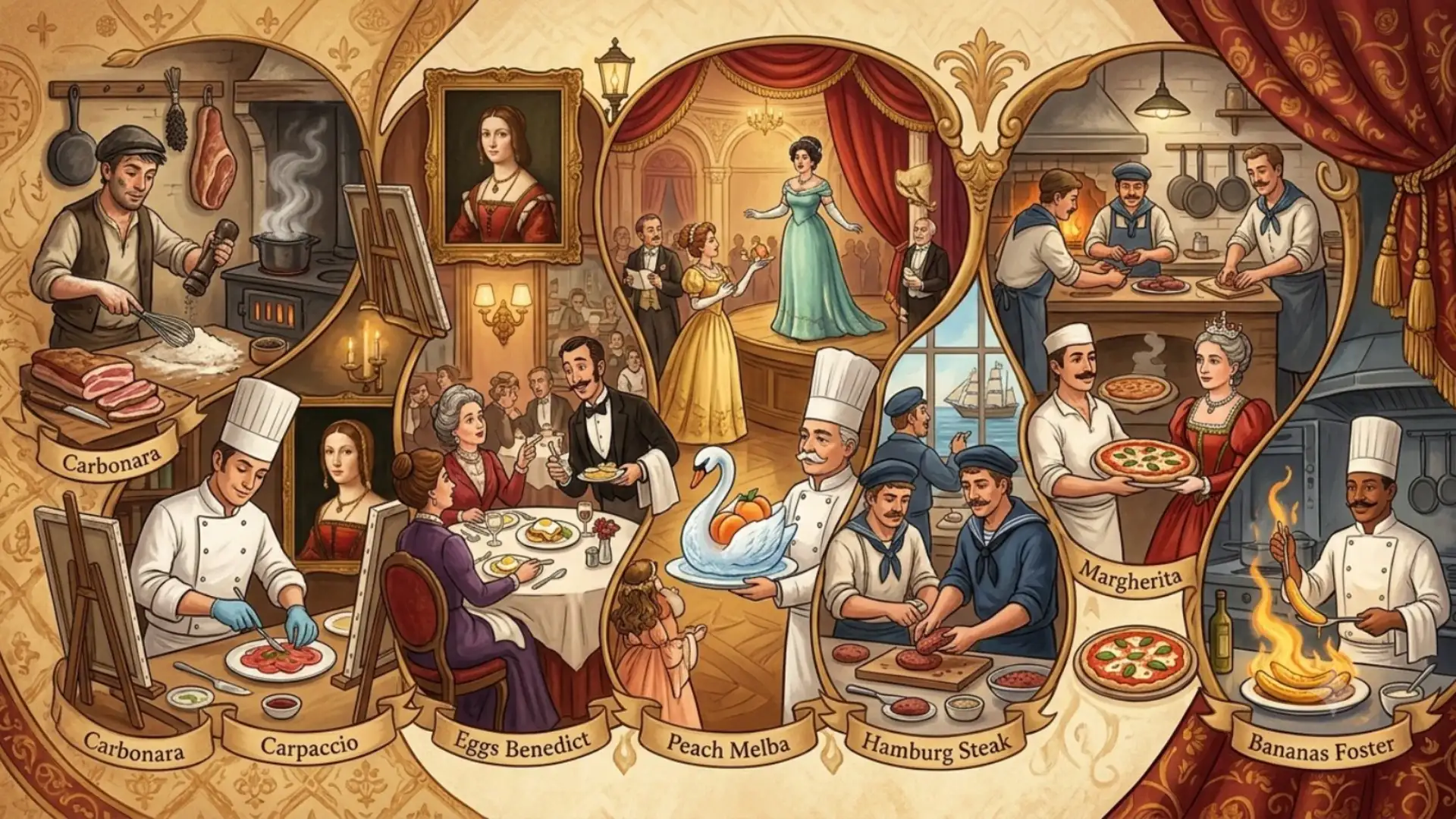
The salad is widely linked to 4 July 1924, when Cardini's kitchen was reportedly busy and ingredients were limited. The dish became famous enough to be prepared tableside.
Its name therefore comes from a person, not an ancient empire.
The original version, credited to maître d'hôtel Oscar Tschirky, was remarkably simple, combining apples, celery and mayonnaise. Walnuts became associated with the salad later.
It is a reminder that some restaurant classics began as surprisingly modest creations.
A long-standing Omaha account credits grocer Reuben Kulakofsky, who supposedly developed the sandwich during a poker gathering at the Blackstone Hotel in the 1920s. However, a competing story credits New York restaurateur Arnold Reuben. Nebraska's State Historical Society acknowledges both claims and notes that the evidence does not completely settle the question.
The two countries have long disputed who created the dessert. New Zealand has evidence of an early published recipe, while Australia has its own later claims.
Next time you order a familiar classic, its name may be hiding a story that is considerably more interesting than the menu suggests.
Caesar Salad Was Named After a Restaurateur
The Caesar salad is not named after the Roman ruler. It is associated with Caesar Cardini, an Italian-born restaurateur who operated a restaurant in Tijuana, Mexico.The salad is widely linked to 4 July 1924, when Cardini's kitchen was reportedly busy and ingredients were limited. The dish became famous enough to be prepared tableside.
Its name therefore comes from a person, not an ancient empire.
Waldorf Salad Came From a Famous Hotel
Waldorf salad takes its name from New York's Waldorf Hotel, later associated with the Waldorf-Astoria.You may also like
- Jose Flores may be the world's oldest living man at 119: What his life in Costa Rica's blue zone says about living Longer
- Check the deadline for solar panel subsidies; don't delay
- If you have a ration card, do this now—otherwise, it could be blocked starting October 1st!
- Bihar class 10 boy builds Rs 1 lakh Wi-Fi device that claims 300 mbps internet without a SIM or recharge. Here's what we know about his innovation
- “My mother and I survived on a single vada pav…”: How Jaykumar Vaidya went from an 8x10 room in Kurla to working on Mars and Moon missions at NASA
The original version, credited to maître d'hôtel Oscar Tschirky, was remarkably simple, combining apples, celery and mayonnaise. Walnuts became associated with the salad later.
It is a reminder that some restaurant classics began as surprisingly modest creations.
The Reuben Has Two Competing Origin Stories
The Reuben sandwich has one of the messiest naming histories.A long-standing Omaha account credits grocer Reuben Kulakofsky, who supposedly developed the sandwich during a poker gathering at the Blackstone Hotel in the 1920s. However, a competing story credits New York restaurateur Arnold Reuben. Nebraska's State Historical Society acknowledges both claims and notes that the evidence does not completely settle the question.
Pavlova Was Named After a Ballerina
Pavlova, the crisp-on-the-outside, soft-centred meringue dessert, was named after Russian ballerina Anna Pavlova, who toured Australia and New Zealand in the 1920s.The two countries have long disputed who created the dessert. New Zealand has evidence of an early published recipe, while Australia has its own later claims.
Names Can Preserve Culinary History
These examples show why food history is rarely straightforward. A dish can carry the name of a person, hotel or cultural figure long after the original circumstances have disappeared.Next time you order a familiar classic, its name may be hiding a story that is considerably more interesting than the menu suggests.






Loving Newspoint? Download the app now
