
Chavath in Goa: Why the Household Ganpati Tradition Feels Nothing Like a Festival


The idol arrives before the crowd doesIn a Mumbai pandal, the Ganpati is already waiting when you get there. In a Goan home during Chavath, you watch him arrive. The murti is brought in through the front door, sometimes carried by the eldest son, sometimes by a priest, sometimes by whoever in the family has always done it, and placed on a wooden maach that has been set up in the same corner of the same room for decades. The maach is not a stage. It is a seat. The distinction matters.
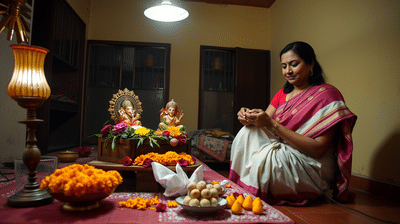 The idol in a Goan household Ganpati is almost always smaller than what you'd see in a public pandal. Not because the devotion is smaller, but because the room has a ceiling and the family has a relationship with this particular form of the deity that predates anyone currently living in the house. Some families have the same murti returned and reinstalled every year. Others commission a new one from the same Konkani sculptor their grandparents used.
What Chavath sounds like from inside the houseThe puja on the first morning is not amplified. That is the first thing you notice if you've only ever experienced Ganesh Chaturthi through speakers mounted on bamboo scaffolding. The priest chants at a volume meant for the room, not the street. The family sits close enough that you can hear individual voices during the aarti. Children are not kept at a distance from the idol, they are brought forward, pressed into the act of offering, handed the coconut or the modak or the agarbatti with a specific instruction about how to hold it.
The Konkani prayers have a domestic cadence. They don't build to a crescendo the way a pandal aarti does, with its drums and cymbals and several hundred people swaying. They resolve. They come to a close the way a conversation does. And then someone in the kitchen starts on the next meal.
The food is not prasad. It is cooking.In Goa, the food prepared during Chavath is not incidental to the celebration, it is a central ritual act. Modak here is often the steamed ukdiche kind, but Konkani households also make patholi, rice flour dumplings stuffed with coconut and jaggery and steamed in turmeric leaves. The turmeric leaf is not decoration. It is the vessel, and the fragrance it gives the rice is irreplaceable.
The cooking happens in the same house where the idol is installed. The smell of coconut oil and fresh grated coconut moves through every room. By the second day, the house smells of all of it at once: incense, flowers, rice steam, and the particular sweetness of jaggery hitting heat. You cannot separate the worship from the meal because they were never separate to begin with.
The visarjan is not a procession. It is a goodbye.Most Goan household Ganpatis are installed for one and a half days, dertya Ganpati, or five days. The visarjan at the end of a Mumbai pandal is a public event, a procession, a crowd. In a Goan village, the family walks the idol to the nearest water body. Sometimes it is a river. Sometimes the sea. The walk is short. The family is small. There is no DJ.
What happens at the water's edge is quiet in a way that takes you off guard if you're expecting spectacle. The idol is lowered in. The family watches until it dissolves or until it can no longer be seen. Someone cries. Someone else holds them. Then everyone turns and walks back to the house, which is now slightly emptier than it was an hour ago, and sits down together.
The Goan Chavath tradition holds something that large public celebrations structurally cannot: the full weight of an ending. The Ganpati came into your home, ate your food, heard your prayers at close range, and now he's gone. The house knows it. That knowledge, specific, domestic, unshared with a crowd, is what makes the household tradition feel less like a festival and more like a visit from someone who matters.
The food is not prasad. It is cooking.In Goa, the food prepared during Chavath is not incidental to the celebration, it is a central ritual act. Modak here is often the steamed ukdiche kind, but Konkani households also make patholi, rice flour dumplings stuffed with coconut and jaggery and steamed in turmeric leaves. The turmeric leaf is not decoration. It is the vessel, and the fragrance it gives the rice is irreplaceable.
Next Story