
Chhath: When Gratitude Becomes Worship


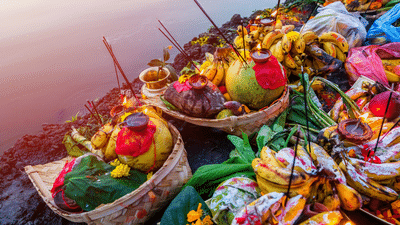
At Chhath, the water a devotee raises towards Surya is itself a gift of the sun. Solar warmth drives evaporation; rain replenishes rivers and fields. The small vessel carries an acknowledgement of something easily forgotten: what we call our own has first been received.
Vedic thought places this dependence within rta, the cosmic order expressed in days and seasons. India’s Surya Siddhanta studied celestial cycles for reckoning time. Modern chronobiology reveals how daylight helps synchronise our internal clocks, influencing sleep and appetite. Standing before the sun, the devotee consciously acknowledges a relationship already sustaining her life.
Gayatri–Savitri upasana carries this relationship inward. The Rig Veda’s prayer to Savitr asks that divine light illumine our intellect. The Mundaka Upanishad deepens contemplation: the sun, moon and stars cannot illuminate the reality by whose light all else shines. In a Vedantic reading, the visible sun becomes a focus for approaching the awareness through which even sunlight is known. We seek discernment in livelihood and desire, allowing dharma to guide us towards moksha , liberation.
Chhath gives this inward movement a bodily discipline. Nahay-Khay begins with cleansing and simple food; Kharna’s evening meal precedes the long fast. Approached as tapas, fasting extends restraint to our thoughts. We may leave a plate untouched while continuing to nourish resentment. Upavasa, understood as drawing near the Divine, asks us to make room within, while honouring the body’s limits.
This preparation deepens the meaning of Sandhya Arghya and Usha Arghya. We honour the setting sun and return to welcome the dawn. Gratitude is offered when light withdraws as well as when it returns. Such worship can teach equanimity: our reverence need not depend on life arranging itself according to our wishes. We can pray for recovery or a new beginning while learning to meet what we cannot control.
The same reverence reaches the river that receives the offering. Keeping its water clean becomes part of the vow. When the fast ends with water and shared prasad, the ordinary can be received as a gift. The body becomes a temple as receiving life grows into a willingness to care for its sources.
The sun has already given its light. Chhath asks us to let that gift change the way we live.
Authored by: Shashank Joshi and Shambo Samrat Samajdar
Vedic thought places this dependence within rta, the cosmic order expressed in days and seasons. India’s Surya Siddhanta studied celestial cycles for reckoning time. Modern chronobiology reveals how daylight helps synchronise our internal clocks, influencing sleep and appetite. Standing before the sun, the devotee consciously acknowledges a relationship already sustaining her life.
Gayatri–Savitri upasana carries this relationship inward. The Rig Veda’s prayer to Savitr asks that divine light illumine our intellect. The Mundaka Upanishad deepens contemplation: the sun, moon and stars cannot illuminate the reality by whose light all else shines. In a Vedantic reading, the visible sun becomes a focus for approaching the awareness through which even sunlight is known. We seek discernment in livelihood and desire, allowing dharma to guide us towards moksha , liberation.
Chhath gives this inward movement a bodily discipline. Nahay-Khay begins with cleansing and simple food; Kharna’s evening meal precedes the long fast. Approached as tapas, fasting extends restraint to our thoughts. We may leave a plate untouched while continuing to nourish resentment. Upavasa, understood as drawing near the Divine, asks us to make room within, while honouring the body’s limits.
This preparation deepens the meaning of Sandhya Arghya and Usha Arghya. We honour the setting sun and return to welcome the dawn. Gratitude is offered when light withdraws as well as when it returns. Such worship can teach equanimity: our reverence need not depend on life arranging itself according to our wishes. We can pray for recovery or a new beginning while learning to meet what we cannot control.
The same reverence reaches the river that receives the offering. Keeping its water clean becomes part of the vow. When the fast ends with water and shared prasad, the ordinary can be received as a gift. The body becomes a temple as receiving life grows into a willingness to care for its sources.
The sun has already given its light. Chhath asks us to let that gift change the way we live.
Authored by: Shashank Joshi and Shambo Samrat Samajdar
Next Story