
Daler Mehndi's son, singer Gurdeep Mehndi: Punjabi singing isn't only about high energy or hitting high notes; it's about melody


A legacy of chart-topping hits can come with its own expectations, especially when you are the son of Daler Mehndi and nephew of Mika Singh . But Gurdeep Mehndi is carving out his own space across independent music, Bollywood and live entertainment. A multilingual singer who performs in Punjabi, Hindi, Gujarati, Marwadi, Marathi and Telugu, he has lent his voice to tracks ranging from Don’t Be Shy Again in Bala to independent releases such as Tadka, Duma Dum and Level. His recent song Lauta Do from Haunted 3D: Echoes Of The Past marks a different turn, taking him into a softer, romantic sound.

Despite having several songs to his credit, Lauta Do holds a special place in Gurdeep’s journey as it allowed him to explore a different side of himself as an artiste. He shares, “This project was a completely new opportunity for me and a genre I hadn’t really explored before. I usually don’t explore love songs or soft, romantic tracks. My music has mostly been upbeat, high-energy Punjabi and Bollywood numbers. The interesting part was that Papaji (Daler Mehndi) had no idea about Lauta Do or that I was planning to try a romantic song, so I was honestly a little nervous about how he’d react or whether the audience would like it. Thankfully, he absolutely loved it, and so did the audience.”
The singer is keen to challenge the narrow perception of Punjabi music as a genre defined by high notes and high-energy performances. He says, “There is definitely a stereotype that Punjabi music is all about high vocals, high energy and loud performances. But at the same time, bahut saari purani Punjabi gayaki Sufi rahi hai. Today, I think almost 80 per cent of the Sufi music people listen to has its roots in Punjab.There are beautiful ghazals, Tappe and Heer, performed by legends like Ghulam Ali Khan sahab and many other great artistes. All of it has been sung in a very graceful, effortless way, on a comfortable scale, with immense beauty and emotion. So yes, this stereotype exists. Isse break karna kitna mushkil hai, woh toh mujhe nahi pata. But if someone asks me, I’d like to prove through my music that Punjabi singing isn’t only about high energy or hitting high notes. It’s about melody. It’s about ek roohaniyat, ek Sufiyana andaaz, where love mohabbat is expressed with tameez and tehzeeb. That’s the side of Punjabi music I also want people to experience.”
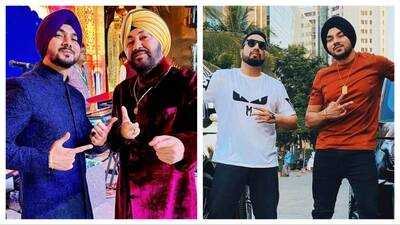
Gurdeep on learning classical music from his grandfather and life lessons from Daler Mehndi and Mika Singh:
Gurdeep’s musical grounding was shaped early by his grandfather, Sardar Ajmer Singh Chandan, who introduced him to Indian classical music and ragas. Growing up around his father and uncle, he also gained an understanding of the discipline and values that underpin a career in music, lessons that continue to guide his approach to his work. He shares, “When I was growing up, music was everywhere around me. My first guru was my grandfather, Sardar Ajmer Singh Chandan. Unse classical sangeet ki taleem mili, and that is why I have knowledge of classical music. He introduced me to Indian classical music and ragas from a very young age. That foundation has stayed with me throughout my journey. As I grew older, I gradually realised what a big name my father is in the Indian music industry. But for me, growing up, I realised he isn’t just a successful singer; he is a deeply knowledgeable, classically trained musician. Along with my Chacha Mika Singh, I was fortunate to learn so much about music from both of them. The guidance I received was detailed, patient and invaluable. I truly feel blessed to have been born into this family.”
He adds, “One of the biggest lessons they taught me wasn’t just about music; it was about life. Because they were also very much into live performances , I always wanted to be a live performer because I love being on stage, travelling and connecting with audiences. They taught me to always be a good human being first. Be respectful to clients and organisers, be punctual, never be jealous of another artiste, and simply focus on your own work. Your only competition should be yourself.”
Despite having several songs to his credit, Lauta Do holds a special place in Gurdeep’s journey as it allowed him to explore a different side of himself as an artiste. He shares, “This project was a completely new opportunity for me and a genre I hadn’t really explored before. I usually don’t explore love songs or soft, romantic tracks. My music has mostly been upbeat, high-energy Punjabi and Bollywood numbers. The interesting part was that Papaji (Daler Mehndi) had no idea about Lauta Do or that I was planning to try a romantic song, so I was honestly a little nervous about how he’d react or whether the audience would like it. Thankfully, he absolutely loved it, and so did the audience.”
The singer is keen to challenge the narrow perception of Punjabi music as a genre defined by high notes and high-energy performances. He says, “There is definitely a stereotype that Punjabi music is all about high vocals, high energy and loud performances. But at the same time, bahut saari purani Punjabi gayaki Sufi rahi hai. Today, I think almost 80 per cent of the Sufi music people listen to has its roots in Punjab.There are beautiful ghazals, Tappe and Heer, performed by legends like Ghulam Ali Khan sahab and many other great artistes. All of it has been sung in a very graceful, effortless way, on a comfortable scale, with immense beauty and emotion. So yes, this stereotype exists. Isse break karna kitna mushkil hai, woh toh mujhe nahi pata. But if someone asks me, I’d like to prove through my music that Punjabi singing isn’t only about high energy or hitting high notes. It’s about melody. It’s about ek roohaniyat, ek Sufiyana andaaz, where love mohabbat is expressed with tameez and tehzeeb. That’s the side of Punjabi music I also want people to experience.”
Gurdeep on learning classical music from his grandfather and life lessons from Daler Mehndi and Mika Singh:
Gurdeep’s musical grounding was shaped early by his grandfather, Sardar Ajmer Singh Chandan, who introduced him to Indian classical music and ragas. Growing up around his father and uncle, he also gained an understanding of the discipline and values that underpin a career in music, lessons that continue to guide his approach to his work. He shares, “When I was growing up, music was everywhere around me. My first guru was my grandfather, Sardar Ajmer Singh Chandan. Unse classical sangeet ki taleem mili, and that is why I have knowledge of classical music. He introduced me to Indian classical music and ragas from a very young age. That foundation has stayed with me throughout my journey. As I grew older, I gradually realised what a big name my father is in the Indian music industry. But for me, growing up, I realised he isn’t just a successful singer; he is a deeply knowledgeable, classically trained musician. Along with my Chacha Mika Singh, I was fortunate to learn so much about music from both of them. The guidance I received was detailed, patient and invaluable. I truly feel blessed to have been born into this family.”
He adds, “One of the biggest lessons they taught me wasn’t just about music; it was about life. Because they were also very much into live performances , I always wanted to be a live performer because I love being on stage, travelling and connecting with audiences. They taught me to always be a good human being first. Be respectful to clients and organisers, be punctual, never be jealous of another artiste, and simply focus on your own work. Your only competition should be yourself.”
Next Story