
Banarasi Silk: How Varanasi's Weavers Put Zari into a Saree

A Banarasi silk saree can take a single weaver anywhere from fifteen days to six months to finish, depending on how dense the zari work runs. That timeline is not a mark of inefficiency; it is a direct consequence of how the fabric is made. The zari is not stitched onto the surface after weaving. It goes in during weaving, one thread at a time, alongside the silk weft. Understanding that one fact changes how you look at every Banarasi saree you have ever seen.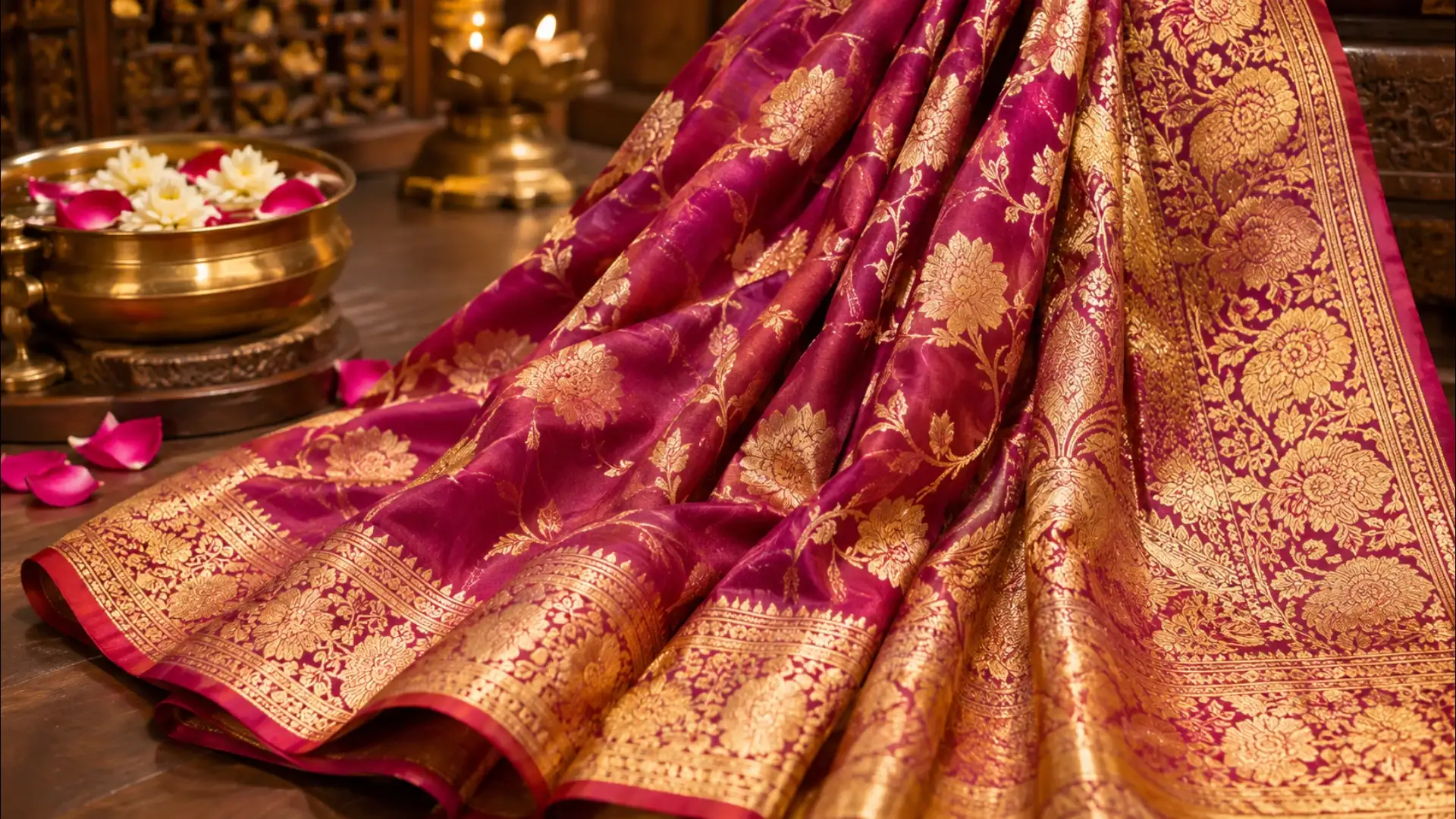
Today, most commercially available Banarasi sarees use what the trade calls tested zari (or imitation zari), where a yarn core is wrapped with copper wire coated in silver and gold plating, or plastic-based metallic yarns like Lurex. Pure silver-and-gold zari still exists and commands a significant price difference, though both are woven using the same technique on the same looms. A buyer who wants to tell metal zari apart from plastic-based synthetic zari can use a simple burn test on a loose thread: metal-wrapped zari leaves behind fine metallic wire and ash, whereas synthetic Lurex zari melts into a hard plastic bead.
The pattern in a Banarasi saree is not drawn freehand. It is controlled by a Jacquard mechanism, a system of punched cards mounted above the loom that lifts individual warp threads in a specific sequence. Each card corresponds to one row of the design. A saree with a dense floral jaal pattern may need several thousand cards. The weaver does not decide which threads rise; the cards do. His skill lies in reading the tension, managing the weft, and keeping the zari thread taut enough to sit flat but loose enough not to pucker the silk.
How the Pattern Gets In
Before a single thread is woven, a designer draws the pattern (naksha) on graph paper at a scale where each square equals one thread crossing. This graph is then translated into a punched Jacquard card sequence by a card-punching specialist—a modern evolution of the traditional nakshaband, who once tied intricate thread harnesses by hand before Jacquard looms reached Varanasi. A complex border design can take several weeks to punch. The cards, once made, are tied into a continuous loop and cycle through the Jacquard head as the weaver works.
The warp, the threads running the length of the saree, is set up on the loom first, usually in pure silk, wound onto a beam at the back. The weft, which runs across the width, is loaded onto a shuttle. When the Jacquard lifts a selection of warp threads, the shuttle passes through the gap, laying one line of weft. The treadle drops those threads and lifts the next selection. Repeat, row by row, for weeks.
Zari enters as a supplementary weft, a second shuttle carrying the metal thread that passes through only where the pattern calls for it. In standard katwa weaving, wherever zari is not needed in a row, it floats across the back of the fabric and is snipped away later. On the finished saree, the back often looks like a map of tiny clipped threads, each one the reverse of a motif on the front.
The old weaving neighbourhoods sit mostly west of the ghats, in a dense grid of lanes too narrow for a car. A single gali might have four or five looms running behind closed doors, identifiable by the rhythmic clack of the treadle and the faint metallic scent of zari. The community that has kept this tradition running for several centuries is predominantly Muslim (the Ansari weavers), working within a craft that supplies sarees for Hindu weddings and festivals, a cultural and economic collaboration so old it is simply the way things are.
The motifs have their own vocabulary. Butidar means scattered small motifs across the body. Jaal is an all-over interlocking net pattern. Shikargah, meaning hunting ground, carries a repeating scene of trees and animals. Meenakari adds coloured silk threads alongside the zari to produce a jewel-like inlay effect. A weaver who has spent years on one pattern type can read a finished saree the way a printer reads a proof, spotting where the tension shifted, where a card skipped, or where a float was cut a thread too short.
The saree is finished when the last weft thread is cut and the ends are knotted into a fringe. At that point, months of Jacquard cards, zari shuttles, and treadle work fold into six yards of cloth. The weight in your hands when you pick it up is exactly the weight of that work.
What Zari Actually Is
Traditional zari (kalabattu) is a metallic thread with a silk core. A fine silk yarn is wrapped tightly with a flattened strip of real silver, which is then electroplated with gold. The result is a thread that catches light differently from every angle, which is why Banarasi fabric seems to shift colour when the wearer moves. The weight of real zari is also the reason a heavy Banarasi saree drapes the way it does; the precious metal content adds mass that synthetic alternatives cannot replicate.Today, most commercially available Banarasi sarees use what the trade calls tested zari (or imitation zari), where a yarn core is wrapped with copper wire coated in silver and gold plating, or plastic-based metallic yarns like Lurex. Pure silver-and-gold zari still exists and commands a significant price difference, though both are woven using the same technique on the same looms. A buyer who wants to tell metal zari apart from plastic-based synthetic zari can use a simple burn test on a loose thread: metal-wrapped zari leaves behind fine metallic wire and ash, whereas synthetic Lurex zari melts into a hard plastic bead.
The Handloom and the Jacquard
The looms of Varanasi are mostly pit looms, the weaver sits with his legs in a pit cut into the floor, his feet working the treadles below. The pit keeps the loom's total height manageable in the low-ceilinged rooms where most weaving happens in the old city's mohallas of Madanpura, Lallapura, and Pilikothi.The pattern in a Banarasi saree is not drawn freehand. It is controlled by a Jacquard mechanism, a system of punched cards mounted above the loom that lifts individual warp threads in a specific sequence. Each card corresponds to one row of the design. A saree with a dense floral jaal pattern may need several thousand cards. The weaver does not decide which threads rise; the cards do. His skill lies in reading the tension, managing the weft, and keeping the zari thread taut enough to sit flat but loose enough not to pucker the silk.
You may also like
- Robert Pattinson will be the next James Bond, but at home he is just a dad in cargo shorts talking about daycare and enjoying how his daughter is the 'biggest trove of energy'
- Novak Djokovic: ATMA Miami: Discover: Aman Group New Hotel and Wellness Destination
- Farah Khan stepped inside Ananya Birla's Mumbai home and compared its grand living room to a James Bond film set; the new tour reveals an MF Husain painting, sculptures and a vast private garden
- Losing Muscle as You Age? How Strength Training Can Slow It Down
- Making these mistakes while opening an FD will reduce your returns! Understand the full math before investing your money..
How the Pattern Gets In
Before a single thread is woven, a designer draws the pattern (naksha) on graph paper at a scale where each square equals one thread crossing. This graph is then translated into a punched Jacquard card sequence by a card-punching specialist—a modern evolution of the traditional nakshaband, who once tied intricate thread harnesses by hand before Jacquard looms reached Varanasi. A complex border design can take several weeks to punch. The cards, once made, are tied into a continuous loop and cycle through the Jacquard head as the weaver works.
The warp, the threads running the length of the saree, is set up on the loom first, usually in pure silk, wound onto a beam at the back. The weft, which runs across the width, is loaded onto a shuttle. When the Jacquard lifts a selection of warp threads, the shuttle passes through the gap, laying one line of weft. The treadle drops those threads and lifts the next selection. Repeat, row by row, for weeks.
Zari enters as a supplementary weft, a second shuttle carrying the metal thread that passes through only where the pattern calls for it. In standard katwa weaving, wherever zari is not needed in a row, it floats across the back of the fabric and is snipped away later. On the finished saree, the back often looks like a map of tiny clipped threads, each one the reverse of a motif on the front.
The Mohalla as Workshop
Weaving in Varanasi has never been a factory operation. The work is distributed across households. A master weaver or merchant, called a kaarkhana-dar or gaddidar, typically supplies the raw material, designs, and looms. Weavers work either in their own homes or in small shared workshops. Finishing work, cutting the float threads on the reverse, washing, starching, and folding, is done by other specialists in the same lane.The old weaving neighbourhoods sit mostly west of the ghats, in a dense grid of lanes too narrow for a car. A single gali might have four or five looms running behind closed doors, identifiable by the rhythmic clack of the treadle and the faint metallic scent of zari. The community that has kept this tradition running for several centuries is predominantly Muslim (the Ansari weavers), working within a craft that supplies sarees for Hindu weddings and festivals, a cultural and economic collaboration so old it is simply the way things are.
Reading a Banarasi Saree
The four best-known Banarasi varieties each have a distinct character. Katan is pure twisted silk on silk, dense and heavy, with a rich sheen. Organza, called kora locally, is lighter and stiffer, with a crisp drape. Shattir is a lighter, more affordable plain-weave variety traditionally made using art silk (viscose/rayon) or blended yarns. Georgette is fluid and lightweight, with a crinkled texture that moves easily. The zari work sits on top of all four, but the base fabric changes how the metal thread reads, on katan, it glows; on organza, it almost floats.The motifs have their own vocabulary. Butidar means scattered small motifs across the body. Jaal is an all-over interlocking net pattern. Shikargah, meaning hunting ground, carries a repeating scene of trees and animals. Meenakari adds coloured silk threads alongside the zari to produce a jewel-like inlay effect. A weaver who has spent years on one pattern type can read a finished saree the way a printer reads a proof, spotting where the tension shifted, where a card skipped, or where a float was cut a thread too short.
The saree is finished when the last weft thread is cut and the ends are knotted into a fringe. At that point, months of Jacquard cards, zari shuttles, and treadle work fold into six yards of cloth. The weight in your hands when you pick it up is exactly the weight of that work.






Loving Newspoint? Download the app now
