
Expanding Universe Explained: From Cosmic Origins To A Mysterious Future

The expanding universe is one of the most fascinating and far-reaching discoveries in modern science. At its core lies a profound realisation—that the cosmos is not static but constantly stretching, growing, and evolving. First proposed in the early 20th century and confirmed by countless observations since, the concept of an expanding universe continues to reshape our understanding of time, space, and the very origin of everything we know. But how did we come to discover this phenomenon, and what mysteries still lie ahead?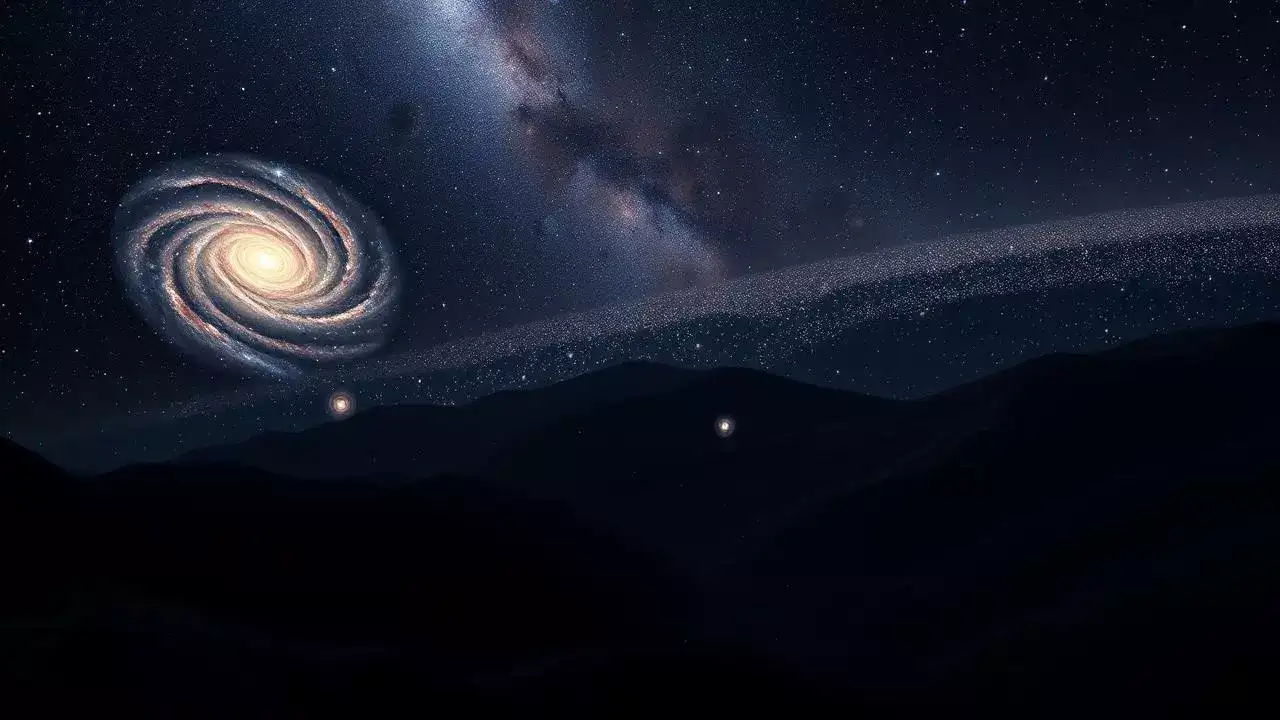
This completely overturned the earlier belief in a steady-state universe and aligned with Einstein’s general theory of relativity, which allowed for a dynamic cosmos. The implication? At some point in the distant past, the universe must have been much smaller, denser, and hotter than it is now.
One piece of strong evidence for this model is the Cosmic Microwave Background (CMB) radiation—an afterglow of the Big Bang, which can still be detected today. It confirms that the universe had a hot, dense beginning and has been cooling as it expands.
The force behind this acceleration is unknown but has been labelled ' dark energy ', a mysterious, invisible energy that makes up roughly 68% of the universe. Unlike gravity, which pulls things together, dark energy appears to push them apart.
If the universe is infinite, it has always been infinite—just less stretched out. If it's finite, it's curved in such a way that travelling in one direction could eventually bring you back to your starting point. Both scenarios are consistent with the current models.
Scientists are using ever-more advanced tools—like the James Webb Space Telescope and future space observatories—to learn more about dark energy, the early universe, and the ultimate fate of cosmic expansion.
A Discovery That Changed Everything
In 1929, astronomer Edwin Hubble observed that distant galaxies were moving away from us, and the farther away they were, the faster they receded. This relationship, now known as Hubble’s Law , gave birth to the idea of an expanding universe. The redshift in the light coming from these galaxies was clear evidence that space itself was stretching.This completely overturned the earlier belief in a steady-state universe and aligned with Einstein’s general theory of relativity, which allowed for a dynamic cosmos. The implication? At some point in the distant past, the universe must have been much smaller, denser, and hotter than it is now.
The Big Bang and Cosmic Expansion
The expanding universe theory gave rise to the Big Bang model—a scientific explanation for the origin of the universe. According to this model, the universe began as a singular point approximately 13.8 billion years ago and has been expanding ever since. This expansion doesn’t mean galaxies are moving through space; rather, space itself is stretching, carrying galaxies along with it.One piece of strong evidence for this model is the Cosmic Microwave Background (CMB) radiation—an afterglow of the Big Bang, which can still be detected today. It confirms that the universe had a hot, dense beginning and has been cooling as it expands.
You may also like
- An hour of exercise may not offset a day of sitting
- IIT Kanpur to Offer Medical Degrees; Here's the Plan
- Want to run your fridge 24/7 on solar power? What capacity panels should you install?
- Wife Earns More: Does She Have to Cover Husband's Expenses After Divorce?
- TRAI's New Rule! Charges of up to 5 paise per minute to apply to certain calls; here's what will change
What Is Driving the Expansion?
While we’ve known for decades that the universe is expanding, a surprising discovery in the late 1990s added a new layer of mystery. Two teams of astronomers studying distant supernovae found that not only is the universe expanding—it’s accelerating. This means that galaxies are moving away from each other faster and faster over time.The force behind this acceleration is unknown but has been labelled ' dark energy ', a mysterious, invisible energy that makes up roughly 68% of the universe. Unlike gravity, which pulls things together, dark energy appears to push them apart.
Is There an Edge to the Universe?
A common question about the expanding universe is whether it has an edge or a centre. The answer is mind-bending: the universe has no edge and no central point from which everything is expanding. Instead, space is expanding everywhere at once, like raisins in rising bread dough—each raisin moves away from all others, regardless of position.If the universe is infinite, it has always been infinite—just less stretched out. If it's finite, it's curved in such a way that travelling in one direction could eventually bring you back to your starting point. Both scenarios are consistent with the current models.
What Lies Ahead?
The future of the expanding universe is a topic of intense research and speculation. If dark energy remains constant, the universe will continue to expand forever, growing colder and darker over time—a scenario known as the “Big Freeze.” However, if the force of dark energy changes, more dramatic outcomes such as the “Big Rip,” where galaxies, stars, and atoms are torn apart, could occur.Scientists are using ever-more advanced tools—like the James Webb Space Telescope and future space observatories—to learn more about dark energy, the early universe, and the ultimate fate of cosmic expansion.
A Profound Cosmic Puzzle
The expanding universe is not just a theory—it’s a constantly unfolding reality with deep implications for physics, astronomy, and philosophy. It challenges our sense of scale and permanence, urging us to rethink our place in a vast, ever-changing cosmos. As we continue to probe its mysteries, we are not just learning about distant galaxies—we’re uncovering the grand narrative of existence itself.





Loving Newspoint? Download the app now
