
The Hidden Animal Highways Running Through Indian Cities

A city may look completely different from the landscape shown in a wildlife documentary. There are apartment blocks instead of forests, roads instead of trails and traffic instead of birdsong.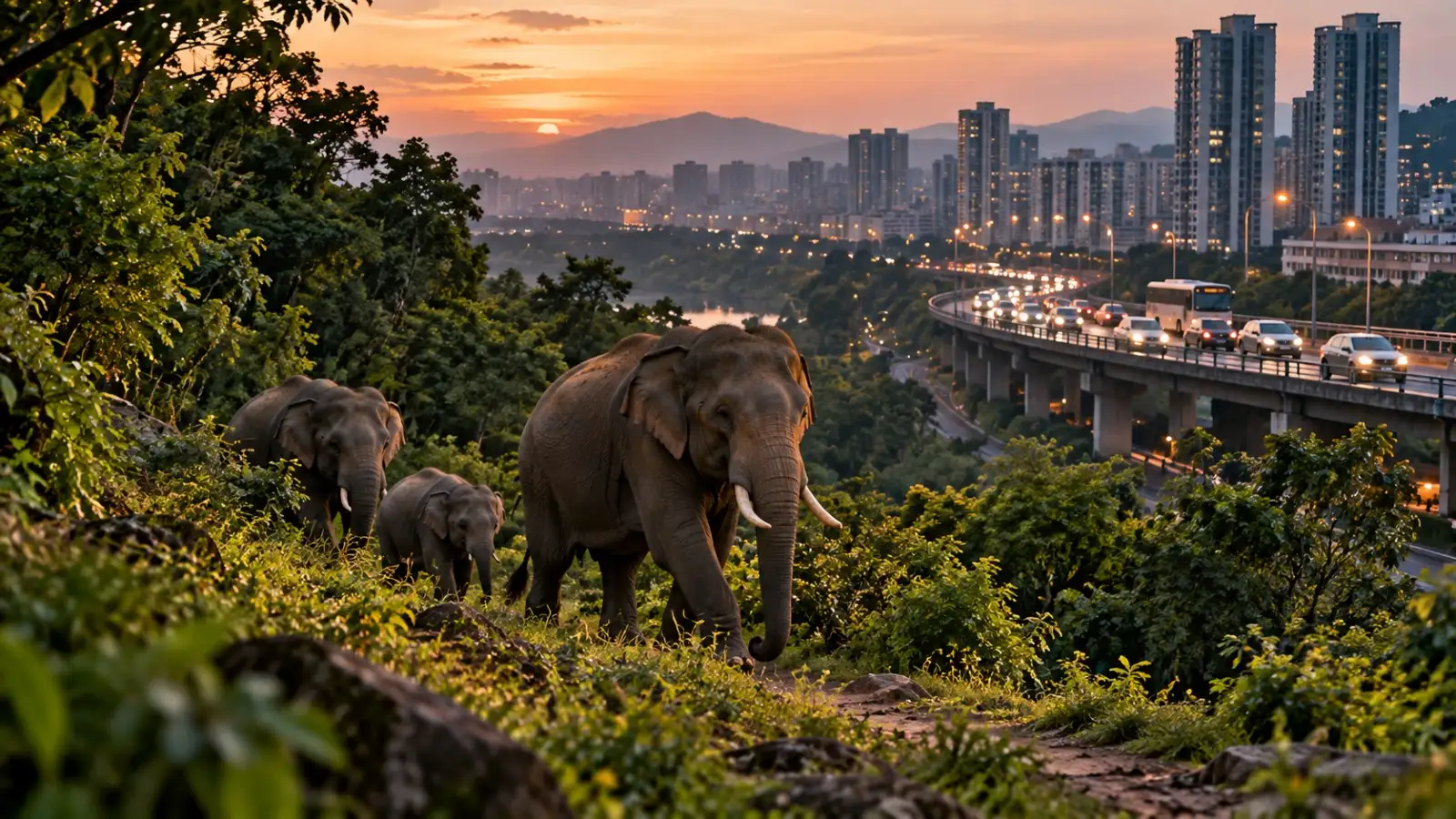
Yet wildlife does not always recognise these boundaries in the way humans do.
Across India, animals continue to move through fragmented landscapes using stretches of forest, riverbanks, agricultural land, scrub, railway edges and other relatively undisturbed spaces. Some of these routes connect protected forests. Others pass surprisingly close to expanding towns and cities.
Scientists call these pathways wildlife corridors or movement corridors.
They can be almost invisible to people, but for an elephant, leopard, deer or smaller mammal, a narrow strip of usable habitat can become part of a much larger journey.
A wildlife corridor is better understood as a connected landscape that allows animals to move between areas where they feed, breed, shelter or find water.
The Wildlife Institute of India has documented such corridors across different parts of the country. India's elephant landscapes alone were reported to contain 150 identified elephant corridors in 2023.
These corridors can pass through forests, farmland, riverine vegetation and areas affected by roads or settlements.
For animals, connectivity matters because a single isolated forest patch may not provide everything a population needs.
Roads, housing colonies, industrial areas and commercial districts have gradually expanded into surrounding countryside.
This creates a strange situation. A city can grow across a landscape that was once used regularly by wildlife, while small pieces of that original landscape remain.
A river may continue flowing through the city. A forest patch may survive beside a highway. A drainage channel may retain vegetation. Agricultural land may remain between residential developments.
These fragments can sometimes retain ecological importance.
The Ministry of Environment, Forest and Climate Change notes that habitat fragmentation, development activity and disturbance of corridors can contribute to human wildlife conflict. It also points out that species such as leopards, monkeys, nilgai and bears can adapt to living close to human habitation.
Research by the Wildlife Institute of India has examined wildlife corridors in the Western Terai Arc Landscape, including areas around Rajaji National Park.
Recent monitoring found leopards and elephants among the most frequently encountered large mammals in the studied corridors. Camera trapping recorded multiple species using these routes, while elephant activity was found to shift towards night-time in some corridors.
This becomes particularly significant as urban development expands around forest boundaries.
A WII assessment of the Rajaji landscape found that urban built-up areas had expanded substantially outside forests, creating implications for elephant movement and human elephant conflict management.
What looks like an ordinary green patch to a city resident can therefore be part of a much larger movement system.
That makes connectivity particularly important for elephant populations.
The Government of India's Elephant Corridors of India 2023 report documents corridors that connect different forest landscapes and notes the presence of roads, villages, agricultural land and other human infrastructure within some corridors.
One documented Uttarakhand corridor, Rawasan-Sonanadi, connects the Rajaji and Corbett landscapes. The corridor includes 35 revenue villages and is crossed by National Highway 119. Elephant movement there is classified as regular.
This shows why the word corridor can be misleading.
It does not always mean an untouched strip of wilderness.
Sometimes it is a working landscape where wildlife and people occupy the same broad area.
Even when a city has developed heavily around a river, vegetation along its banks can provide cover and movement opportunities.
Water also attracts animals directly.
River systems can connect forest patches that would otherwise be separated by roads, farms or settlements. In hilly areas, streams and river valleys can be particularly important because they create naturally connected routes through difficult terrain.
This is one reason protecting vegetation along waterways can have consequences beyond water management alone.
A seemingly narrow green strip can sometimes provide a connection between much larger habitats.
But animals sometimes attempt to cross them, particularly where roads cut through established movement routes.
The Wildlife Institute of India's monitoring of animal underpasses in Pench Tiger Reserve provides a useful example. Camera traps recorded 18 species using nine crossing structures beneath National Highway 44.
The recorded users included spotted deer, wild pig, gaur, nilgai, sambar, jungle cat, leopard, tiger, wild dog, sloth bear and jackal. Researchers recorded 89 tiger crossings by 11 individual tigers at six of the structures.
The lesson is important.
A highway may appear to divide a landscape completely, but appropriately designed crossing structures can restore some of the connectivity.
Animals may make use of spaces humans have left relatively undisturbed.
Railway edges, undeveloped plots, plantation areas, canals and scrubland can sometimes provide cover.
This does not mean every vacant plot is a wildlife corridor. A functioning corridor needs suitable habitat and connectivity, and its importance varies between species.
But urban planners increasingly have to consider the ecological value of spaces that might otherwise be viewed simply as leftover land.
Their ability to use different habitats can bring them close to villages and cities, especially where natural landscapes have been fragmented.
The Ministry of Environment, Forest and Climate Change specifically identifies leopards among species capable of living successfully close to human habitation.
This adaptability can sometimes make their movements difficult for people to notice.
A leopard does not necessarily need a large uninterrupted forest to move between suitable areas. Vegetated drains, scrub, agricultural fields and forest fragments can sometimes become part of its route.
That does not mean that seeing a leopard automatically indicates a corridor. Individual sightings need to be interpreted in their local ecological context.
One road may not completely block movement. One housing project may not either.
But when several roads, buildings, walls, railway lines and industrial areas accumulate, a previously usable route can become fragmented.
The consequences can extend beyond individual animals.
The WII's work in the Rajaji landscape notes that the Chilla-Motichur corridor was non-functional for a period and that this contributed to isolation of elephant populations on either side of the Ganga. Restoration efforts subsequently improved the corridor's functionality.
This illustrates why wildlife conservation is not only about protecting parks.
The spaces connecting those parks can be just as important.
That makes the question of wildlife connectivity increasingly relevant.
Cities do not necessarily have to choose between development and every form of wildlife movement. Better planning can include underpasses, overpasses, protected river buffers, connected green spaces and restrictions on development in particularly sensitive areas.
The challenge is identifying which routes actually matter before they disappear.
For residents, these corridors can also explain why wildlife occasionally appears in unexpected places.
A monkey crossing a neighbourhood, nilgai appearing near an urban edge or a leopard moving through a green belt may seem like isolated incidents.
Sometimes, however, they are clues that the city is sitting on top of an older landscape.
There may be no signboard, road marking or obvious trail.
Instead, they can consist of a chain of forests, farms, riverbanks, scrub patches and relatively quiet spaces that together allow animals to move across an increasingly fragmented landscape.
Some pass beside major roads. Some cross beneath them. Others run surprisingly close to expanding cities.
The animals are following routes that existed long before today's urban boundaries.
The real challenge is whether India's future cities will leave enough room for those routes to remain connected.
Yet wildlife does not always recognise these boundaries in the way humans do.
Across India, animals continue to move through fragmented landscapes using stretches of forest, riverbanks, agricultural land, scrub, railway edges and other relatively undisturbed spaces. Some of these routes connect protected forests. Others pass surprisingly close to expanding towns and cities.
Scientists call these pathways wildlife corridors or movement corridors.
They can be almost invisible to people, but for an elephant, leopard, deer or smaller mammal, a narrow strip of usable habitat can become part of a much larger journey.
1. What is an animal highway?
An animal highway is not necessarily a clearly visible trail.A wildlife corridor is better understood as a connected landscape that allows animals to move between areas where they feed, breed, shelter or find water.
The Wildlife Institute of India has documented such corridors across different parts of the country. India's elephant landscapes alone were reported to contain 150 identified elephant corridors in 2023.
These corridors can pass through forests, farmland, riverine vegetation and areas affected by roads or settlements.
For animals, connectivity matters because a single isolated forest patch may not provide everything a population needs.
2. The city often grows around an older landscape
Many Indian cities did not begin as the enormous urban areas they are today.Roads, housing colonies, industrial areas and commercial districts have gradually expanded into surrounding countryside.
This creates a strange situation. A city can grow across a landscape that was once used regularly by wildlife, while small pieces of that original landscape remain.
A river may continue flowing through the city. A forest patch may survive beside a highway. A drainage channel may retain vegetation. Agricultural land may remain between residential developments.
These fragments can sometimes retain ecological importance.
The Ministry of Environment, Forest and Climate Change notes that habitat fragmentation, development activity and disturbance of corridors can contribute to human wildlife conflict. It also points out that species such as leopards, monkeys, nilgai and bears can adapt to living close to human habitation.
3. The forests around Dehradun and Haridwar
The landscape around Dehradun, Haridwar and the Rajaji region offers one of the clearest examples of how urban growth and wildlife movement can overlap.Research by the Wildlife Institute of India has examined wildlife corridors in the Western Terai Arc Landscape, including areas around Rajaji National Park.
Recent monitoring found leopards and elephants among the most frequently encountered large mammals in the studied corridors. Camera trapping recorded multiple species using these routes, while elephant activity was found to shift towards night-time in some corridors.
This becomes particularly significant as urban development expands around forest boundaries.
A WII assessment of the Rajaji landscape found that urban built-up areas had expanded substantially outside forests, creating implications for elephant movement and human elephant conflict management.
What looks like an ordinary green patch to a city resident can therefore be part of a much larger movement system.
4. Elephants can travel through surprisingly fragmented landscapes
Elephants need large areas and considerable access to food and water.That makes connectivity particularly important for elephant populations.
The Government of India's Elephant Corridors of India 2023 report documents corridors that connect different forest landscapes and notes the presence of roads, villages, agricultural land and other human infrastructure within some corridors.
One documented Uttarakhand corridor, Rawasan-Sonanadi, connects the Rajaji and Corbett landscapes. The corridor includes 35 revenue villages and is crossed by National Highway 119. Elephant movement there is classified as regular.
This shows why the word corridor can be misleading.
It does not always mean an untouched strip of wilderness.
Sometimes it is a working landscape where wildlife and people occupy the same broad area.
5. Riverbanks can become wildlife routes
Rivers are another important part of India's hidden animal network.Even when a city has developed heavily around a river, vegetation along its banks can provide cover and movement opportunities.
Water also attracts animals directly.
River systems can connect forest patches that would otherwise be separated by roads, farms or settlements. In hilly areas, streams and river valleys can be particularly important because they create naturally connected routes through difficult terrain.
This is one reason protecting vegetation along waterways can have consequences beyond water management alone.
A seemingly narrow green strip can sometimes provide a connection between much larger habitats.
6. Roads do not always stop wildlife
Roads are among the biggest obstacles facing animals moving through fragmented landscapes.But animals sometimes attempt to cross them, particularly where roads cut through established movement routes.
The Wildlife Institute of India's monitoring of animal underpasses in Pench Tiger Reserve provides a useful example. Camera traps recorded 18 species using nine crossing structures beneath National Highway 44.
The recorded users included spotted deer, wild pig, gaur, nilgai, sambar, jungle cat, leopard, tiger, wild dog, sloth bear and jackal. Researchers recorded 89 tiger crossings by 11 individual tigers at six of the structures.
The lesson is important.
A highway may appear to divide a landscape completely, but appropriately designed crossing structures can restore some of the connectivity.
7. Railway lines and empty land can become accidental corridors
Not every wildlife route is deliberately created for conservation.Animals may make use of spaces humans have left relatively undisturbed.
Railway edges, undeveloped plots, plantation areas, canals and scrubland can sometimes provide cover.
This does not mean every vacant plot is a wildlife corridor. A functioning corridor needs suitable habitat and connectivity, and its importance varies between species.
But urban planners increasingly have to consider the ecological value of spaces that might otherwise be viewed simply as leftover land.
8. Leopards are particularly good at navigating human landscapes
Leopards are among the most adaptable large carnivores in India.Their ability to use different habitats can bring them close to villages and cities, especially where natural landscapes have been fragmented.
The Ministry of Environment, Forest and Climate Change specifically identifies leopards among species capable of living successfully close to human habitation.
This adaptability can sometimes make their movements difficult for people to notice.
A leopard does not necessarily need a large uninterrupted forest to move between suitable areas. Vegetated drains, scrub, agricultural fields and forest fragments can sometimes become part of its route.
That does not mean that seeing a leopard automatically indicates a corridor. Individual sightings need to be interpreted in their local ecological context.
9. Cities can accidentally block an entire route
The biggest problem with wildlife corridors is that connectivity can disappear gradually.One road may not completely block movement. One housing project may not either.
But when several roads, buildings, walls, railway lines and industrial areas accumulate, a previously usable route can become fragmented.
The consequences can extend beyond individual animals.
The WII's work in the Rajaji landscape notes that the Chilla-Motichur corridor was non-functional for a period and that this contributed to isolation of elephant populations on either side of the Ganga. Restoration efforts subsequently improved the corridor's functionality.
This illustrates why wildlife conservation is not only about protecting parks.
The spaces connecting those parks can be just as important.
10. The future of Indian cities may depend on these invisible routes
India's urban population and built-up areas continue to expand.That makes the question of wildlife connectivity increasingly relevant.
Cities do not necessarily have to choose between development and every form of wildlife movement. Better planning can include underpasses, overpasses, protected river buffers, connected green spaces and restrictions on development in particularly sensitive areas.
The challenge is identifying which routes actually matter before they disappear.
For residents, these corridors can also explain why wildlife occasionally appears in unexpected places.
You may also like
- Psychology says people who arrive three hours early at the airport are not just 'early birds', there is a surprising childhood reason behind it
- 'Har shaks yahan apna sa lage'- Jeetendra wins hearts with shayari during his visit to Pune to seek Ganpati Bappa's blessings
- Psychology says children who don't tell parents when they have been left out by friends may fear what happens after they tell them
- Protein in Urine During Pregnancy: What It Means and Why It Matters
- From a rented room and a missed Cambridge dream to Padma Shri: How Anand Kumar built Super 30 and changed the lives of underprivileged IIT aspirants through free education and hope
A monkey crossing a neighbourhood, nilgai appearing near an urban edge or a leopard moving through a green belt may seem like isolated incidents.
Sometimes, however, they are clues that the city is sitting on top of an older landscape.
The highways we cannot see
India's wildlife corridors rarely look like highways.There may be no signboard, road marking or obvious trail.
Instead, they can consist of a chain of forests, farms, riverbanks, scrub patches and relatively quiet spaces that together allow animals to move across an increasingly fragmented landscape.
Some pass beside major roads. Some cross beneath them. Others run surprisingly close to expanding cities.
The animals are following routes that existed long before today's urban boundaries.
The real challenge is whether India's future cities will leave enough room for those routes to remain connected.






Loving Newspoint? Download the app now
