
He thought he had found a T. rex footprint; scientists returned the next day and uncovered four tracks from 66.5 million years ago


A Colorado high school teacher looking for fossils in North Dakota noticed something that did not look quite right. A wedge-shaped rock seemed to have three enormous toes. That small observation eventually led scientists to a rare discovery: a sequence of four footprints likely made by an adult Tyrannosaurus rex about 66.5 million years ago. The study was published in the Journal of Vertebrate Paleontology on September 8, 2026.
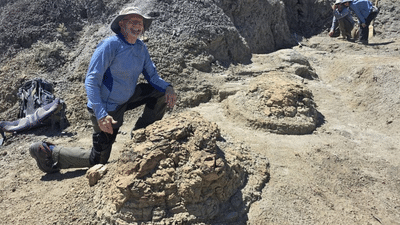
Teacher's unusual find gets a closer look Kent Hups , a teacher at Northglenn High School in Colorado and an experienced amateur fossil hunter , found the structure while volunteering on a dig in the Hell Creek Formation .
He alerted palaeontologist Tyler Lyson , who was leading the excavation. Lyson did not immediately accept that it was a T. rex footprint. One strange shape was not enough.
Further excavation changed the picture. Researchers found four three-toed tracks arranged in a sequence, stretching roughly 7 metres, or 23 feet.
That distinction matters. A single footprint can reveal the size and shape of a foot. A trackway can reveal movement.
Why four footprints matter so muchAdult T. rex footprints have been reported before, but they were isolated finds. They could show that the animal had walked across an ancient landscape, but not where its next step landed.
This trackway contains two left and two right footprints. The spacing between them gives researchers a glimpse of the dinosaur's stride and walking pace.
Scientists estimate that the animal was moving at about 1.5 to 2 metres per second, roughly 3.4 to 4.5 miles per hour. That is closer to a brisk human walking pace than the dramatic sprint often imagined in popular dinosaur films.
The fossils preserved a moment, not just bonesThe footprints formed in fine-grained sandstone concretions cemented with calcium carbonate. The hardened material eventually became more resistant than the surrounding rock.
The surfaces are heavily fractured, so they do not preserve every detail of the dinosaur's foot. But their size, narrow three-toed shape, age and location all support an adult T. rex as the most likely trackmaker. Nearby T. rex fossils provide additional evidence.
What this discovery changesThe find does not give scientists a complete picture of how T. rex lived or moved. But it adds something bones cannot provide: a physical record of an animal actually walking.
High-resolution 3D scans have also preserved the trackway digitally. Three of the fossilised tracks are expected to be recovered and taken to the Denver Museum of Nature & Science for further study.
There is something fitting about the discovery's beginning. A teacher noticed an odd shape because years of curiosity had taught him to stop and look closely. Hups later said he often tells students that science starts with curiosity and careful observation. This time, the lesson was written into the rock itself.
Disclaimer: The identification of the trackmaker is scientific interpretation, not direct proof from the footprints alone.
Teacher's unusual find gets a closer look Kent Hups , a teacher at Northglenn High School in Colorado and an experienced amateur fossil hunter , found the structure while volunteering on a dig in the Hell Creek Formation .
He alerted palaeontologist Tyler Lyson , who was leading the excavation. Lyson did not immediately accept that it was a T. rex footprint. One strange shape was not enough.
Further excavation changed the picture. Researchers found four three-toed tracks arranged in a sequence, stretching roughly 7 metres, or 23 feet.
That distinction matters. A single footprint can reveal the size and shape of a foot. A trackway can reveal movement.
Why four footprints matter so muchAdult T. rex footprints have been reported before, but they were isolated finds. They could show that the animal had walked across an ancient landscape, but not where its next step landed.
This trackway contains two left and two right footprints. The spacing between them gives researchers a glimpse of the dinosaur's stride and walking pace.
Scientists estimate that the animal was moving at about 1.5 to 2 metres per second, roughly 3.4 to 4.5 miles per hour. That is closer to a brisk human walking pace than the dramatic sprint often imagined in popular dinosaur films.
The fossils preserved a moment, not just bonesThe footprints formed in fine-grained sandstone concretions cemented with calcium carbonate. The hardened material eventually became more resistant than the surrounding rock.
The surfaces are heavily fractured, so they do not preserve every detail of the dinosaur's foot. But their size, narrow three-toed shape, age and location all support an adult T. rex as the most likely trackmaker. Nearby T. rex fossils provide additional evidence.
What this discovery changesThe find does not give scientists a complete picture of how T. rex lived or moved. But it adds something bones cannot provide: a physical record of an animal actually walking.
High-resolution 3D scans have also preserved the trackway digitally. Three of the fossilised tracks are expected to be recovered and taken to the Denver Museum of Nature & Science for further study.
There is something fitting about the discovery's beginning. A teacher noticed an odd shape because years of curiosity had taught him to stop and look closely. Hups later said he often tells students that science starts with curiosity and careful observation. This time, the lesson was written into the rock itself.
Disclaimer: The identification of the trackmaker is scientific interpretation, not direct proof from the footprints alone.
Next Story