
Who decided we had to work 9 to 5 anyway? The Odd History of the Workday

Think about how strange the 9-to-5 routine sounds when you say it out loud. You wake up, rush through breakfast, travel somewhere, and spend most of the daylight hours working. Then go home tired enough to spend the evening recovering before doing it all again tomorrow.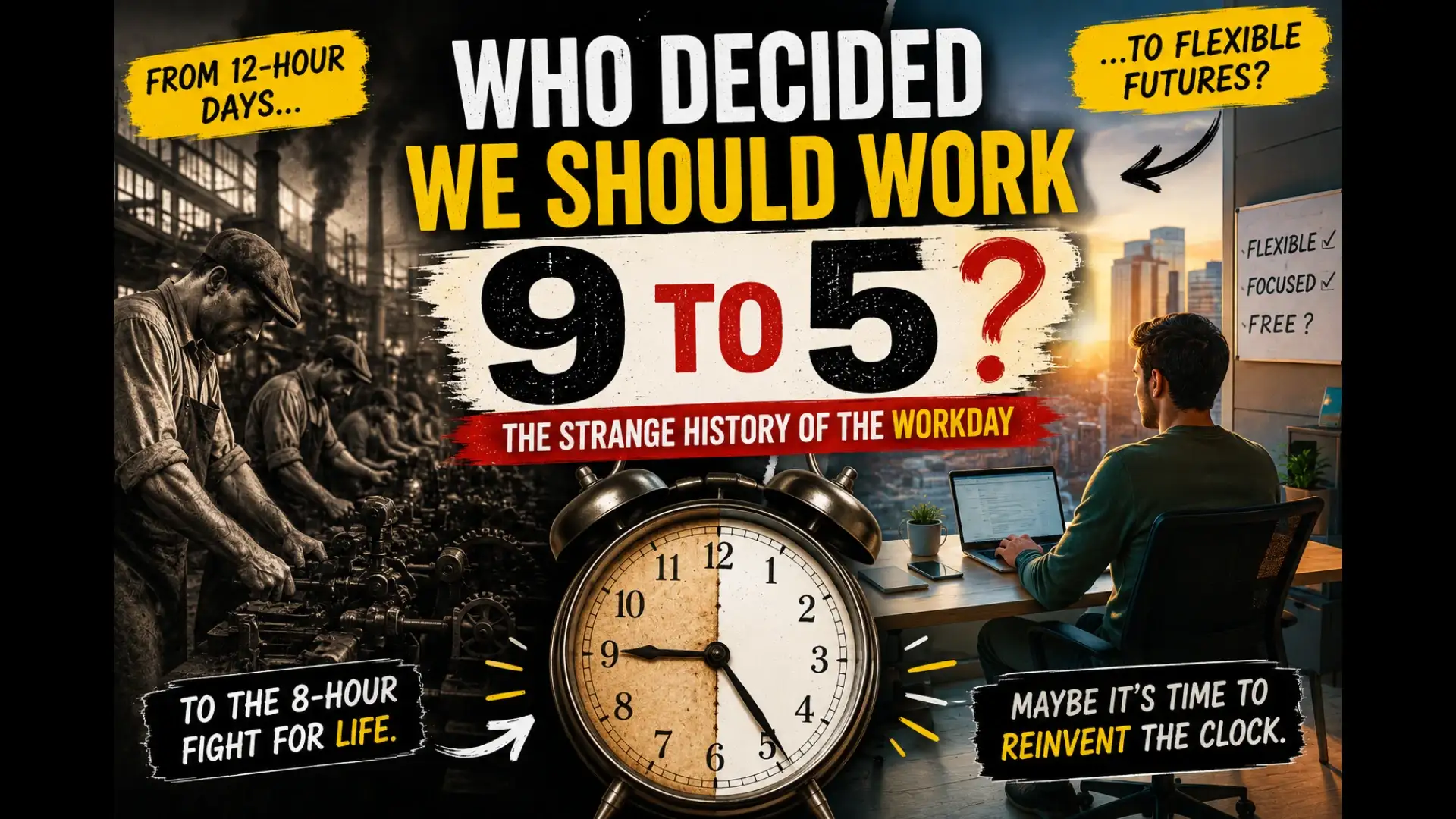
And somehow, we've collectively decided this is what a normal adult life looks like. But who actually decided that? There is nothing biologically special about 9 a.m. There is no natural law saying humans should work until 5 p.m. The clock on your office wall isn't following some ancient human tradition. The modern workday was built. And it took a surprisingly long time to get there.
Before the Clock Ruled Everything
For much of history, work wasn't organised around a fixed timetable. Farmers worked according to daylight, weather and seasons. Craftspeople worked according to their trade. Shopkeepers followed customers. People didn't necessarily think of a working day as a neat block of hours that began and ended at exactly the same time.
Then industrialisation changed everything. Factories needed people to arrive at specific times because machines couldn't simply wait for everyone to feel ready to start. The clock became increasingly important. Instead of asking, “Is the work finished?”, employers could ask, “How many hours did you work?” That changed the relationship between people and time.
The Problem With Working All Day
Early industrial workers often worked extremely long hours. Twelve-hour days were not unusual, and in some industries the working day could stretch even longer. Factories were productive because workers spent enormous amounts of time inside them. But that came with a cost.
People were exhausted. Working conditions could be dangerous, and there was little separation between earning a living and simply having a life. Eventually, workers began pushing back. The idea that people deserved more time away from work became a serious political and social demand.
The Eight-Hour Idea Takes Off
One of the most important ideas to emerge from labour movements was surprisingly simple: Eight hours for work. Eight hours for rest. Eight hours for us. The slogan captured something workers were asking for that sounds obvious today but was revolutionary at the time.
They didn't want to stop working. They wanted work to stop taking over their entire lives. Labour organisations, activists and reformers pushed for shorter working hours across different countries and industries. Change didn't happen overnight, but the eight-hour workday gradually became more accepted.
Then businesses realised shorter could actually work.
One of the interesting twists in this story is that shorter working hours weren't only pushed by workers. Some employers eventually discovered that exhausted employees weren't necessarily productive employees.
A famous example came when Ford Motor Company reduced working hours for many workers in the 1920s while maintaining relatively strong pay. The move helped popularise the idea that workers could be productive without spending their entire waking lives at the factory.
Other businesses began experimenting with shorter schedules. The eight-hour day started looking less like a radical demand and more like a workable system.
So Where Did “9-to-5” Come From?
The exact phrase became especially familiar through the growth of office work and the modern corporate schedule. The eight-hour workday didn't necessarily have to be 9-to-5. Different workplaces used different start and finish times.
But as office culture became standardised, the familiar daytime schedule became increasingly common. It was convenient for businesses, predictable for employees and easy to organise. Eventually, it became so normal that we stopped asking why it existed.
The Funny Thing Is, Work Has Changed Again
Today, the 9-to-5 is starting to look less permanent than it once did. Remote work, flexible hours, freelancing and hybrid jobs have made it possible for some people to organise their days differently.
A person might start at 7 a.m. and finish early. Someone else might work later in the evening. Another person may measure their day by tasks rather than hours. The technology that once helped create the clock-driven workplace and is now helping people escape it.
Maybe 9-to-5 Was Never Meant to Be Forever
The biggest irony is that the workday many people complain about today was once considered a major improvement. Eight hours of work was progress compared with twelve or fourteen. But progress doesn't have to stop there.
The 9-to-5 was created for a particular era, with particular factories, schedules and ideas about productivity. Our lives don't look exactly like they did then. So perhaps the more interesting question isn't whether 9-to-5 is good or bad. It's whether we still need to organise modern work around a system designed for a world that no longer exists. Because if history has taught us anything, it's this: The working day isn't a law of nature. Someone invented it. And that means someone can reinvent it too.
And somehow, we've collectively decided this is what a normal adult life looks like. But who actually decided that? There is nothing biologically special about 9 a.m. There is no natural law saying humans should work until 5 p.m. The clock on your office wall isn't following some ancient human tradition. The modern workday was built. And it took a surprisingly long time to get there.
Before the Clock Ruled Everything
For much of history, work wasn't organised around a fixed timetable. Farmers worked according to daylight, weather and seasons. Craftspeople worked according to their trade. Shopkeepers followed customers. People didn't necessarily think of a working day as a neat block of hours that began and ended at exactly the same time.
Then industrialisation changed everything. Factories needed people to arrive at specific times because machines couldn't simply wait for everyone to feel ready to start. The clock became increasingly important. Instead of asking, “Is the work finished?”, employers could ask, “How many hours did you work?” That changed the relationship between people and time.
The Problem With Working All Day
Early industrial workers often worked extremely long hours. Twelve-hour days were not unusual, and in some industries the working day could stretch even longer. Factories were productive because workers spent enormous amounts of time inside them. But that came with a cost.
People were exhausted. Working conditions could be dangerous, and there was little separation between earning a living and simply having a life. Eventually, workers began pushing back. The idea that people deserved more time away from work became a serious political and social demand.
The Eight-Hour Idea Takes Off
One of the most important ideas to emerge from labour movements was surprisingly simple: Eight hours for work. Eight hours for rest. Eight hours for us. The slogan captured something workers were asking for that sounds obvious today but was revolutionary at the time.
They didn't want to stop working. They wanted work to stop taking over their entire lives. Labour organisations, activists and reformers pushed for shorter working hours across different countries and industries. Change didn't happen overnight, but the eight-hour workday gradually became more accepted.
Then businesses realised shorter could actually work.
One of the interesting twists in this story is that shorter working hours weren't only pushed by workers. Some employers eventually discovered that exhausted employees weren't necessarily productive employees.
A famous example came when Ford Motor Company reduced working hours for many workers in the 1920s while maintaining relatively strong pay. The move helped popularise the idea that workers could be productive without spending their entire waking lives at the factory.
Other businesses began experimenting with shorter schedules. The eight-hour day started looking less like a radical demand and more like a workable system.
So Where Did “9-to-5” Come From?
The exact phrase became especially familiar through the growth of office work and the modern corporate schedule. The eight-hour workday didn't necessarily have to be 9-to-5. Different workplaces used different start and finish times.
But as office culture became standardised, the familiar daytime schedule became increasingly common. It was convenient for businesses, predictable for employees and easy to organise. Eventually, it became so normal that we stopped asking why it existed.
The Funny Thing Is, Work Has Changed Again
Today, the 9-to-5 is starting to look less permanent than it once did. Remote work, flexible hours, freelancing and hybrid jobs have made it possible for some people to organise their days differently.
A person might start at 7 a.m. and finish early. Someone else might work later in the evening. Another person may measure their day by tasks rather than hours. The technology that once helped create the clock-driven workplace and is now helping people escape it.
Maybe 9-to-5 Was Never Meant to Be Forever
The biggest irony is that the workday many people complain about today was once considered a major improvement. Eight hours of work was progress compared with twelve or fourteen. But progress doesn't have to stop there.
The 9-to-5 was created for a particular era, with particular factories, schedules and ideas about productivity. Our lives don't look exactly like they did then. So perhaps the more interesting question isn't whether 9-to-5 is good or bad. It's whether we still need to organise modern work around a system designed for a world that no longer exists. Because if history has taught us anything, it's this: The working day isn't a law of nature. Someone invented it. And that means someone can reinvent it too.
Next Story