
How to Plan a Sharad Purnima Terrace Night the Whole Building Joins


The moon on Sharad Purnima rises full and unusually close to the horizon, which means the terrace you barely use eleven months of the year becomes the most valuable square footage in the building for one night. Getting the logistics right is what separates a gathering that people talk about for a week from one that quietly dissolves by nine o'clock.
Start with the building, not the guest listBefore a single chit of paper goes under any door, speak to the society secretary or the building committee. A terrace gathering with more than a handful of people usually needs a verbal or written go-ahead, and getting it early means you have a co-organiser rather than someone who can shut you down at seven in the evening. Once you have clearance, a simple handwritten invite slipped under doors works better than a group message. A physical note signals effort; a WhatsApp forward signals forwarding.
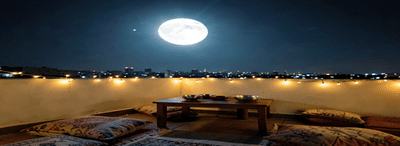
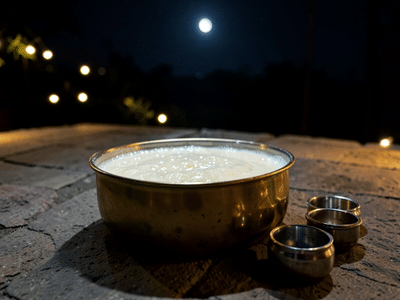 My Sharad Purnima kheer ritual under the full moon. A simple, serene celebration.
Anchor the night around the kheer ritualSharad Purnima has one food tradition that needs no explanation to anyone in the building: kheer left out under the moonlight to absorb the dew. Chanakya wrote in the Arthashastra that a community bound by shared ritual is harder to fracture than one bound by shared interest alone. The kheer ritual is your anchor. Set up one large vessel, a wide brass or steel parat works best, and invite each flat to contribute a small bowl of their own. By the time the moon is directly overhead, there are twenty bowls of kheer on the terrace and the whole building has a stake in the same thing. Distribute it together after midnight. That shared distribution is the moment people remember.
Keep the setup simple enough that it runs itselfThe two things that kill a terrace gathering early are chairs that run out and lights that need someone watching them. Solve both before anyone arrives. String fairy lights or paper lanterns along the parapet wall and plug them into a timer so they come on automatically at dusk. Bring up more seating than you think you need: durries and chatais on the floor cost nothing and remove the chair-scarcity problem entirely. One table for the kheer, one cooler with nimbu pani and water, and a Bluetooth speaker at low volume playing instrumental classical, Yaman or Bhairavi ragas suit the mood without demanding attention. Keep the speaker low enough that conversation does not have to compete with it.
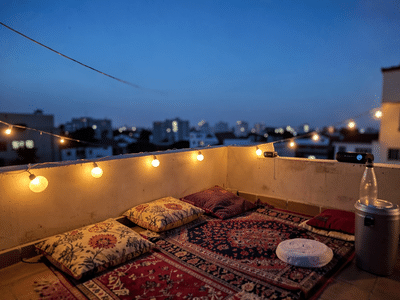 My perfect full moon night terrace setup, ready for a peaceful evening. #SharadPurnima
Give people something to do in the first twenty minutesThe awkward window is arrival. Neighbours who do not know each other well will cluster by flat and leave early if nothing pulls them into the middle. A simple fix: set up a small telescope or binoculars on a tripod pointed at the moon, and put one person in charge of showing people the craters. Almost no one has looked at a full moon through even a basic pair of binoculars, and the reaction is reliably enough to break any ice. If a telescope is not available, a printed moon map from any astronomy website does the same job at zero cost. People gather around information.
End it at a time you name in advanceThe invite should say: kheer distribution at midnight, wrap by twelve-thirty. A stated end time does two things. It tells reluctant neighbours that they are not committing to an open-ended night, which gets more of them up there. And it gives you a clean close so the terrace is clear and swept before one in the morning, which protects your relationship with the building for every gathering after this one. The neighbours who leave at ten-thirty will come back next year because they know it will not run until two.
Start with the building, not the guest listBefore a single chit of paper goes under any door, speak to the society secretary or the building committee. A terrace gathering with more than a handful of people usually needs a verbal or written go-ahead, and getting it early means you have a co-organiser rather than someone who can shut you down at seven in the evening. Once you have clearance, a simple handwritten invite slipped under doors works better than a group message. A physical note signals effort; a WhatsApp forward signals forwarding.
Anchor the night around the kheer ritualSharad Purnima has one food tradition that needs no explanation to anyone in the building: kheer left out under the moonlight to absorb the dew. Chanakya wrote in the Arthashastra that a community bound by shared ritual is harder to fracture than one bound by shared interest alone. The kheer ritual is your anchor. Set up one large vessel, a wide brass or steel parat works best, and invite each flat to contribute a small bowl of their own. By the time the moon is directly overhead, there are twenty bowls of kheer on the terrace and the whole building has a stake in the same thing. Distribute it together after midnight. That shared distribution is the moment people remember.
Keep the setup simple enough that it runs itselfThe two things that kill a terrace gathering early are chairs that run out and lights that need someone watching them. Solve both before anyone arrives. String fairy lights or paper lanterns along the parapet wall and plug them into a timer so they come on automatically at dusk. Bring up more seating than you think you need: durries and chatais on the floor cost nothing and remove the chair-scarcity problem entirely. One table for the kheer, one cooler with nimbu pani and water, and a Bluetooth speaker at low volume playing instrumental classical, Yaman or Bhairavi ragas suit the mood without demanding attention. Keep the speaker low enough that conversation does not have to compete with it.
Give people something to do in the first twenty minutesThe awkward window is arrival. Neighbours who do not know each other well will cluster by flat and leave early if nothing pulls them into the middle. A simple fix: set up a small telescope or binoculars on a tripod pointed at the moon, and put one person in charge of showing people the craters. Almost no one has looked at a full moon through even a basic pair of binoculars, and the reaction is reliably enough to break any ice. If a telescope is not available, a printed moon map from any astronomy website does the same job at zero cost. People gather around information.
End it at a time you name in advanceThe invite should say: kheer distribution at midnight, wrap by twelve-thirty. A stated end time does two things. It tells reluctant neighbours that they are not committing to an open-ended night, which gets more of them up there. And it gives you a clean close so the terrace is clear and swept before one in the morning, which protects your relationship with the building for every gathering after this one. The neighbours who leave at ten-thirty will come back next year because they know it will not run until two.
Next Story