
I wanted to capture the Kashmir I know: Raja Shabir Khan on The Sledge


Kashmiri filmmaker Raja Shabir Khan ’s The Sledge has been selected for the International Competition at the 31st SCHLiNGEL International Film Festival for Children and Young Audiences in Chemnitz, Germany, where it will have its world premiere. Shot almost entirely around Gulmarg and Tangmarg, the Kashmiri-language film is set against the snow-covered landscape of Kashmir but looks beyond its postcard beauty to the everyday lives unfolding within it.
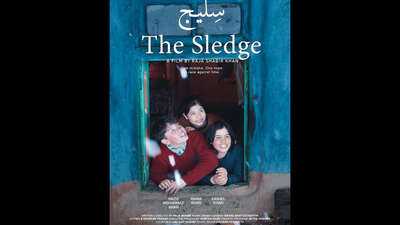
The film grew out of Khan’s documentary The Sledge Puller, about an elderly sledge puller in Gulmarg. An incident in which the man’s sledge was stolen stayed with Khan and eventually became the seed for a fictional story about a father, his children and a sledge. Made independently, the film features no professional actors: Khan’s son Haziq, daughter Eashel and niece Raima play the children, while his brother and sister-in-law play the parents. In this conversation, he talks about the film’s origins, shooting in Kashmir, working with his children and the influence of Abbas Kiarostami. Excerpts from an interview -
It’s one of the most beautiful films shot in Kashmir. Which were the locations where the film was shot?
Kashmir is, in any case, like a postcard. You don’t really have to make it beautiful—it already is. For me, the challenge was to look beyond that beauty and find the story within it.
The film was shot almost entirely around Gulmarg and the surrounding areas of Tangmarg. I wanted the landscape to belong to the characters and to the story, rather than simply serve as a beautiful backdrop. The snow, the forests, the mountains, the sledges, the roads and the small spaces where people live and work are all part of the film’s world.
We shot in winter, and I allowed the changing weather and natural light to become part of the visual language. Snowfall, mist, sunlight and even the grey, cold days were things I wanted to embrace rather than control.
I wanted to capture the Kashmir I know—not just the Kashmir that visitors see, but a lived-in Kashmir. A place where children grow up playing in the snow, people make a living from the landscape, and very ordinary lives unfold amidst extraordinary beauty. For me, that was more interesting than simply making another postcard of Kashmir.
What is the origin story of this film?
The origin of The Sledge goes back to a documentary, The Sledge Puller, I was making about the life of an old sledge puller in Gulmarg. While filming him, I began to understand how deeply the sledge was connected to his life. It wasn’t simply a means of earning a livelihood; it had become a part of his identity and his existence.
At one point, his sledge was stolen, and I saw how deeply that affected him. That stayed with me.
I began thinking about the sledge not just as an object, but as something that could carry a whole story. From there, the idea for The Sledge slowly emerged.
I wanted to tell a very simple story—a father, his children, a sledge, and a small incident that gradually becomes a big adventure in the children’s world. The sledge is such a familiar part of life in Gulmarg, particularly for children, but I was interested in looking at it through their imagination and their relationship with snow.
I also wanted the film to be deeply rooted in Kashmir and, importantly, in the Kashmiri language, while keeping the emotions universal. The story is small and intimate, but for the children, what happens to the sledge becomes something much bigger. In a way, the film grew out of a real-life observation and then found its own fictional world.
Please tell us about the selection
The Sledge has been selected for the 31st SCHLiNGEL International Film Festival for Children and Young Audiences in Chemnitz, Germany, where it will have its world premiere in the International Competition.
For me, this is particularly meaningful because the film was made in Kashmiri and is essentially a very local story. Having it travel to an international festival and meet an audience of children and young people in Germany is a wonderful opportunity.
I will also be attending the festival’s industry events, including the Industry Forum, as well as the opening and award ceremonies. The screening is scheduled for 7 October.
s there a mix of actors and non-actors in the film?
No. The Sledge has no professional actors. Everyone in the film is a non-professional performer. The children are my son, Haziq, my daughter, Eashel, and my niece, Raima. The parents are played by my brother and his wife.
So, in many ways, the film became a family production.
That was not only a creative choice but also a practical one. Since I was making the film independently, working with my family allowed me to keep the production very small and intimate and, importantly, complete it without external funding.
I was particularly interested in retaining a sense of naturalism because the story revolves around children. With non-professional performers, you cannot always predict their reactions, body language or silences—and I actually wanted that unpredictability. I didn’t want the children to look like they were performing; I wanted them to simply be themselves.
Having people from my own family in the film also gave me a certain freedom. They were already comfortable with one another, and the children were familiar with the world in which the story was set. That helped me create a very natural atmosphere in front of the camera.
It seems like a story from Abbas Kiarostami’s world. Was that intentional?
Kiarostami has certainly been an important filmmaker for me, particularly in the way he could find a profound human story in something apparently very simple. So I understand the comparison.
But The Sledge was not conceived as an attempt to make a Kiarostami-like film. The story, its characters and its setting came from my own experience of Kashmir. If there is a similarity, perhaps it comes from a shared interest in simplicity, children, everyday life and finding drama in very ordinary situations.
I have always believed that you don’t necessarily need a complicated plot to tell a meaningful story. Sometimes a very small incident can reveal much more about people and relationships.
Why did you decide to make a film with children as lead actors; how was it working with them?
Children were central to the story from the very beginning. I wanted to see the world through their eyes—the way a seemingly small problem can become a huge adventure when you are a child.
Working with children was both challenging and liberating. And because the children are my own, it came with its own advantages and disadvantages. On the one hand, they were completely comfortable with me and with each other. On the other hand, it was sometimes difficult to separate being their father from being their director.
They were incredibly supportive, not just in front of the camera but behind it as well. They would help me carry the tripod, organise things on set and, most importantly, never demanded any special treatment. In many ways, they became part of the filmmaking process rather than simply the actors in the film.
You also cannot approach children in exactly the same way you would approach professional actors. You have to give them space, allow them to play and sometimes simply let the camera observe them rather than constantly directing them.
In fact, some of the most interesting moments came precisely because they weren’t trying to “act”. I had to learn to be patient and allow things to happen. As a filmmaker, that was a valuable lesson—it made me trust the moment rather than trying to control every detail.
They also understood the world of the film naturally. They know snow, they know the landscape and they know how children actually behave in that environment. That familiarity brought a kind of authenticity to the film that would have been very difficult to create.
The film grew out of Khan’s documentary The Sledge Puller, about an elderly sledge puller in Gulmarg. An incident in which the man’s sledge was stolen stayed with Khan and eventually became the seed for a fictional story about a father, his children and a sledge. Made independently, the film features no professional actors: Khan’s son Haziq, daughter Eashel and niece Raima play the children, while his brother and sister-in-law play the parents. In this conversation, he talks about the film’s origins, shooting in Kashmir, working with his children and the influence of Abbas Kiarostami. Excerpts from an interview -
It’s one of the most beautiful films shot in Kashmir. Which were the locations where the film was shot?
Kashmir is, in any case, like a postcard. You don’t really have to make it beautiful—it already is. For me, the challenge was to look beyond that beauty and find the story within it.
The film was shot almost entirely around Gulmarg and the surrounding areas of Tangmarg. I wanted the landscape to belong to the characters and to the story, rather than simply serve as a beautiful backdrop. The snow, the forests, the mountains, the sledges, the roads and the small spaces where people live and work are all part of the film’s world.
We shot in winter, and I allowed the changing weather and natural light to become part of the visual language. Snowfall, mist, sunlight and even the grey, cold days were things I wanted to embrace rather than control.
I wanted to capture the Kashmir I know—not just the Kashmir that visitors see, but a lived-in Kashmir. A place where children grow up playing in the snow, people make a living from the landscape, and very ordinary lives unfold amidst extraordinary beauty. For me, that was more interesting than simply making another postcard of Kashmir.
What is the origin story of this film?
The origin of The Sledge goes back to a documentary, The Sledge Puller, I was making about the life of an old sledge puller in Gulmarg. While filming him, I began to understand how deeply the sledge was connected to his life. It wasn’t simply a means of earning a livelihood; it had become a part of his identity and his existence.
At one point, his sledge was stolen, and I saw how deeply that affected him. That stayed with me.
I began thinking about the sledge not just as an object, but as something that could carry a whole story. From there, the idea for The Sledge slowly emerged.
I wanted to tell a very simple story—a father, his children, a sledge, and a small incident that gradually becomes a big adventure in the children’s world. The sledge is such a familiar part of life in Gulmarg, particularly for children, but I was interested in looking at it through their imagination and their relationship with snow.
I also wanted the film to be deeply rooted in Kashmir and, importantly, in the Kashmiri language, while keeping the emotions universal. The story is small and intimate, but for the children, what happens to the sledge becomes something much bigger. In a way, the film grew out of a real-life observation and then found its own fictional world.
Please tell us about the selection
The Sledge has been selected for the 31st SCHLiNGEL International Film Festival for Children and Young Audiences in Chemnitz, Germany, where it will have its world premiere in the International Competition.
For me, this is particularly meaningful because the film was made in Kashmiri and is essentially a very local story. Having it travel to an international festival and meet an audience of children and young people in Germany is a wonderful opportunity.
I will also be attending the festival’s industry events, including the Industry Forum, as well as the opening and award ceremonies. The screening is scheduled for 7 October.
s there a mix of actors and non-actors in the film?
No. The Sledge has no professional actors. Everyone in the film is a non-professional performer. The children are my son, Haziq, my daughter, Eashel, and my niece, Raima. The parents are played by my brother and his wife.
So, in many ways, the film became a family production.
That was not only a creative choice but also a practical one. Since I was making the film independently, working with my family allowed me to keep the production very small and intimate and, importantly, complete it without external funding.
I was particularly interested in retaining a sense of naturalism because the story revolves around children. With non-professional performers, you cannot always predict their reactions, body language or silences—and I actually wanted that unpredictability. I didn’t want the children to look like they were performing; I wanted them to simply be themselves.
Having people from my own family in the film also gave me a certain freedom. They were already comfortable with one another, and the children were familiar with the world in which the story was set. That helped me create a very natural atmosphere in front of the camera.
It seems like a story from Abbas Kiarostami’s world. Was that intentional?
Kiarostami has certainly been an important filmmaker for me, particularly in the way he could find a profound human story in something apparently very simple. So I understand the comparison.
But The Sledge was not conceived as an attempt to make a Kiarostami-like film. The story, its characters and its setting came from my own experience of Kashmir. If there is a similarity, perhaps it comes from a shared interest in simplicity, children, everyday life and finding drama in very ordinary situations.
I have always believed that you don’t necessarily need a complicated plot to tell a meaningful story. Sometimes a very small incident can reveal much more about people and relationships.
Why did you decide to make a film with children as lead actors; how was it working with them?
Children were central to the story from the very beginning. I wanted to see the world through their eyes—the way a seemingly small problem can become a huge adventure when you are a child.
Working with children was both challenging and liberating. And because the children are my own, it came with its own advantages and disadvantages. On the one hand, they were completely comfortable with me and with each other. On the other hand, it was sometimes difficult to separate being their father from being their director.
They were incredibly supportive, not just in front of the camera but behind it as well. They would help me carry the tripod, organise things on set and, most importantly, never demanded any special treatment. In many ways, they became part of the filmmaking process rather than simply the actors in the film.
You also cannot approach children in exactly the same way you would approach professional actors. You have to give them space, allow them to play and sometimes simply let the camera observe them rather than constantly directing them.
In fact, some of the most interesting moments came precisely because they weren’t trying to “act”. I had to learn to be patient and allow things to happen. As a filmmaker, that was a valuable lesson—it made me trust the moment rather than trying to control every detail.
They also understood the world of the film naturally. They know snow, they know the landscape and they know how children actually behave in that environment. That familiarity brought a kind of authenticity to the film that would have been very difficult to create.
Next Story