
5 Types of Lamps That Light Up Diwali and What Each One Means

Every Diwali evening, millions of hands reach for a lamp before they reach for anything else. The lamp comes first, before the sweets are arranged, before the rangoli is finished, before the first cracker is lit. That instinct is older than any one family's memory of the festival, and it runs through every kind of lamp that Diwali uses.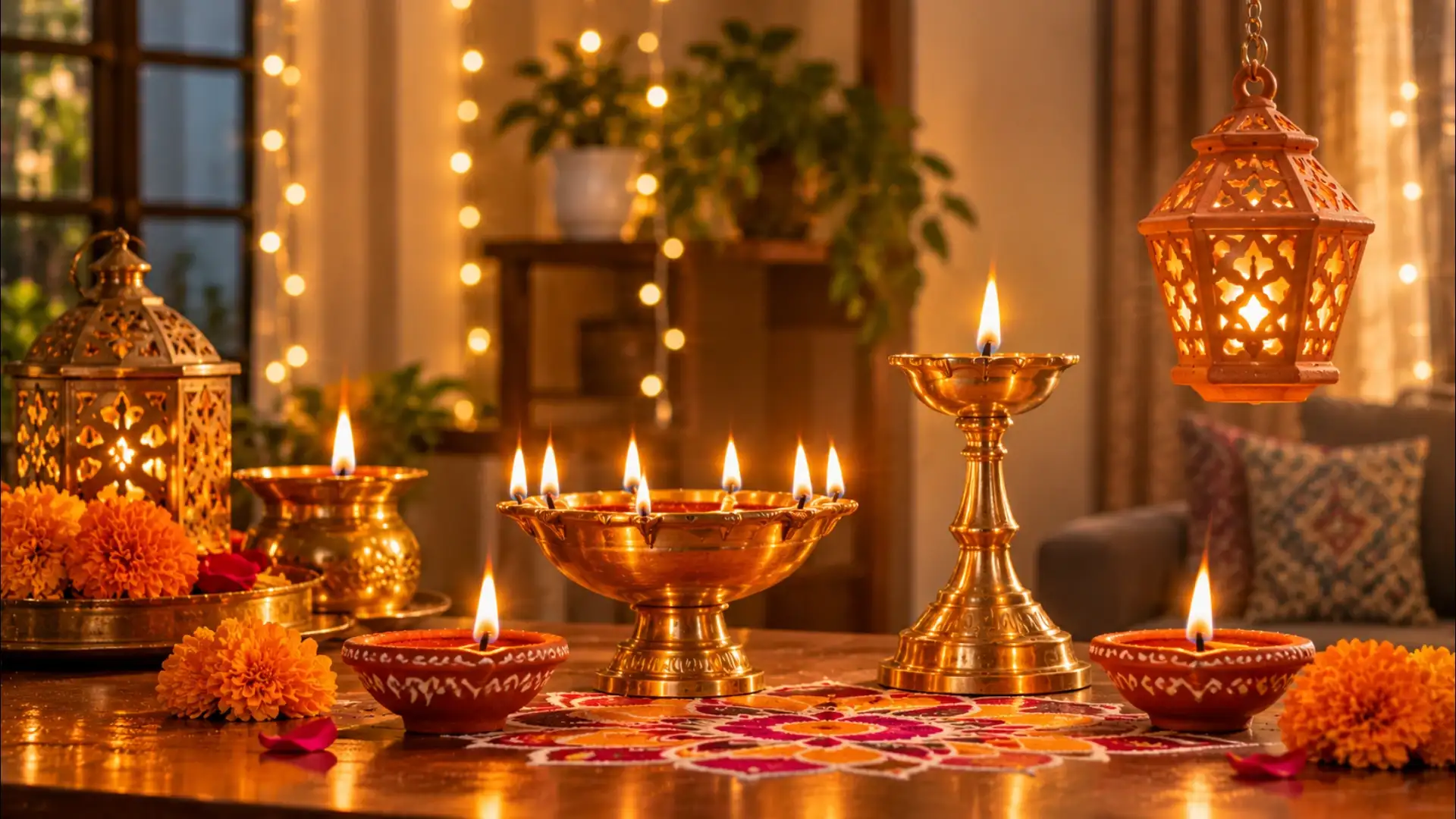
In Hindu tradition, the clay diya carries the five elements: earth in the clay, water used to shape it, fire in the flame, air that feeds the burn, and the space the light opens up. Lighting one is understood as an act of completeness, not just illumination. The diya is also linked to Lakshmi, whose arrival is invited by a clean, lit threshold on the main night of Diwali.
In Vedic tradition, an unbroken flame is understood as the continuous presence of the divine in the home. Letting it die is considered inauspicious, so the lamp is placed where it will not be disturbed by wind, and someone in the household takes responsibility for it. The akhand jyot is also kept in many temples during religious observances, where the same principle applies: the flame is a living presence, not a decoration.
Brass holds heat and does not crack. A brass diya bought at a grandmother's wedding can still be lit at her grandchild's Diwali. That continuity is part of what the material carries, it is not disposable, and it is not meant to be. In vastu shastra, brass is considered a conductor of positive energy, and placing a brass diya at the northeast corner of a room is a common practice during the festival.
Kandils are hung at the entrance of homes during Diwali and the days leading up to it. In Marathi tradition, they are associated with the festival of Narak Chaturdashi, the night before the main Diwali day, when lamps are lit before dawn to mark the defeat of the demon Narakasura. The kandil's glow at the doorway signals a home that is ready to receive the light the festival promises.
In tradition, the deepa Lakshmi is understood as the goddess herself holding the light, which reverses the usual relationship between the worshipper and the lamp. The lamp is not offered to Lakshmi; Lakshmi carries the lamp into the home. This distinction matters to the families who keep these lamps, and it is why the deepa Lakshmi stays on the altar year after year, brought out each Diwali and returned to its place when the festival ends.
Each of these lamps belongs to a different part of Diwali, the threshold, the altar, the doorway, the all-night vigil, the ritual tray. Together they describe a festival that has always understood light not as spectacle but as something placed with intention, in a specific spot, for a specific reason.
The Clay Diya
The clay diya is the lamp most people picture when they think of Diwali. It is made from terracotta, shaped on a wheel or in a mould, and fired just enough to hold its form. Cotton wicks soaked in mustard oil or ghee sit in the shallow bowl and burn with a warm, slightly unsteady flame.In Hindu tradition, the clay diya carries the five elements: earth in the clay, water used to shape it, fire in the flame, air that feeds the burn, and the space the light opens up. Lighting one is understood as an act of completeness, not just illumination. The diya is also linked to Lakshmi, whose arrival is invited by a clean, lit threshold on the main night of Diwali.
The Akhand Jyot
The akhand jyot is a lamp that is kept burning without a break, akhand means unbroken. It is larger than a standard diya, often brass or copper, and uses a thicker wick fed by ghee. Families who keep one tend the flame through the night, adding ghee as needed, making sure it never goes out.In Vedic tradition, an unbroken flame is understood as the continuous presence of the divine in the home. Letting it die is considered inauspicious, so the lamp is placed where it will not be disturbed by wind, and someone in the household takes responsibility for it. The akhand jyot is also kept in many temples during religious observances, where the same principle applies: the flame is a living presence, not a decoration.
The Brass Diya
Brass diyas are passed down through families. They are heavier than clay, shaped by hand or cast in moulds, and often carry engravings of lotus flowers, peacocks, or the footprints of Lakshmi. Some have multiple wicks arranged in a row or a circle; the panch-aarti diya, with five wicks, is used specifically in aarti rituals.Brass holds heat and does not crack. A brass diya bought at a grandmother's wedding can still be lit at her grandchild's Diwali. That continuity is part of what the material carries, it is not disposable, and it is not meant to be. In vastu shastra, brass is considered a conductor of positive energy, and placing a brass diya at the northeast corner of a room is a common practice during the festival.
The Earthen Kandil Lamp
The kandil is a hanging lamp, and in Maharashtra and parts of central India, it is as central to Diwali as the diya is elsewhere. The earthen kandil is a lantern made from thin clay panels joined together, sometimes coloured red and yellow, with a small diya inside that shines through the walls.Kandils are hung at the entrance of homes during Diwali and the days leading up to it. In Marathi tradition, they are associated with the festival of Narak Chaturdashi, the night before the main Diwali day, when lamps are lit before dawn to mark the defeat of the demon Narakasura. The kandil's glow at the doorway signals a home that is ready to receive the light the festival promises.
The Deepa Lakshmi Lamp
The deepa Lakshmi is a lamp shaped in the form of a woman holding a flame, her figure is the stand, and the diya rests in her raised hands or on her head. These lamps are cast in brass or panchdhatu, an alloy of five metals, and are kept on the home altar rather than placed on the floor or the threshold.In tradition, the deepa Lakshmi is understood as the goddess herself holding the light, which reverses the usual relationship between the worshipper and the lamp. The lamp is not offered to Lakshmi; Lakshmi carries the lamp into the home. This distinction matters to the families who keep these lamps, and it is why the deepa Lakshmi stays on the altar year after year, brought out each Diwali and returned to its place when the festival ends.
Each of these lamps belongs to a different part of Diwali, the threshold, the altar, the doorway, the all-night vigil, the ritual tray. Together they describe a festival that has always understood light not as spectacle but as something placed with intention, in a specific spot, for a specific reason.
Next Story