
In the 1980s, red-eared sliders became popular pets: How released turtles established wild populations and began competing with native freshwater turtles


A turtle that once fit neatly into a child’s hand can eventually need a pond, years of care and a surprisingly large amount of food. That is part of the problem with the red-eared slider , a turtle sold as an easy, colorful pet for decades.
When some owners later release these turtles into ponds and lakes, the animals can survive, reproduce and establish populations far from their native range. In places such as New York, Hawaii and California, wildlife researchers have documented populations linked largely to pet releases. The story is not simply about unwanted pets, though. It is about what happens when an animal adapted to one ecosystem suddenly gets access to another.
The tiny turtle that became a pet-trade favorite
The red-eared slider gets its name from the distinctive red stripe behind each eye. As hatchlings, they are tiny, brightly colored and easy to sell.
Their popularity exploded through the 20th-century pet trade. Research published in PLOS One notes that by the early 1970s, roughly 15 million hatchling turtles were being sold annually in the US, with red-eared sliders making up most of that trade.
The pond becomes a new home
Red-eared sliders are remarkably adaptable. They tolerate a wide range of conditions and readily use slow-moving water, ponds, canals and artificial lakes. California wildlife officials say they are frequently found close to urban areas, where pet releases are a major pathway for their introduction.
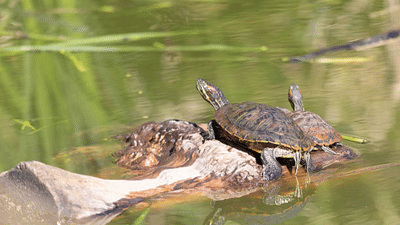
In New York City, DailyMail documented ponds where abandoned red-eared sliders had established themselves. One report described a striking scene: turtles crowding logs in city water bodies, with many of the animals believed to have originated as pets.
Why native turtles can lose out
The issue is not simply that there are more turtles in the pond.
Introduced red-eared sliders can compete with native turtles for food, basking sites and nesting areas. Their success is partly explained by their flexibility. The turtles can eat a broad range of foods, reproduce successfully and tolerate habitats associated with people.
They can also potentially carry diseases and parasites that native turtles have not encountered.
A 2026 Vermont Fish & Wildlife statement on pond sliders warned that introduced sliders can compete with native turtles and may transmit diseases and parasites. The department has advised people not to release unwanted pet turtles into the wild. “Pond slider turtles can outcompete native turtles and cause them to have smaller body sizes, slower growth rates, and higher mortality rates,” said Luke Groff, the lead reptile and amphibian biologist with the department. “Sliders can also transfer diseases and parasites to native turtles. Ultimately, these impacts can result in population declines for our native species.”
The pet trade story did not end in the 1980s
The timing is also more complicated than the popular “1980s pet boom” narrative suggests.
Red-eared sliders had already been major pets for decades before the 1980s. US Geological Survey records say introductions outside their native range have occurred primarily through pet releases and escapes since the 1930s, with introductions peaking around the late-1980s and early-1990s during the Teenage Mutant Ninja Turtles craze.
The trade itself was enormous. California officials report that more than 52 million red-eared sliders were exported from the US to international markets between 1989 and 1997.
And that means today's invasive populations are not necessarily the result of one careless owner. They are the ecological legacy of a decades-long global pet trade.
The important lesson is surprisingly simple
A turtle sitting quietly on a log may look completely at home. But that does not mean it belongs there.
The red-eared slider is native to parts of the Mississippi Valley and surrounding regions. Outside that range, established populations can compete with native turtles and alter local ecosystems. USGS records now document the species far beyond its original distribution.
That is why wildlife agencies repeatedly make the same recommendation: never release an unwanted pet into a pond, lake, river or park.
The animal may survive.
And once it does, the problem is no longer simply about finding a new home for one turtle. It can become about an entire population settling into a place where evolution never intended it to be.
When some owners later release these turtles into ponds and lakes, the animals can survive, reproduce and establish populations far from their native range. In places such as New York, Hawaii and California, wildlife researchers have documented populations linked largely to pet releases. The story is not simply about unwanted pets, though. It is about what happens when an animal adapted to one ecosystem suddenly gets access to another.
The tiny turtle that became a pet-trade favorite
The red-eared slider gets its name from the distinctive red stripe behind each eye. As hatchlings, they are tiny, brightly colored and easy to sell.
Their popularity exploded through the 20th-century pet trade. Research published in PLOS One notes that by the early 1970s, roughly 15 million hatchling turtles were being sold annually in the US, with red-eared sliders making up most of that trade.
The pond becomes a new home
Red-eared sliders are remarkably adaptable. They tolerate a wide range of conditions and readily use slow-moving water, ponds, canals and artificial lakes. California wildlife officials say they are frequently found close to urban areas, where pet releases are a major pathway for their introduction.
In New York City, DailyMail documented ponds where abandoned red-eared sliders had established themselves. One report described a striking scene: turtles crowding logs in city water bodies, with many of the animals believed to have originated as pets.
Why native turtles can lose out
The issue is not simply that there are more turtles in the pond.
Introduced red-eared sliders can compete with native turtles for food, basking sites and nesting areas. Their success is partly explained by their flexibility. The turtles can eat a broad range of foods, reproduce successfully and tolerate habitats associated with people.
They can also potentially carry diseases and parasites that native turtles have not encountered.
A 2026 Vermont Fish & Wildlife statement on pond sliders warned that introduced sliders can compete with native turtles and may transmit diseases and parasites. The department has advised people not to release unwanted pet turtles into the wild. “Pond slider turtles can outcompete native turtles and cause them to have smaller body sizes, slower growth rates, and higher mortality rates,” said Luke Groff, the lead reptile and amphibian biologist with the department. “Sliders can also transfer diseases and parasites to native turtles. Ultimately, these impacts can result in population declines for our native species.”
The pet trade story did not end in the 1980s
The timing is also more complicated than the popular “1980s pet boom” narrative suggests.
Red-eared sliders had already been major pets for decades before the 1980s. US Geological Survey records say introductions outside their native range have occurred primarily through pet releases and escapes since the 1930s, with introductions peaking around the late-1980s and early-1990s during the Teenage Mutant Ninja Turtles craze.
The trade itself was enormous. California officials report that more than 52 million red-eared sliders were exported from the US to international markets between 1989 and 1997.
And that means today's invasive populations are not necessarily the result of one careless owner. They are the ecological legacy of a decades-long global pet trade.
The important lesson is surprisingly simple
A turtle sitting quietly on a log may look completely at home. But that does not mean it belongs there.
The red-eared slider is native to parts of the Mississippi Valley and surrounding regions. Outside that range, established populations can compete with native turtles and alter local ecosystems. USGS records now document the species far beyond its original distribution.
That is why wildlife agencies repeatedly make the same recommendation: never release an unwanted pet into a pond, lake, river or park.
The animal may survive.
And once it does, the problem is no longer simply about finding a new home for one turtle. It can become about an entire population settling into a place where evolution never intended it to be.
Next Story