
India's Freshwater Turtles Are Natural River Cleanup Crew, and They're Disappearing Fast


The biology behind the cleanupIndia has 29 species of freshwater turtles, and several of them are obligate scavengers, meaning their digestive systems are specifically adapted to break down decomposing flesh and organic matter that other animals avoid. The Indian softshell turtle (Nilssonia gangetica) and the Indian flapshell turtle (Lissemys punctata) are among the species documented feeding on carrion in rivers like the Ganga, Yamuna, and Chambal. A single adult softshell turtle can consume several kilograms of organic waste per week. Multiply that across a healthy population and the numbers become ecologically significant.
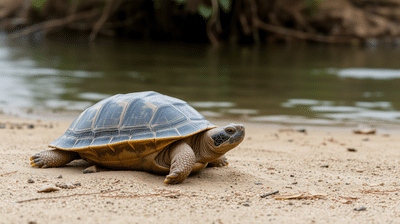 The scavenging function matters because rivers are not static bodies of water. They receive runoff, animal carcasses, agricultural waste, and in many stretches of the Ganga, human remains from incomplete cremations. Without biological cleanup agents, this organic load accumulates, depletes dissolved oxygen, and creates conditions where harmful bacteria proliferate. Turtles are not the only scavengers in this system, gharial, mahseer, and certain catfish species play roles too, but turtles are the most numerous and the most consistent, active across seasons and water depths where other scavengers don't reach.
How turtle populations collapsedThe decline happened through several overlapping pressures, none of them new. Poaching for meat has been documented in Uttar Pradesh, Bihar, and West Bengal for decades. Turtle eggs are collected from sandbanks along the Chambal and Ganga. Fishing nets trap and drown turtles that cannot surface to breathe. Sand mining destroys the riverbank nesting sites that turtles return to year after year, softshell turtles in particular are highly site-faithful, meaning they don't simply relocate when a sandbank disappears.
The Wildlife Protection Act of 1972 lists most Indian freshwater turtle species under Schedule I or Schedule IV, giving them legal protection equivalent to tigers and elephants on paper. Enforcement is a different matter. A 2020 seizure in Uttar Pradesh recovered over 6,000 live turtles packed into sacks destined for markets in West Bengal and beyond, one bust, one route, one year. The trade is not occasional.
What rivers look like when turtles disappearThe Ganga provides the clearest evidence. Stretches of the river where turtle populations have crashed show measurably higher concentrations of coliform bacteria and lower dissolved oxygen than stretches where turtles persist in moderate numbers. The connection is not purely causal, sewage discharge and industrial effluent are the dominant factors in river health, but the removal of biological scavengers removes a layer of resilience the river cannot replace with engineering alone.
In the 1980s, the government of India released thousands of turtles into the Ganga at Varanasi specifically to address the problem of decomposing bodies fouling the river. The Turtle Survival Programme, run through the Uttar Pradesh Forest Department, established turtle rescue and release operations at sites including Sarnath. For a period, it worked. Turtle density in those stretches increased, and observers recorded measurable improvements in water clarity. The programme lost momentum, funding thinned, and poaching pressure continued. The turtles released were not a permanent solution, they were a demonstration of what a functioning population does naturally.
The species most at riskThe red-crowned roofed turtle (Batagur kachuga) is critically endangered, with viable wild populations now confined largely to the Chambal river system. The Ganges softshell turtle (Nilssonia gangetica) is listed as Vulnerable on the IUCN Red List, but field surveys suggest the actual population trajectory is steeper than the listing implies. The peacock softshell turtle (Nilssonia hurum) faces similar pressure.
What makes these losses compounding is that turtles are slow reproducers. A female softshell turtle reaches sexual maturity at roughly 10 to 15 years. She may live for decades and produce eggs every season, but hatchling survival rates in disturbed river systems are low. When adult females are removed from the population, through poaching or bycatch, the population cannot rebound quickly. A river that loses its turtles over 20 years will not get them back in five, even if all poaching stopped tomorrow.
Conservation work that is actually happeningThe Chambal river remains the strongest remaining habitat for freshwater turtles in northern India, partly because it also hosts the gharial, which draws conservation attention and some degree of protection to the same sandbanks turtles use for nesting. The Wildlife Institute of India has conducted population surveys along the Chambal and Ganga, and NGOs including the Turtle Survival Alliance have active field programmes in Bihar and Uttar Pradesh focused on nest protection and community engagement with fishing communities.
Community-based conservation has shown the most durable results. In stretches of the Chambal where local fishermen have been brought into monitoring programmes, paid to report nests and discourage poaching rather than participate in it, nest survival rates have improved substantially. The logic is straightforward: the people who know where the turtles nest are the same people whose livelihoods intersect with the river every day.
The cleanup function that turtles perform is not a service that can be replicated by sewage treatment plants or aeration systems. Those technologies address chemical and bacterial load. They do not consume a floating carcass. The rivers that still have healthy turtle populations are not clean because of turtles alone, but they are measurably more resilient because of them. The species and the river's capacity for self-repair are not separate things. They are the same thing, measured differently.
Next Story