
India's Purple Frog: 46 Weeks Underground, 130 Million Years of Survival, and Two Weeks to Breed


A Species Science Almost MissedThe Purple Frog, Nasikabatrachus sahyadrensis, was formally described by scientists S.D. Biju and Franky Bossuyt in a 2003 paper published in Nature, making it one of the most significant amphibian discoveries of the century. It had been living in the forests of the Western Ghats for millions of years before anyone in the scientific community documented it. Local residents in Kerala and Tamil Nadu knew of it, but the species had no place in any zoological catalogue. That absence is less a failure of science than a consequence of what this frog does: it stays underground for roughly 46 weeks of the year, emerging only when the pre-monsoon rains arrive.
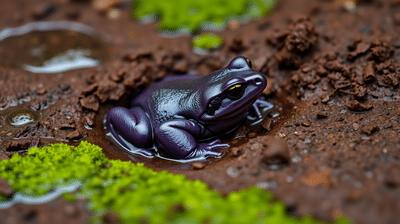 Its body tells you everything about that lifestyle. The Purple Frog is small, dark violet-grey, and shaped like nothing else in its order. It has a bloated, almost spherical torso, a tiny head, and a pointed, pig-like snout adapted for pushing through soil. Its forelimbs are hardened and spade-like. It does not look like a frog built for ponds or tree canopies. It looks like a frog built for the earth. Life Below the SurfaceUnderground, the Purple Frog feeds almost exclusively on termites and ants, using a specialised tongue to extract them from the narrow tunnels of subterranean insect colonies. This is not a frog that waits near a water body for passing insects. It has adapted to hunt in total darkness, several feet below the surface, in the laterite and loam soils of the Ghats.
The burrowing depth varies by season, but studies have recorded individuals at depths of up to 3.7 metres. At that depth, the frog is insulated from temperature swings, predators, and the dry months that would desiccate it above ground. The skin of Nasikabatrachus sahyadrensis secretes a mucus that reduces water loss, a critical adaptation for an animal spending most of its life in soil rather than water. Thirteen Days to Do EverythingWhen the Southwest Monsoon arrives over Kerala, typically in late May or early June, the Purple Frog surfaces. The window is short, sometimes as few as 10 to 14 days. Males call from the edges of fast-moving streams, producing a sound more like a chicken cluck than the deep croak of a common frog. Females, which are considerably larger than males, arrive at the water. Amplexus, the mating embrace, happens in or near the stream, and the female deposits eggs that attach to submerged rocks.
The tadpoles that hatch have a sucker-like mouth, which they use to cling to rocks in the current. This is another unusual adaptation: most frog tadpoles live in still water. The Purple Frog's young are built for fast-moving streams from the moment they hatch. Once metamorphosis is complete, the juveniles disappear into the soil, and the cycle begins again. What 130 Million Years of Isolation Looks LikeThe Purple Frog belongs to the family Nasikabatrachidae, a lineage with only one other member, Nasikabatrachus bhupathi, described in 2017. Its closest living relatives are the Sooglossidae frogs of the Seychelles. The two families diverged when the landmass that would become India separated from the Seychelles microcontinent, an event estimated at around 120 to 130 million years ago. This makes the Purple Frog a genuine living fossil: a species that has retained its basic body plan across geological time while the world around it changed beyond recognition.
The Western Ghats, one of the world's eight hottest biodiversity hotspots, provided the conditions for that survival. The consistent rainfall, deep soils, and intact forest cover of this endemic-rich mountain range gave the species a stable underground world even as surface ecosystems shifted. The frog did not survive by adapting to change. It survived by avoiding it. Why It Matters NowNasikabatrachus sahyadrensis is currently listed as Vulnerable on the IUCN Red List. The threats are the standard ones for endemic Western Ghats species: deforestation, agricultural expansion, and the fragmentation of forest corridors. For a burrowing amphibian that needs intact soil columns and specific stream chemistry for its tadpoles, habitat degradation hits at every stage of its life cycle simultaneously.
Amphibians are among the most extinction-prone vertebrates on the planet. The Purple Frog compounds that general vulnerability with extreme specialisation. It cannot shift its breeding window, cannot relocate to a different stream type, and cannot feed above ground. The two weeks it spends on the surface are the only two weeks anything can go wrong visibly. The rest of the damage happens in the soil, quietly, before anyone notices.
The frog spent 130 million years perfecting a life lived entirely out of sight. The irony is that its survival now depends on whether the things happening above ground, the roads, the plantations, the warming monsoon patterns, leave enough of the underground world intact.
Next Story