
Inside India’s Mountain Villages Where Ancient Water Systems Still Work

Long before pipelines and electric pumps reached remote mountain settlements, Indian villages had already developed ingenious ways to collect, store and distribute water. Across the Himalayas, communities built systems that worked with gravity, springs, melting snow and natural slopes rather than against them. In Uttarakhand, stone-lined naulas captured spring water. In Himachal Pradesh, kuhls carried streams towards agricultural fields. In Ladakh, villagers used zings to store precious meltwater in one of the country's driest landscapes. These Indian villages where people still follow ancient water systems offer more than a glimpse into the past. They demonstrate how local knowledge can become increasingly valuable as climate change puts pressure on modern water supplies.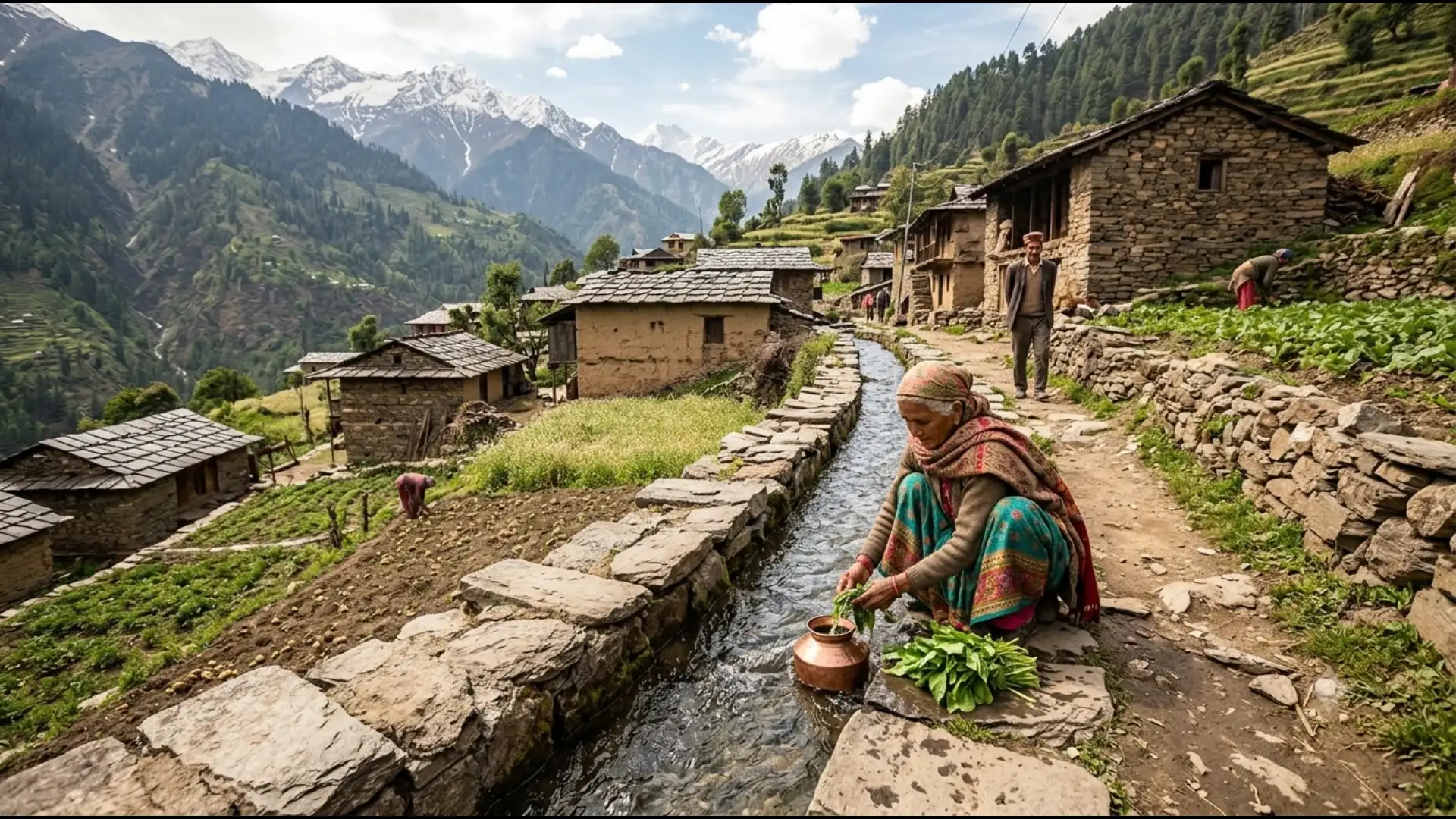
The design was practical but also deeply cultural. Many naulas were built to resemble small temples, with stone carvings and religious associations. Their protected structure helped keep animals and contaminants away from the water.
The system depended on understanding the landscape. Villagers knew which slopes, soils and vegetation were associated with reliable springs, and communities traditionally took responsibility for maintaining these sources.
A kuhl diverts water from a natural stream or mountain channel and guides it towards cultivated terraces. Because the system relies primarily on gravity, it does not require electricity or pumps.
Government documentation records thousands of traditional water sources in Himachal Pradesh, including kuhls, baoris, ponds and other structures. Kuhls have traditionally been used for irrigation and, in some areas, to operate small water mills known as gharats.
The system was also social. In many villages, communities collectively built and maintained the channels, deciding how water would be distributed among farms. Historical records of Kangra's irrigation customs show how these rules were passed down as detailed local knowledge.
Villagers developed zings, small community reservoirs designed to store water that arrives through channels as snow and ice melt. Water could be collected during the day and stored for agricultural use later. Official documentation on traditional Ladakhi water management describes how meltwater was diverted into zings because natural streams often carried usable water only at particular times of the day.
In some communities, a person known as a churpun was responsible for managing distribution and ensuring that available water was shared fairly.
A 2025-26 publication from the Indian Himalayan region also points to naulas, kuhls and zings as examples of passive water harvesting that can operate without mechanical or electrical energy.
At the same time, many traditional systems have declined as piped water, pumps and other modern infrastructure have expanded. Some villages have consequently lost the skills and community arrangements needed to maintain old structures.
These systems were designed around local geography. They used gravity instead of electricity, natural springs instead of deep pumping and community rules instead of complicated distribution networks.
As Himalayan communities face changing rainfall patterns, declining springs and growing water demand, such knowledge could become useful again. Some recent initiatives are already looking at ways to revive traditional systems such as zings and kuhls as climate-resilient solutions.
The real achievement of these villages is not simply that they found ways to collect water. It is that they learned to understand where water moved, when it appeared and how much could safely be taken.
In a world increasingly worried about water scarcity, that old village wisdom may prove to be far more valuable than it first appears.
The Naula: A Water Source Built Like a Temple
In the Kumaon region of Uttarakhand, traditional naulas were designed around naturally occurring springs and underground seepage. These stone-lined structures collected and protected water while allowing villagers to access it through a small stepped entrance.The design was practical but also deeply cultural. Many naulas were built to resemble small temples, with stone carvings and religious associations. Their protected structure helped keep animals and contaminants away from the water.
The system depended on understanding the landscape. Villagers knew which slopes, soils and vegetation were associated with reliable springs, and communities traditionally took responsibility for maintaining these sources.
Kuhls Turn Mountain Streams Into Irrigation
In Himachal Pradesh, another remarkable system developed around kuhls, traditional gravity-fed irrigation channels.A kuhl diverts water from a natural stream or mountain channel and guides it towards cultivated terraces. Because the system relies primarily on gravity, it does not require electricity or pumps.
Government documentation records thousands of traditional water sources in Himachal Pradesh, including kuhls, baoris, ponds and other structures. Kuhls have traditionally been used for irrigation and, in some areas, to operate small water mills known as gharats.
The system was also social. In many villages, communities collectively built and maintained the channels, deciding how water would be distributed among farms. Historical records of Kangra's irrigation customs show how these rules were passed down as detailed local knowledge.
Ladakh’s Ingenious Zing System
Farther north, the challenge is completely different. Ladakh receives very little rainfall, and agriculture depends heavily on snow and glacial meltwater.Villagers developed zings, small community reservoirs designed to store water that arrives through channels as snow and ice melt. Water could be collected during the day and stored for agricultural use later. Official documentation on traditional Ladakhi water management describes how meltwater was diverted into zings because natural streams often carried usable water only at particular times of the day.
In some communities, a person known as a churpun was responsible for managing distribution and ensuring that available water was shared fairly.
Ancient Knowledge Facing a Modern Test
These systems are not simply historical curiosities. A recent review of traditional water systems in the lower Himalayan region highlights their continuing relevance amid seasonal water shortages, changing lifestyles and climate pressures.A 2025-26 publication from the Indian Himalayan region also points to naulas, kuhls and zings as examples of passive water harvesting that can operate without mechanical or electrical energy.
At the same time, many traditional systems have declined as piped water, pumps and other modern infrastructure have expanded. Some villages have consequently lost the skills and community arrangements needed to maintain old structures.
Why These Village Systems Matter Today
The greatest lesson from these Indian villages where people still follow ancient water systems is that sophisticated water management does not always require sophisticated machinery.These systems were designed around local geography. They used gravity instead of electricity, natural springs instead of deep pumping and community rules instead of complicated distribution networks.
As Himalayan communities face changing rainfall patterns, declining springs and growing water demand, such knowledge could become useful again. Some recent initiatives are already looking at ways to revive traditional systems such as zings and kuhls as climate-resilient solutions.
The real achievement of these villages is not simply that they found ways to collect water. It is that they learned to understand where water moved, when it appeared and how much could safely be taken.
In a world increasingly worried about water scarcity, that old village wisdom may prove to be far more valuable than it first appears.
Next Story