
“Kisi maa ke saamne agar uski bachchi mar jae…”: How a plea for an SMA-affected child and her mother reached Jama Masjid and raised money for treatment


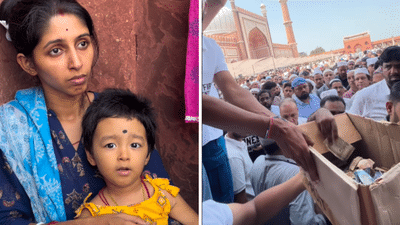
It began with a mother crying for her child on her lap and a few people who stopped to ask what was wrong. When a social media influencer and his friends saw the distressed mother and her toddler outside AIIMS in south Delhi, they decided to find out what had happened. What followed was not a one-time contribution, but an expanding effort to raise money for the child's treatment.
The child has been diagnosed with Spinal Muscular Atrophy (SMA) Type 1, a genetic disorder that affects motor neurons and causes severe muscle weakness. Type 1 is the most severe form and generally develops during infancy.
According to the child's family, her treatment requires a specific injection costing more than ₹9 crore.
“Paani bhi peena pade toh meri beti dekhti hai ki kaun aake isko paani pila dega…” says the child’s mother describing how difficult the little girl’s daily life has become because of the disease. “Baaki saare bachche pura din khelte hain, daudte hain, meri beti pura din bistar par lete rehti hai,” the mother says how other children of the same age run and play while her daughter remains largely confined to bed.
Creator Sunny Mahor (@thodakhalo) and his group first approached people outside the hospital, explaining the family's situation and asking them to contribute. The appeal later moved to Jama Masjid, where they continued asking people to help after Friday prayers.
From asking passersby to a larger campaignAt the beginning, the group was simply approaching passersby outside AIIMS. They explained the child's medical condition and the family's financial difficulties to those willing to listen.
The group decided to fundraise. ““Kisi maa ke saamne agar uski bachchi mar jae…” Sunny shouted as he began asking people for contributions outside AIIMS Delhi .
Later, the campaign then reached Jama Masjid. The group carried photographs and details of the mother and child on T-shirts and displayed a QR code so people could make digital donations.
As people came out after Friday prayers, many stopped to hear the appeal. Many contributed money according to their means.
The effort eventually grew far beyond those who happened to encounter the group in person. Videos and posts about the fundraiser helped take the appeal to social media, where more people could participate.
A fundraiser powered by small and large contributionsThe amont of monet collected is not yet clear, however, the cumulative response to the campaign was huge. People were approached individually, and the campaign made it possible for them to contribute digitally as well.
The appeal keeps movingThere was no elaborate fundraising campaign when the group first encountered the family outside AIIMS. There were simply people willing to stop and hear the story.
That small effort then moved from person to person- first among passersby outside the hospital, then among people leaving Jama Masjid, and eventually across social media.
For now, the fundraiser continues to depend on the same thing that set it in motion: people deciding that they can do something, even if that contribution is small.
The child has been diagnosed with Spinal Muscular Atrophy (SMA) Type 1, a genetic disorder that affects motor neurons and causes severe muscle weakness. Type 1 is the most severe form and generally develops during infancy.
According to the child's family, her treatment requires a specific injection costing more than ₹9 crore.
“Paani bhi peena pade toh meri beti dekhti hai ki kaun aake isko paani pila dega…” says the child’s mother describing how difficult the little girl’s daily life has become because of the disease. “Baaki saare bachche pura din khelte hain, daudte hain, meri beti pura din bistar par lete rehti hai,” the mother says how other children of the same age run and play while her daughter remains largely confined to bed.
Creator Sunny Mahor (@thodakhalo) and his group first approached people outside the hospital, explaining the family's situation and asking them to contribute. The appeal later moved to Jama Masjid, where they continued asking people to help after Friday prayers.
From asking passersby to a larger campaignAt the beginning, the group was simply approaching passersby outside AIIMS. They explained the child's medical condition and the family's financial difficulties to those willing to listen.
The group decided to fundraise. ““Kisi maa ke saamne agar uski bachchi mar jae…” Sunny shouted as he began asking people for contributions outside AIIMS Delhi .
Later, the campaign then reached Jama Masjid. The group carried photographs and details of the mother and child on T-shirts and displayed a QR code so people could make digital donations.
As people came out after Friday prayers, many stopped to hear the appeal. Many contributed money according to their means.
The effort eventually grew far beyond those who happened to encounter the group in person. Videos and posts about the fundraiser helped take the appeal to social media, where more people could participate.
A fundraiser powered by small and large contributionsThe amont of monet collected is not yet clear, however, the cumulative response to the campaign was huge. People were approached individually, and the campaign made it possible for them to contribute digitally as well.
The appeal keeps movingThere was no elaborate fundraising campaign when the group first encountered the family outside AIIMS. There were simply people willing to stop and hear the story.
That small effort then moved from person to person- first among passersby outside the hospital, then among people leaving Jama Masjid, and eventually across social media.
For now, the fundraiser continues to depend on the same thing that set it in motion: people deciding that they can do something, even if that contribution is small.
Next Story