
Why Northeast India Villages Look So Different From the Rest of India

Travellers visiting Northeast India often notice something different before they can put it into words. Villages appear closely connected with forests, houses are adapted to local terrain and weather, community life remains highly visible, and traditional crafts and food continue to play an important role in everyday culture.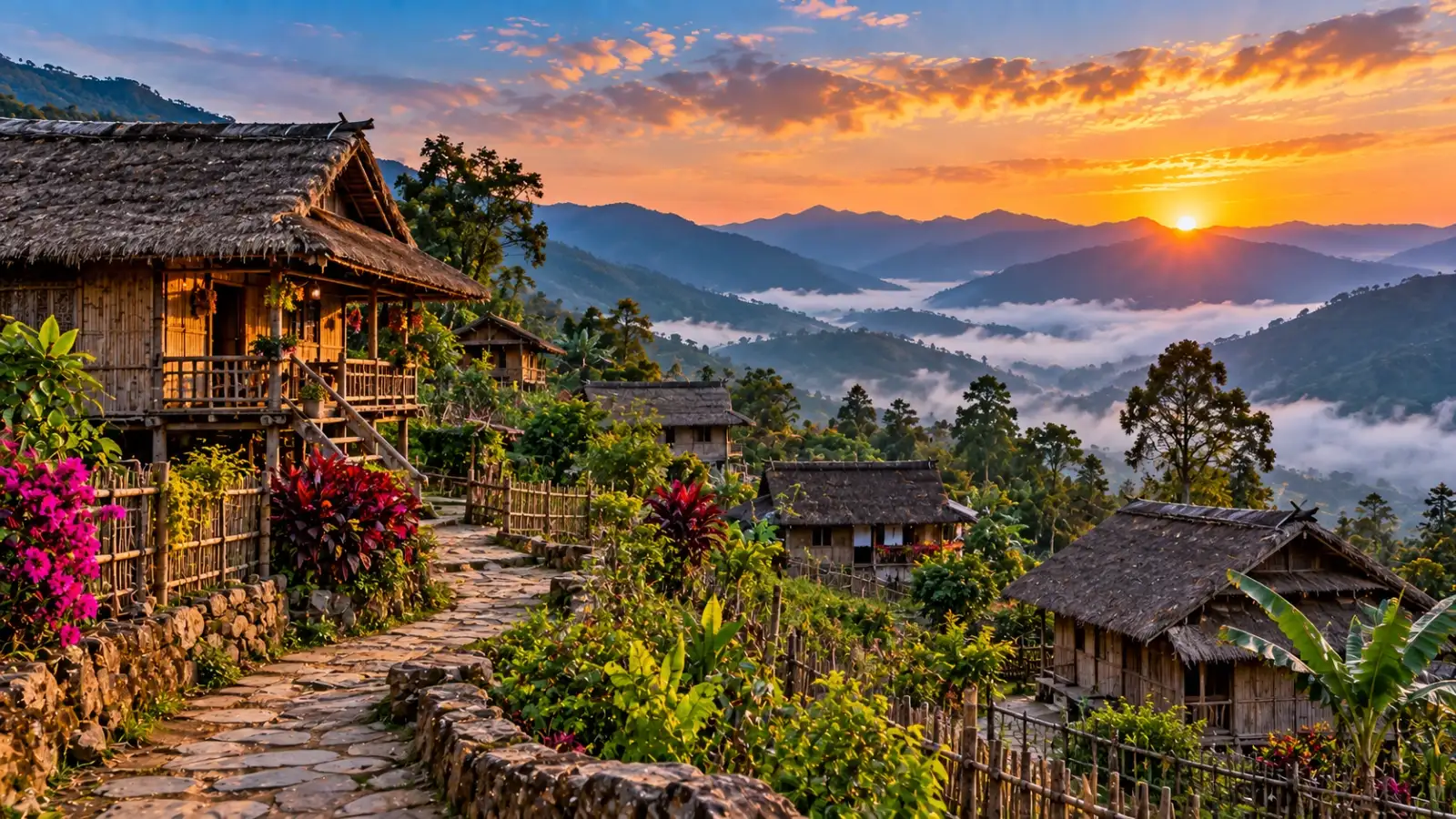
This difference is not the result of a single factor. Northeast India is home to eight states, numerous ethnic communities and a remarkable range of landscapes, from Himalayan valleys and steep hills to river plains, forests and wetlands. The North Eastern Council describes the region as having significant linguistic, ethnic and cultural diversity, including different histories, traditions and systems of community governance.
As a result, there is no single model of a "Northeast Indian village". A settlement in Nagaland can look and function very differently from one in Arunachal Pradesh, Meghalaya, Mizoram or Sikkim. Yet several characteristics help explain why many villages across the region feel distinct from rural landscapes elsewhere in India.
This means villages have developed around very different physical conditions. In Arunachal Pradesh, settlements can be tucked into steep valleys surrounded by mountains and forests. In Meghalaya, villages exist among exceptionally wet landscapes and dense vegetation, while parts of Assam are closely connected with rivers and floodplains.
The North Eastern Council's tourism information highlights the region's varied topography and vegetation, with Arunachal Pradesh alone having multiple tourism circuits distinguished by different ethnic cultures, landscapes and vegetation.
Instead of imposing one architectural or agricultural pattern across the landscape, communities have historically adapted their homes and livelihoods to their particular surroundings.
The design is not simply decorative. It can reflect rainfall, temperature, terrain and available resources. In some areas, houses are raised above the ground, while in others stone and timber construction is better suited to the climate and landscape.
In Sikkim's Kitam village, for example, traditional Limboo houses have been documented as more than 150 years old and use an interlocking stone-and-timber construction technique without nails.
In Mizoram's Zokhua-Falkawn cultural village, traditional Mizo structures include the Lal In, associated with the village chief, and the Zawlbuk, a traditional communal dormitory for young men. These structures demonstrate how buildings could also reflect social organisation and community roles.
The exact system varies considerably between communities. Some villages have traditional councils, customary rules or institutions associated with particular clans, tribes or village groups. These should not be treated as one uniform Northeast Indian system, but they demonstrate how social organisation has often been closely connected with village life.
The North Eastern Council notes that tribal groups across the region have their own cultures, traditions and governance systems.
This helps explain why the village can feel like a stronger social unit in some parts of the Northeast. Community spaces, festivals, agricultural activities and traditional institutions can remain closely interconnected.
Villages may sit directly alongside forests, hills, rivers and community-managed landscapes. This proximity has influenced food gathering, agriculture, construction materials and cultural practices.
The Mawphlang Sacred Grove in Meghalaya is a particularly interesting example. The forest has been protected through traditional religious practices, allowing a distinctive ecosystem of plants and wildlife to survive.
The relationship between communities and natural landscapes is therefore not simply about scenery. In some areas, forests have cultural, spiritual and practical importance at the same time.
Rice cultivation remains important in several parts of the region, but farming systems differ according to local geography. The Apatani cultural landscape around Ziro in Arunachal Pradesh, for example, is associated with distinctive agricultural practices alongside the surrounding hills and pine forests. The North Eastern Council identifies Ziro as the home of the Apatani community and highlights its rice fields and distinctive landscape.
In other areas, terrace cultivation allows farmers to use steep slopes more effectively. Elsewhere, communities have historically relied on shifting cultivation, horticulture, livestock, forest products or combinations of different livelihoods.
The important point is that there is no single agricultural model across Northeast India. Farming reflects local terrain, rainfall, soil and community traditions.
Rice is important across many parts of the Northeast, but the accompanying ingredients and cooking methods can change dramatically from one state or community to another. Bamboo shoots, fermented foods, herbs, chillies, leafy vegetables and locally available meats and fish feature in different regional traditions.
This diversity mirrors the region's broader cultural landscape. The North Eastern Council describes Northeast India as a region with distinct ethnic and cultural heritage rather than a single homogeneous tradition.
For travellers, local food can therefore provide one of the clearest ways to understand the differences between neighbouring communities.
Mizoram's Thenzawl, for example, is identified by the North Eastern Council as an important centre for traditional Mizo handloom production.
Crafts can also be linked to everyday needs rather than being produced solely as souvenirs. Bamboo and cane are used for household objects, baskets, structures and tools in many communities.
This connection between craft and daily life helps keep traditional skills relevant. At the same time, tourism has created new markets for some artisans, allowing certain village-based crafts to reach visitors and wider markets.
Different communities celebrate different festivals, and their meanings vary. Some mark planting or harvesting seasons, while others commemorate historical events, religious traditions or community identity.
Nagaland's villages, for example, are strongly associated with festivals that showcase the traditions of different Naga communities. In Arunachal Pradesh, festivals likewise vary between ethnic groups and regions.
These celebrations are not simply performances created for visitors. Many have deep community significance, although tourism has increasingly provided opportunities for outsiders to experience aspects of these traditions.
Two settlements located relatively close to each other can have different languages, food traditions, clothing, architecture, festivals and customary practices. This is particularly noticeable in states such as Nagaland, Arunachal Pradesh, Manipur and Meghalaya, where multiple communities live within the same state.
The North Eastern Council explicitly notes that cultural and ethnic diversity exists not only between the eight states but also within individual states.
That is why travellers should be careful about describing "Northeast culture" as if it were one unified tradition. The region is better understood as a collection of many distinct cultural landscapes.
Mopungchuket in Nagaland, for example, has been formally recognised as a rural tourism village. It is associated with Ao Naga heritage, forests, riverine ecosystems, tea gardens and community-owned spaces.
Diezephe in Nagaland is another example. Incredible India describes the village as a living representation of Naga heritage, with traditional houses, indigenous materials and historic stone monoliths.
Dzuleke, also in Nagaland, has a relatively small population and is associated with Angami culture, traditional landscapes and community-based tourism experiences.
These examples show that rural tourism in the Northeast can involve much more than simply viewing a scenic village.
Most importantly, the region has never had a single rural culture. Its many communities developed their own responses to different landscapes and historical circumstances.
That is why a village in Nagaland can feel completely different from one in Sikkim, while an Arunachal settlement can differ dramatically from a village in Assam. The differences are not superficial. They are connected to the way communities have adapted to their environment and preserved their cultural identities over generations.
Ask before photographing people or entering private spaces, follow local instructions and avoid treating religious or community traditions as entertainment. Staying with local hosts or using community-based tourism initiatives can also provide a more meaningful experience while supporting residents directly.
The Northeast's villages are fascinating precisely because many retain strong connections between landscape, community and culture. Exploring them with patience and respect offers a much deeper understanding of why this part of India feels so different from the rest of the country.
This difference is not the result of a single factor. Northeast India is home to eight states, numerous ethnic communities and a remarkable range of landscapes, from Himalayan valleys and steep hills to river plains, forests and wetlands. The North Eastern Council describes the region as having significant linguistic, ethnic and cultural diversity, including different histories, traditions and systems of community governance.
As a result, there is no single model of a "Northeast Indian village". A settlement in Nagaland can look and function very differently from one in Arunachal Pradesh, Meghalaya, Mizoram or Sikkim. Yet several characteristics help explain why many villages across the region feel distinct from rural landscapes elsewhere in India.
Geography Shapes Almost Everything
The first major difference is geography. Much of Northeast India is mountainous or hilly, while Assam contains extensive river plains shaped by the Brahmaputra and its tributaries.This means villages have developed around very different physical conditions. In Arunachal Pradesh, settlements can be tucked into steep valleys surrounded by mountains and forests. In Meghalaya, villages exist among exceptionally wet landscapes and dense vegetation, while parts of Assam are closely connected with rivers and floodplains.
The North Eastern Council's tourism information highlights the region's varied topography and vegetation, with Arunachal Pradesh alone having multiple tourism circuits distinguished by different ethnic cultures, landscapes and vegetation.
Instead of imposing one architectural or agricultural pattern across the landscape, communities have historically adapted their homes and livelihoods to their particular surroundings.
Traditional Houses Reflect Local Conditions
Architecture is one of the easiest ways to notice the regional differences. Traditional homes in many Northeast Indian communities make extensive use of materials that are available locally, including bamboo, timber, stone and thatch.The design is not simply decorative. It can reflect rainfall, temperature, terrain and available resources. In some areas, houses are raised above the ground, while in others stone and timber construction is better suited to the climate and landscape.
In Sikkim's Kitam village, for example, traditional Limboo houses have been documented as more than 150 years old and use an interlocking stone-and-timber construction technique without nails.
In Mizoram's Zokhua-Falkawn cultural village, traditional Mizo structures include the Lal In, associated with the village chief, and the Zawlbuk, a traditional communal dormitory for young men. These structures demonstrate how buildings could also reflect social organisation and community roles.
Villages Can Have Strong Community Institutions
Another important difference is the visibility of community life. In several Northeast Indian societies, village institutions have historically played an important role in organising community affairs.The exact system varies considerably between communities. Some villages have traditional councils, customary rules or institutions associated with particular clans, tribes or village groups. These should not be treated as one uniform Northeast Indian system, but they demonstrate how social organisation has often been closely connected with village life.
The North Eastern Council notes that tribal groups across the region have their own cultures, traditions and governance systems.
This helps explain why the village can feel like a stronger social unit in some parts of the Northeast. Community spaces, festivals, agricultural activities and traditional institutions can remain closely interconnected.
Forests Are Often Part of the Village Landscape
In many parts of India, rural settlements are surrounded by farmland, while forests may be located further away. In parts of Northeast India, the distinction can be less pronounced.Villages may sit directly alongside forests, hills, rivers and community-managed landscapes. This proximity has influenced food gathering, agriculture, construction materials and cultural practices.
The Mawphlang Sacred Grove in Meghalaya is a particularly interesting example. The forest has been protected through traditional religious practices, allowing a distinctive ecosystem of plants and wildlife to survive.
The relationship between communities and natural landscapes is therefore not simply about scenery. In some areas, forests have cultural, spiritual and practical importance at the same time.
Agriculture Looks Different Across the Hills
The terrain of Northeast India has also shaped farming practices. Flat agricultural land is not available everywhere, particularly in mountainous states.Rice cultivation remains important in several parts of the region, but farming systems differ according to local geography. The Apatani cultural landscape around Ziro in Arunachal Pradesh, for example, is associated with distinctive agricultural practices alongside the surrounding hills and pine forests. The North Eastern Council identifies Ziro as the home of the Apatani community and highlights its rice fields and distinctive landscape.
In other areas, terrace cultivation allows farmers to use steep slopes more effectively. Elsewhere, communities have historically relied on shifting cultivation, horticulture, livestock, forest products or combinations of different livelihoods.
The important point is that there is no single agricultural model across Northeast India. Farming reflects local terrain, rainfall, soil and community traditions.
Food Traditions Are Extremely Local
Food is another reason Northeast Indian villages can feel different. The region's cuisine varies enormously between communities, and traditional diets often reflect local crops, forests, rivers and livestock practices.Rice is important across many parts of the Northeast, but the accompanying ingredients and cooking methods can change dramatically from one state or community to another. Bamboo shoots, fermented foods, herbs, chillies, leafy vegetables and locally available meats and fish feature in different regional traditions.
This diversity mirrors the region's broader cultural landscape. The North Eastern Council describes Northeast India as a region with distinct ethnic and cultural heritage rather than a single homogeneous tradition.
For travellers, local food can therefore provide one of the clearest ways to understand the differences between neighbouring communities.
Traditional Crafts Remain Closely Connected to Village Life
Handloom and handicraft traditions are another visible feature of many Northeast Indian communities. Weaving is particularly important in several states, with textiles often carrying designs, colours and patterns associated with specific communities.Mizoram's Thenzawl, for example, is identified by the North Eastern Council as an important centre for traditional Mizo handloom production.
Crafts can also be linked to everyday needs rather than being produced solely as souvenirs. Bamboo and cane are used for household objects, baskets, structures and tools in many communities.
This connection between craft and daily life helps keep traditional skills relevant. At the same time, tourism has created new markets for some artisans, allowing certain village-based crafts to reach visitors and wider markets.
Festivals Can Reflect the Agricultural Calendar
Village festivals across Northeast India often reveal the connection between culture, agriculture and community life.Different communities celebrate different festivals, and their meanings vary. Some mark planting or harvesting seasons, while others commemorate historical events, religious traditions or community identity.
Nagaland's villages, for example, are strongly associated with festivals that showcase the traditions of different Naga communities. In Arunachal Pradesh, festivals likewise vary between ethnic groups and regions.
These celebrations are not simply performances created for visitors. Many have deep community significance, although tourism has increasingly provided opportunities for outsiders to experience aspects of these traditions.
Villages Can Preserve Strong Cultural Identities
The Northeast contains an unusually high level of cultural and linguistic diversity within a relatively compact part of India. This is reflected directly in village life.Two settlements located relatively close to each other can have different languages, food traditions, clothing, architecture, festivals and customary practices. This is particularly noticeable in states such as Nagaland, Arunachal Pradesh, Manipur and Meghalaya, where multiple communities live within the same state.
The North Eastern Council explicitly notes that cultural and ethnic diversity exists not only between the eight states but also within individual states.
That is why travellers should be careful about describing "Northeast culture" as if it were one unified tradition. The region is better understood as a collection of many distinct cultural landscapes.
Some Villages Are Becoming Rural Tourism Destinations
Tourism is also changing how some Northeast Indian villages interact with visitors. Several communities have developed rural tourism initiatives that allow travellers to experience local architecture, food, crafts and landscapes.Mopungchuket in Nagaland, for example, has been formally recognised as a rural tourism village. It is associated with Ao Naga heritage, forests, riverine ecosystems, tea gardens and community-owned spaces.
Diezephe in Nagaland is another example. Incredible India describes the village as a living representation of Naga heritage, with traditional houses, indigenous materials and historic stone monoliths.
Dzuleke, also in Nagaland, has a relatively small population and is associated with Angami culture, traditional landscapes and community-based tourism experiences.
These examples show that rural tourism in the Northeast can involve much more than simply viewing a scenic village.
Why Northeast Villages Feel So Different
The distinct appearance and atmosphere of Northeast India's villages come from several factors working together. Geography influences settlement patterns and architecture, climate affects construction, forests shape livelihoods, and community traditions influence everything from food and clothing to festivals and social organisation.Most importantly, the region has never had a single rural culture. Its many communities developed their own responses to different landscapes and historical circumstances.
That is why a village in Nagaland can feel completely different from one in Sikkim, while an Arunachal settlement can differ dramatically from a village in Assam. The differences are not superficial. They are connected to the way communities have adapted to their environment and preserved their cultural identities over generations.
Exploring Northeast Villages Responsibly
Travellers visiting villages in the Northeast should approach them as living communities rather than open-air attractions. Traditional houses, sacred forests, community spaces and ceremonies may have cultural significance that is not immediately obvious to visitors.Ask before photographing people or entering private spaces, follow local instructions and avoid treating religious or community traditions as entertainment. Staying with local hosts or using community-based tourism initiatives can also provide a more meaningful experience while supporting residents directly.
The Northeast's villages are fascinating precisely because many retain strong connections between landscape, community and culture. Exploring them with patience and respect offers a much deeper understanding of why this part of India feels so different from the rest of the country.
Next Story