
Not the inland and coastal taipan snake, a little-known third taipan snake is keeping scientists searching for answers


The inland taipan is famous for having the most toxic snake venom measured in laboratory tests. The coastal taipan has its own fearsome reputation. But Australia's taipan story has a lesser-known chapter, one that begins with a snake initially mistaken for something far more familiar.
In 2006, a snake caught in a remote part of Western Australia was thought to be a western brown snake. A closer examination revealed something unexpected: it belonged to a previously unrecognised species of taipan. Scientists formally described it the following year, naming it the western desert taipan ( Oxyuranus temporalis ). Nearly two decades later, its biology remains poorly understood, as per University of Melbourne.
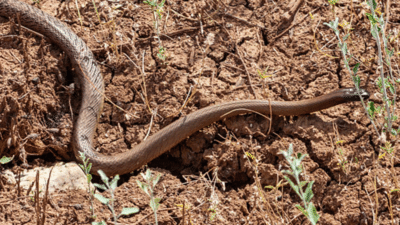
The third taipan was hiding in Australia's remote desertThe western desert taipan was identified in a remote area east of the Walter James Range in Western Australia. Its discovery added a third recognised species to the taipan genus, Oxyuranus, alongside the inland taipan (Oxyuranus microlepidotus) and coastal taipan (Oxyuranus scutellatus).
Unlike its better-known relatives, the western desert taipan has attracted relatively little research. Its known distribution includes parts of Western Australia and the Northern Territory, including the Great Victoria Desert region. It is associated with dry landscapes, sandy plains, dunes and grassland.
That remote habitat is part of what makes the snake difficult to study. Finding an animal is one thing; observing it often enough in the wild to understand its behaviour, diet and reproduction is another. For a species living across sparsely populated desert country, researchers have limited opportunities to build a detailed picture of its life.
What do scientists know about the western desert taipan?The western desert taipan is smaller than the image many people have of a giant taipan. The University of Melbourne's Australian Venom Research Unit lists its length at around 1.2 to 1.6 metres. It has a dark brown or reddish-brown back, often with darker-edged scales that create a net-like or herringbone pattern. Its underside is pale, ranging from white to yellow.
Scientists believe it feeds on small mammals, although the available information is limited. Like other taipans, it lays eggs. But even basic details, including its clutch size and daily activity patterns, remain poorly documented compared with those of better-studied snakes.
And that is what makes this discovery more than a story about another venomous snake. Researchers cannot confidently describe every aspect of an animal's life from its appearance or its relationship to a better-known species. Field observations and further study are needed to fill those gaps.
Is the western desert taipan as venomous as the other two?The western desert taipan belongs to a genus known for potent venom, but it would be misleading to assume its venom works in exactly the same way as that of the inland or coastal taipan.
Preliminary analyses cited by the Australian Venom Research Unit suggest that the western desert taipan's venom differs in composition and activity from the venom of the other two species. Laboratory findings indicate differences in how it affects the nervous system and blood-clotting processes. The available evidence, however, is not a reason to treat the snake as harmless or to make sweeping claims about its relative danger to humans.
No human bites from the western desert taipan had been recorded in the University of Melbourne reference consulted for this article. That does not establish that a bite would be safe. Taipans are dangerously venomous snakes, and any suspected bite requires emergency medical treatment.
A discovery that left more questions than answersThe western desert taipan is a reminder that even a group of snakes as well-known as taipans can contain species about which science knows surprisingly little. Its discovery in 2006 showed that a snake initially mistaken for another species could turn out to be a new member of one of Australia's most notorious snake groups.
For now, the western desert taipan remains the least understood of the three recognised taipan species. Its behaviour, ecology and venom deserve further study, particularly because preliminary findings suggest it may differ from its more familiar relatives in important ways.
The inland and coastal taipans may dominate headlines, but the western desert taipan offers a different kind of story: not simply a reputation for danger, but a scientific mystery playing out across Australia's remote desert landscape.
In 2006, a snake caught in a remote part of Western Australia was thought to be a western brown snake. A closer examination revealed something unexpected: it belonged to a previously unrecognised species of taipan. Scientists formally described it the following year, naming it the western desert taipan ( Oxyuranus temporalis ). Nearly two decades later, its biology remains poorly understood, as per University of Melbourne.
The third taipan was hiding in Australia's remote desertThe western desert taipan was identified in a remote area east of the Walter James Range in Western Australia. Its discovery added a third recognised species to the taipan genus, Oxyuranus, alongside the inland taipan (Oxyuranus microlepidotus) and coastal taipan (Oxyuranus scutellatus).
Unlike its better-known relatives, the western desert taipan has attracted relatively little research. Its known distribution includes parts of Western Australia and the Northern Territory, including the Great Victoria Desert region. It is associated with dry landscapes, sandy plains, dunes and grassland.
That remote habitat is part of what makes the snake difficult to study. Finding an animal is one thing; observing it often enough in the wild to understand its behaviour, diet and reproduction is another. For a species living across sparsely populated desert country, researchers have limited opportunities to build a detailed picture of its life.
What do scientists know about the western desert taipan?The western desert taipan is smaller than the image many people have of a giant taipan. The University of Melbourne's Australian Venom Research Unit lists its length at around 1.2 to 1.6 metres. It has a dark brown or reddish-brown back, often with darker-edged scales that create a net-like or herringbone pattern. Its underside is pale, ranging from white to yellow.
Scientists believe it feeds on small mammals, although the available information is limited. Like other taipans, it lays eggs. But even basic details, including its clutch size and daily activity patterns, remain poorly documented compared with those of better-studied snakes.
And that is what makes this discovery more than a story about another venomous snake. Researchers cannot confidently describe every aspect of an animal's life from its appearance or its relationship to a better-known species. Field observations and further study are needed to fill those gaps.
Is the western desert taipan as venomous as the other two?The western desert taipan belongs to a genus known for potent venom, but it would be misleading to assume its venom works in exactly the same way as that of the inland or coastal taipan.
Preliminary analyses cited by the Australian Venom Research Unit suggest that the western desert taipan's venom differs in composition and activity from the venom of the other two species. Laboratory findings indicate differences in how it affects the nervous system and blood-clotting processes. The available evidence, however, is not a reason to treat the snake as harmless or to make sweeping claims about its relative danger to humans.
No human bites from the western desert taipan had been recorded in the University of Melbourne reference consulted for this article. That does not establish that a bite would be safe. Taipans are dangerously venomous snakes, and any suspected bite requires emergency medical treatment.
A discovery that left more questions than answersThe western desert taipan is a reminder that even a group of snakes as well-known as taipans can contain species about which science knows surprisingly little. Its discovery in 2006 showed that a snake initially mistaken for another species could turn out to be a new member of one of Australia's most notorious snake groups.
For now, the western desert taipan remains the least understood of the three recognised taipan species. Its behaviour, ecology and venom deserve further study, particularly because preliminary findings suggest it may differ from its more familiar relatives in important ways.
The inland and coastal taipans may dominate headlines, but the western desert taipan offers a different kind of story: not simply a reputation for danger, but a scientific mystery playing out across Australia's remote desert landscape.
Next Story