
From Touch-Sensitive Leaves to Explosive Pods: Plants That Can Move Without Muscles

When we visualize the natural world, we tend to split living organisms into two neat categories. Animals are active creatures that run, leap, and hunt using complex nervous systems and muscular tissues. Flora , on the other hand, is usually viewed as stationary, rooted firmly in the soil and standing completely still while weather patterns shift overhead. However, this common assumption overlooks a fascinating biological reality. The plant kingdom is full of remarkable species that jump, snap, fold, and dance in response to environmental stimuli. What makes these physical feats so astonishing is that botanical organisms accomplish them without a single muscle cell, nerve fibre, or joint. Exploring plants that can move without muscles reveals how changes in water pressure, clever cellular design, and stored mechanical energy allow vegetation to move with incredible precision and speed.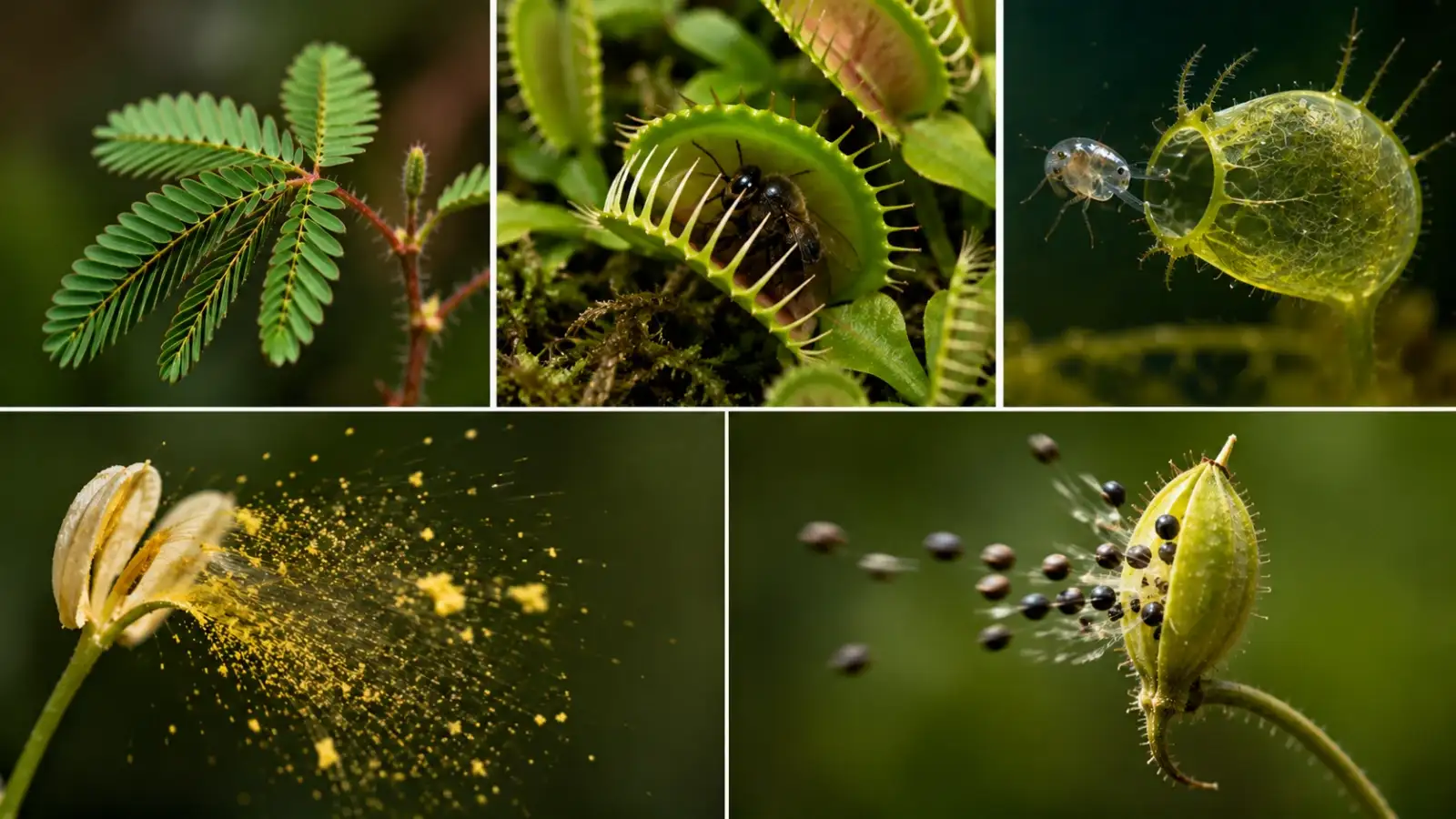
A famous example of this hydraulic mechanism is Mimosa pudica , commonly known as the sensitive plant. When a grazing animal or human finger touches its delicate green leaflets, microscopic hair triggers send an electrical signal through the stem. This signal prompts potassium ions to flood out of specialized joint-like organs called pulvini located at the leaf bases. Water immediately follows the shifting salts through osmosis. As water drains out, the cells deflate like tiny balloons, causing the leaves to fold inward and droop instantly. This sudden defensive collapsing motion deters hungry herbivores and shakes off unwanted insects.
Even faster motion occurs in aquatic carnivorous species like bladderworts . These tiny water plants feature submerged vacuum bladders fitted with airtight trapdoors. The plant pumps water out of the bladder, creating a strong internal vacuum. When a tiny water flea touches external trigger bristles, the trapdoor opens. The surrounding water rushes into the chamber, sucking the prey inside in less than a single millisecond.
Similarly, plants like the touch-me-not squeeze water into specialized pod tissues as their seeds ripen. The pod walls build up immense internal tension until a minor bump or brush triggers a violent pop. The pod splits open and twists tightly, flinging seeds several metres away from the parent plant to prevent overcrowded root competition.
The hydraulic engine of turgor pressure and touch-sensitive leaves
The primary driving force behind many rapid botanical movements is a hydraulic process involving turgor pressure. Plants fill their cells with water, which pushes outward against rigid cell walls to keep stems and leaves upright. To create motion, certain species manipulate this water pressure at lightning speed.A famous example of this hydraulic mechanism is Mimosa pudica , commonly known as the sensitive plant. When a grazing animal or human finger touches its delicate green leaflets, microscopic hair triggers send an electrical signal through the stem. This signal prompts potassium ions to flood out of specialized joint-like organs called pulvini located at the leaf bases. Water immediately follows the shifting salts through osmosis. As water drains out, the cells deflate like tiny balloons, causing the leaves to fold inward and droop instantly. This sudden defensive collapsing motion deters hungry herbivores and shakes off unwanted insects.
You may also like
- When it comes to protein, it's about eating appropriately, not eating more, say experts
- Anand Mahindra says, “How could this state not be on top of the travel bucket list?” as 5-year-old Yato Wangnao stuns the world with his National Anthem
- A town in the Netherlands will not let you live there unless you grow food on at least half of your land
- How your daily UAE commute could expose skin to sun damage; experts weigh in
- From beauty to self-care: Cosmetics are becoming everyday essentials
Snap traps and explosive mechanical spring triggers
While turgor pressure manages moderate movements, carnivorous species use clever structural design to achieve extreme acceleration. The Venus flytrap features modified leaf lobes shaped like clamshells lined with sensitive trigger hairs. When an unsuspecting insect steps onto the inner trap surface and touches two trigger hairs within a short window, the plant releases stored mechanical energy. The curved leaf lobes instantly snap from convex to concave, trapping the insect in a fraction of a second.Even faster motion occurs in aquatic carnivorous species like bladderworts . These tiny water plants feature submerged vacuum bladders fitted with airtight trapdoors. The plant pumps water out of the bladder, creating a strong internal vacuum. When a tiny water flea touches external trigger bristles, the trapdoor opens. The surrounding water rushes into the chamber, sucking the prey inside in less than a single millisecond.
Catapulting pollen and explosive seed dispersal strategies
Vegetation also relies on rapid mechanical movements to reproduce and spread its offspring over wide distances. The white mulberry tree holds a world record for explosive botanical motion. Its flowers store elastic tension in their stamens like tiny catapults. When fully mature, the stamens release instantly, firing pollen into the air at over half the speed of sound.Similarly, plants like the touch-me-not squeeze water into specialized pod tissues as their seeds ripen. The pod walls build up immense internal tension until a minor bump or brush triggers a violent pop. The pod splits open and twists tightly, flinging seeds several metres away from the parent plant to prevent overcrowded root competition.
Celebrating the hidden biomechanics of the botanical world
Uncovering the secrets of plants that can move without muscles completely changes how we view nature. Far from being passive objects fixed in the earth, vegetation uses fluid dynamics, elastic mechanics, and structural design to interact dynamically with its environment. Observing these quiet hydraulic marvels reminds us that nature finds brilliant ways to thrive through engineering feats that rival the animal kingdom.





Loving Newspoint? Download the app now
