
10 Remote Islands Where Life Still Feels Far Away From the Modern World

Modern life has made it possible to travel, communicate and work across enormous distances with very little effort. Yet there are still islands where geography creates a very different rhythm. Reaching some of them can require days at sea, limited transport options or special permission, while their small communities have developed ways of living that are closely connected to the surrounding ocean.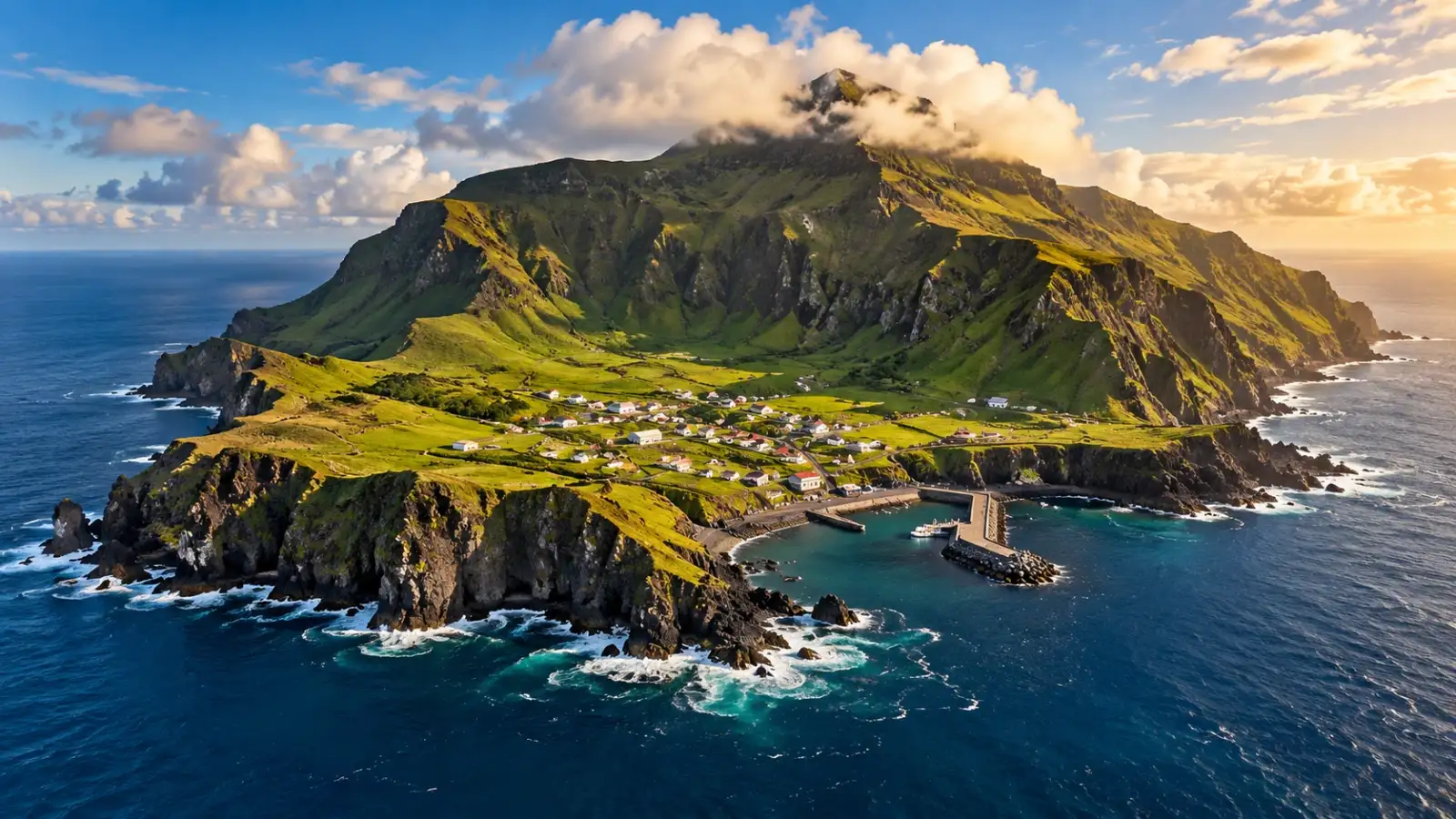
These islands are not frozen in time. Many have electricity, telephones, internet connections and modern healthcare facilities. What makes them feel so distant is the combination of geography, small populations, limited transport and the enormous stretches of ocean separating them from major cities.
From the South Atlantic to the Pacific and the Arctic, these remote islands reveal just how varied island life can be. Some are home to tiny permanent communities, while others are uninhabited wildernesses where nature has developed with remarkably little human interference.
There is no airport. Visitors have to travel by sea, with scheduled vessels generally departing from Cape Town. The voyage can take up to a week and can become longer when weather conditions interfere with the journey. Even after reaching the island, boats usually anchor offshore because larger vessels cannot enter the harbour.
This distance affects almost every aspect of life. Supplies arrive by ship, travel has to be planned carefully and visitors are limited by available berths. The island has a close-knit community and a landscape dominated by the enormous volcanic peak of Queen Mary's Peak.
For a traveller accustomed to airports, motorways and frequent public transport, Tristan da Cunha represents a radically different relationship with distance.
The island has a very small population and is the only inhabited island in the Pitcairn group. Its residents are descendants of the HMS Bounty mutineers and their Tahitian companions, giving the community a distinctive history that remains an important part of local identity.
Getting there is part of the experience. Visitors currently travel aboard the island's passenger and supply vessel, with tourism authorities publishing sailing schedules and offering stays lasting several days or more. There are no conventional international airports bringing a constant flow of tourists.
Despite its isolation, Pitcairn is not completely disconnected from modern technology. Internet access is available, showing that physical remoteness and digital connectivity can exist side by side. What remains unusual is the sheer distance separating the community from the rest of the world.
The island's isolation has played an important role in its natural history. Its government notes that more than 500 species of plants and animals found on St Helena occur nowhere else on Earth. The island also contains the last natural cloud forest on British soil.
Modern St Helena is connected to the outside world and receives regular sea freight, but its distance still shapes everyday life. Supplies, transport and travel require considerably more planning than they would on a mainland destination.
For visitors, that slower pace is part of the attraction. Instead of moving through a densely populated tourist destination, travellers encounter a small community surrounded by an enormous expanse of ocean.
The island is an elevated coral atoll with no major landmass within roughly 5,000 kilometres. Its isolation has allowed distinctive plants and animals to survive, including several endemic bird and plant species. UNESCO describes Henderson as one of the world's best remaining examples of an elevated coral atoll ecosystem.
There is very little here in the conventional sense of civilisation. No towns, hotels or permanent modern infrastructure define the island. Instead, limestone cliffs, beaches, vegetation and seabird colonies dominate the landscape.
Henderson demonstrates that remoteness does not always mean living far away from modern society. Sometimes it means having almost no permanent human society at all.
The islands are separated from the wider world by roughly 2,000 nautical miles of open ocean and are exposed to some of the fiercest weather in the region. UNESCO describes Gough and Inaccessible as among the most pristine environments remaining on Earth.
Gough is not a normal tourist destination. The island is managed as a protected wildlife reserve, with activities focused on conservation, scientific research and weather monitoring. Permission to land is tightly controlled, and access is particularly restricted because of the site's ecological importance.
The island is home to important seabird populations, including albatrosses, petrels and the Northern Rockhopper Penguin. Its isolation has also allowed numerous plants and animals found nowhere else to survive.
The island is part of the UNESCO World Heritage property covering Gough and Inaccessible Islands. Its protected status means that human activity is extremely limited, with conservation and research taking priority.
One of its remarkable features is the absence of introduced mammals. That is particularly significant on oceanic islands, where introduced species can dramatically alter ecosystems. The island therefore provides scientists with an opportunity to study relatively undisturbed island ecology.
For travellers, Inaccessible Island is not about checking into a remote resort. Its value lies in remaining largely wild.
The landscape is dominated by mountains, glaciers, windswept plains and an extremely cold maritime climate. There are research and scientific facilities, but there is no conventional island town with a large permanent population.
Kerguelen's distance from major population centres creates an environment where scientific logistics matter enormously. Getting people, equipment and supplies to the islands requires carefully organised transport, while the weather can make movement difficult.
The result is an environment that feels less like a conventional destination and more like a remote scientific frontier. It is a reminder that there are still parts of the planet where human presence remains small compared with the surrounding wilderness.
The island's small population and distance from larger centres mean that everyday life is closely connected to the sea. Fishing, boats, weather and supply movements become much more important when there is no major urban centre nearby.
What makes places like Palmerston fascinating is the way community life becomes highly visible. In a large city, neighbours can easily remain strangers. On a tiny island, social connections, family relationships and shared responsibilities can become central to everyday existence.
The result is a lifestyle that feels dramatically different from the anonymous rhythm of a modern metropolis.
There is no conventional civilian settlement or tourism industry comparable with mainland destinations. Instead, the island has a small permanent or rotating presence connected to Norwegian administration, meteorological observation and other essential operations.
The surrounding North Atlantic weather can be harsh, while the volcanic landscape and high latitude create an environment that feels far removed from everyday European life.
Jan Mayen is particularly striking because of the contrast between its isolation and its location within a technologically advanced country. It demonstrates that modern infrastructure can reach remarkably remote places without turning them into conventional towns.
On Tristan da Cunha, a journey to the nearest mainland city involves thousands of kilometres of ocean. On Pitcairn, supplies and visitors depend heavily on shipping. On protected islands such as Henderson and Gough, the absence of permanent settlements allows natural systems to dominate.
That separation changes the meaning of ordinary things. A delivery is not simply a van arriving at a door. Fresh supplies may depend on a ship reaching the island. A medical emergency may involve complex evacuation arrangements. A change in weather can affect travel plans for days.
At the same time, these islands demonstrate that isolation does not necessarily mean being trapped in the past. People can have internet connections, modern medicine and contemporary communications while still living thousands of kilometres from the nearest major city.
Perhaps that is what makes remote islands so fascinating. They show that modern life is not one single experience. There are still communities and landscapes where the ocean remains the dominant geographical fact, where distance cannot simply be ignored and where the outside world feels genuinely far away.
These islands are not frozen in time. Many have electricity, telephones, internet connections and modern healthcare facilities. What makes them feel so distant is the combination of geography, small populations, limited transport and the enormous stretches of ocean separating them from major cities.
From the South Atlantic to the Pacific and the Arctic, these remote islands reveal just how varied island life can be. Some are home to tiny permanent communities, while others are uninhabited wildernesses where nature has developed with remarkably little human interference.
Tristan da Cunha Is One of the Most Isolated Inhabited Places on Earth
Deep in the South Atlantic, Tristan da Cunha is famous for being one of the world's most isolated inhabited islands. Its main settlement, Edinburgh of the Seven Seas, sits on a volcanic island thousands of kilometres from the nearest mainland. The island government describes it as the world's most isolated settlement.There is no airport. Visitors have to travel by sea, with scheduled vessels generally departing from Cape Town. The voyage can take up to a week and can become longer when weather conditions interfere with the journey. Even after reaching the island, boats usually anchor offshore because larger vessels cannot enter the harbour.
This distance affects almost every aspect of life. Supplies arrive by ship, travel has to be planned carefully and visitors are limited by available berths. The island has a close-knit community and a landscape dominated by the enormous volcanic peak of Queen Mary's Peak.
For a traveller accustomed to airports, motorways and frequent public transport, Tristan da Cunha represents a radically different relationship with distance.
Pitcairn Island Has a Tiny Community in the Middle of the Pacific
Pitcairn is one of the world's most famous remote inhabited islands, partly because of its unusual history and partly because of its extraordinary location. It lies in the South Pacific, roughly 2,170 kilometres south-east of Tahiti, while the nearest major administrative centre is thousands of kilometres away in New Zealand.The island has a very small population and is the only inhabited island in the Pitcairn group. Its residents are descendants of the HMS Bounty mutineers and their Tahitian companions, giving the community a distinctive history that remains an important part of local identity.
Getting there is part of the experience. Visitors currently travel aboard the island's passenger and supply vessel, with tourism authorities publishing sailing schedules and offering stays lasting several days or more. There are no conventional international airports bringing a constant flow of tourists.
Despite its isolation, Pitcairn is not completely disconnected from modern technology. Internet access is available, showing that physical remoteness and digital connectivity can exist side by side. What remains unusual is the sheer distance separating the community from the rest of the world.
St Helena Feels Like a World Suspended in the South Atlantic
St Helena sits roughly 1,200 miles from Africa and 1,800 miles from South America, making it one of the world's more remote inhabited islands. The British Overseas Territory is small, but its landscape is surprisingly varied, ranging from rugged coastlines to green uplands and cloud-covered areas.The island's isolation has played an important role in its natural history. Its government notes that more than 500 species of plants and animals found on St Helena occur nowhere else on Earth. The island also contains the last natural cloud forest on British soil.
Modern St Helena is connected to the outside world and receives regular sea freight, but its distance still shapes everyday life. Supplies, transport and travel require considerably more planning than they would on a mainland destination.
For visitors, that slower pace is part of the attraction. Instead of moving through a densely populated tourist destination, travellers encounter a small community surrounded by an enormous expanse of ocean.
Henderson Island Is a Wilderness Rather Than a Conventional Travel Destination
Henderson Island is part of the Pitcairn group, but unlike Pitcairn itself, it is uninhabited. Its remoteness has helped preserve an unusually intact ecosystem, and UNESCO recognises it as a World Heritage Site.The island is an elevated coral atoll with no major landmass within roughly 5,000 kilometres. Its isolation has allowed distinctive plants and animals to survive, including several endemic bird and plant species. UNESCO describes Henderson as one of the world's best remaining examples of an elevated coral atoll ecosystem.
There is very little here in the conventional sense of civilisation. No towns, hotels or permanent modern infrastructure define the island. Instead, limestone cliffs, beaches, vegetation and seabird colonies dominate the landscape.
Henderson demonstrates that remoteness does not always mean living far away from modern society. Sometimes it means having almost no permanent human society at all.
Gough Island Exists Almost Entirely for Nature and Research
Gough Island is another South Atlantic outpost where the feeling of being cut off from modern civilisation is extreme. It forms part of the Tristan da Cunha group and is recognised by UNESCO alongside Inaccessible Island for its exceptional ecological importance.The islands are separated from the wider world by roughly 2,000 nautical miles of open ocean and are exposed to some of the fiercest weather in the region. UNESCO describes Gough and Inaccessible as among the most pristine environments remaining on Earth.
Gough is not a normal tourist destination. The island is managed as a protected wildlife reserve, with activities focused on conservation, scientific research and weather monitoring. Permission to land is tightly controlled, and access is particularly restricted because of the site's ecological importance.
The island is home to important seabird populations, including albatrosses, petrels and the Northern Rockhopper Penguin. Its isolation has also allowed numerous plants and animals found nowhere else to survive.
Inaccessible Island Is Almost Exactly What Its Name Suggests
Also belonging to the Tristan da Cunha group, Inaccessible Island offers one of the clearest examples of how geography can keep humans at a distance. It is a protected wilderness rather than a populated island, and its name reflects the difficult conditions involved in reaching it.The island is part of the UNESCO World Heritage property covering Gough and Inaccessible Islands. Its protected status means that human activity is extremely limited, with conservation and research taking priority.
One of its remarkable features is the absence of introduced mammals. That is particularly significant on oceanic islands, where introduced species can dramatically alter ecosystems. The island therefore provides scientists with an opportunity to study relatively undisturbed island ecology.
For travellers, Inaccessible Island is not about checking into a remote resort. Its value lies in remaining largely wild.
Kerguelen Islands Feel More Like the Edge of the Planet Than a Holiday Destination
Far into the southern Indian Ocean lies the Kerguelen archipelago, a collection of rugged islands belonging to the French Southern and Antarctic Lands. The main island is enormous compared with many other remote islands, but permanent civilian settlement is absent.The landscape is dominated by mountains, glaciers, windswept plains and an extremely cold maritime climate. There are research and scientific facilities, but there is no conventional island town with a large permanent population.
Kerguelen's distance from major population centres creates an environment where scientific logistics matter enormously. Getting people, equipment and supplies to the islands requires carefully organised transport, while the weather can make movement difficult.
The result is an environment that feels less like a conventional destination and more like a remote scientific frontier. It is a reminder that there are still parts of the planet where human presence remains small compared with the surrounding wilderness.
Palmerston Island Is a Tiny Pacific Community Built Around the Ocean
Palmerston Island in the Cook Islands is another example of an extremely small Pacific community whose geography influences everyday life. Unlike large tropical destinations built around mass tourism, Palmerston is a tiny coral atoll spread across a vast area of ocean.The island's small population and distance from larger centres mean that everyday life is closely connected to the sea. Fishing, boats, weather and supply movements become much more important when there is no major urban centre nearby.
What makes places like Palmerston fascinating is the way community life becomes highly visible. In a large city, neighbours can easily remain strangers. On a tiny island, social connections, family relationships and shared responsibilities can become central to everyday existence.
You may also like
- 4 Hacks to keep your kitchen free from flies and bugs
- Throwing away egg shells? Reuse these shells in these easy ways
- Psychology says children behave differently with each parent for a reason; what it may reveal about their emotional comfort
- Today's Birthday : 27th September 2026
- Alia Bhatt brings old-world glamour to Manish Malhotra's Mijwan fashion show in ivory Chikankari
The result is a lifestyle that feels dramatically different from the anonymous rhythm of a modern metropolis.
Jan Mayen Is a Volcanic Island in the North Atlantic
Far to the north, Jan Mayen offers a completely different vision of isolation. The Norwegian island lies between Iceland and Greenland and is dominated by the enormous Beerenberg volcano.There is no conventional civilian settlement or tourism industry comparable with mainland destinations. Instead, the island has a small permanent or rotating presence connected to Norwegian administration, meteorological observation and other essential operations.
The surrounding North Atlantic weather can be harsh, while the volcanic landscape and high latitude create an environment that feels far removed from everyday European life.
Jan Mayen is particularly striking because of the contrast between its isolation and its location within a technologically advanced country. It demonstrates that modern infrastructure can reach remarkably remote places without turning them into conventional towns.
Why Remote Islands Feel So Different From the Rest of the World
The strongest sense of isolation on these islands does not necessarily come from a lack of technology. It comes from distance.On Tristan da Cunha, a journey to the nearest mainland city involves thousands of kilometres of ocean. On Pitcairn, supplies and visitors depend heavily on shipping. On protected islands such as Henderson and Gough, the absence of permanent settlements allows natural systems to dominate.
That separation changes the meaning of ordinary things. A delivery is not simply a van arriving at a door. Fresh supplies may depend on a ship reaching the island. A medical emergency may involve complex evacuation arrangements. A change in weather can affect travel plans for days.
At the same time, these islands demonstrate that isolation does not necessarily mean being trapped in the past. People can have internet connections, modern medicine and contemporary communications while still living thousands of kilometres from the nearest major city.
Perhaps that is what makes remote islands so fascinating. They show that modern life is not one single experience. There are still communities and landscapes where the ocean remains the dominant geographical fact, where distance cannot simply be ignored and where the outside world feels genuinely far away.






Loving Newspoint? Download the app now
