
The Forgotten Art of Making Sun-Dried Foods in Indian Homes

There was a time when an Indian summer was not only about rising temperatures, mangoes and long afternoons.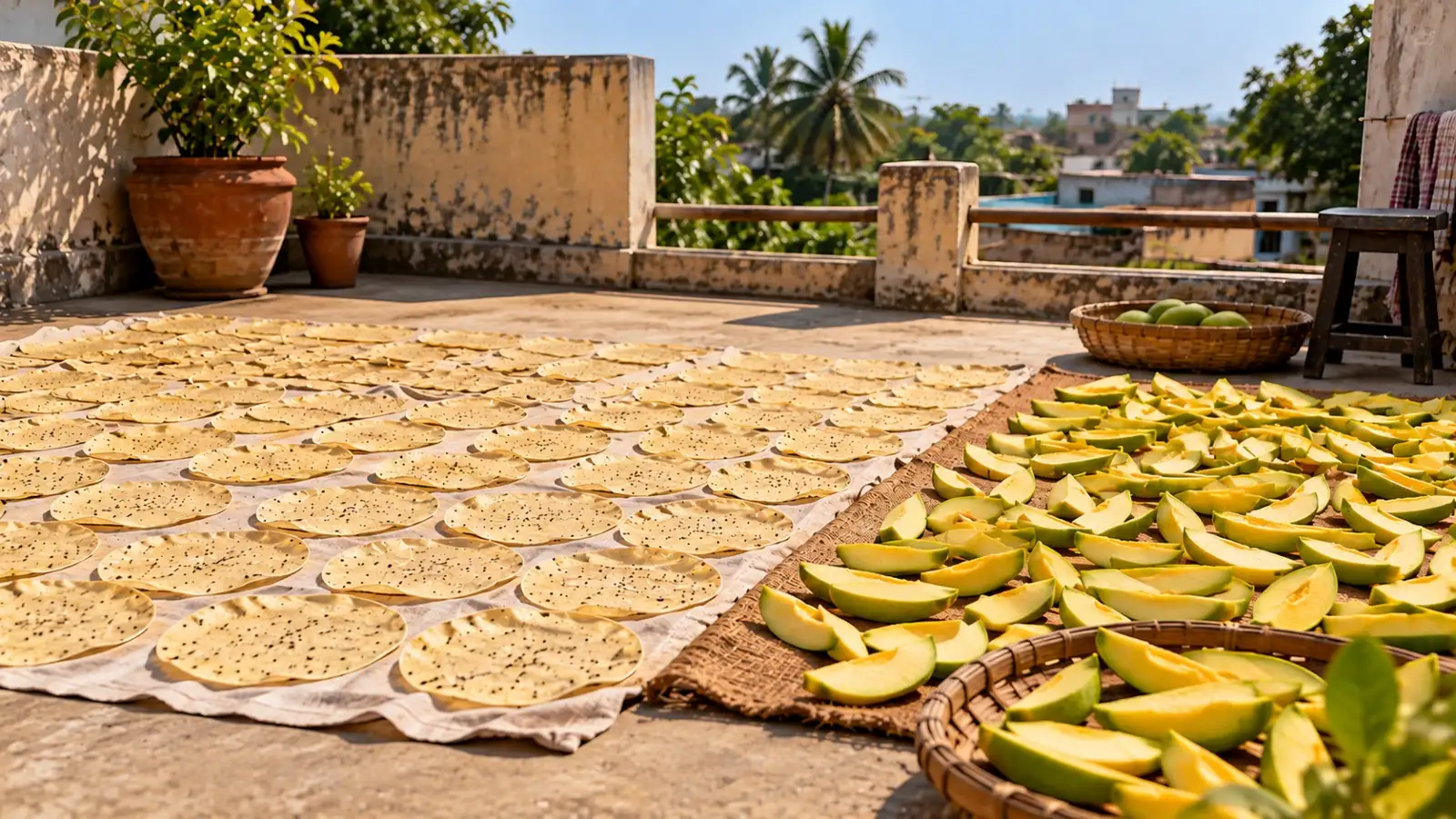
For many households, it was also the season for preparing food that would be eaten months later.
Rooftops, balconies, courtyards and verandahs could become temporary food-processing spaces. Women would wash, slice, season, shape and spread ingredients out in the sun, carefully timing the process according to the weather.
Papad would be laid out in rows. Badi would dry on large trays. Raw mangoes could be transformed into dried pieces and powders. Vegetables were sometimes sliced and dehydrated for use when the fresh produce was no longer available.
This was not simply a culinary tradition.
It was a practical preservation system developed around India's climate, seasonal harvests and household routines.
Fresh food contains considerable moisture, and removing much of that moisture can slow deterioration. Traditional Indian households learned to combine sunlight, airflow, salt, spices and careful storage to extend the usable life of seasonal ingredients.
The technique varied from region to region.
Some foods were sliced thinly. Others were shaped into small portions. Certain preparations were salted or spiced before drying.
The basic idea remained remarkably simple.
Prepare the food, expose it to suitable sunlight and airflow, allow it to dry properly and store it for later use.
Modern food-processing research still uses dehydration as a way of extending the shelf life of agricultural produce. ICAR, for example, documents domestic preparation of dehydrated potato products and notes that properly dried potato slices can be stored for extended periods in airtight containers.
Depending on the region, households have traditionally prepared papad using ingredients such as lentils, black gram, rice or other flour-based mixtures.
The dough is seasoned, shaped into thin discs and dried before storage.
Once properly dried, the papad can be kept for later use and cooked when required.
What makes the tradition interesting is that papad preparation was often not a one-day kitchen task. Large batches could be prepared when the weather was suitable, turning a seasonal household activity into a form of food planning.
ICAR publications also include papad among dehydrated food products that can be prepared and stored.
Pulse-based mixtures are seasoned, shaped into small pieces and dried in sunlight.
Once completely dry, they can be stored and later added to curries and other dishes.
The advantage was obvious for households managing seasonal ingredients.
Instead of relying entirely on fresh vegetables every day, a pantry could contain dried preparations that could be cooked whenever required.
Traditional badi-making also demonstrates how preservation was connected with local food habits. The ingredients and seasonings differed across regions, but the underlying principle was similar.
Drying provided one way of extending the usefulness of the fruit.
Raw mango could be cut into pieces and dried to make preparations such as amchur, a souring ingredient used in numerous Indian dishes.
The fruit could also be preserved in other forms using combinations of drying, salt and spices.
This meant that the flavour of summer could remain in the kitchen long after the fresh mango season had ended.
The idea was particularly useful in regions where families traditionally prepared large quantities of seasonal ingredients for later consumption.
Seasonal produce could be sliced into thin pieces and dried when there was plenty available.
Depending on the region and household, ingredients such as okra, chillies and other vegetables could be preserved through drying.
Once dehydrated, they took up less space and could be stored for later cooking.
This was especially useful before modern refrigeration became a routine feature of Indian homes.
Instead of asking how to keep fresh vegetables available indefinitely, households worked with the seasons.
When something was abundant, some of it could be preserved for later.
A clean cloth, tray, bamboo mat or metal surface could become a temporary drying area.
The arrangement mattered.
Pieces needed enough space for air to circulate, while the food had to be protected from dust, insects, unexpected moisture and animals.
Family members would also monitor the weather.
A sudden shower could undo hours of work.
That made sun-drying a surprisingly hands-on process.
It depended on sunlight, temperature, humidity and timing rather than simply switching on an appliance.
The hot and relatively dry conditions in many parts of the country provided an opportunity to remove moisture from prepared foods.
However, not every day was suitable.
Humidity, cloudy weather and rain could slow drying and increase the risk of spoilage.
This remains a challenge even in modern agricultural processing. ICAR notes that unpredictable weather in high-rainfall and hilly regions can make conventional open-sun drying slow and unreliable.
Traditional households therefore developed practical knowledge about when and how to dry different foods.
A large harvest did not necessarily have to be consumed immediately.
Some could be eaten fresh.
Some could be cooked into pickles or other preparations.
Some could be dried and stored.
This principle remains relevant today because food processing and preservation can help farmers and households increase the useful life of agricultural produce.
ICAR's work on traditional ginger processing in Uttarakhand, for example, describes indigenous drying practices that extend shelf life and improve the marketability of the crop.
The old idea, therefore, was not simply about saving food.
It was about turning seasonal abundance into something that could be used later.
Someone had to know how thin to slice an ingredient.
Another person knew when the sunlight was too strong.
Someone knew when a papad had dried sufficiently.
Families learned which foods needed repeated exposure to sunlight and which required shade at certain stages.
These details were often taught by watching older family members rather than following exact measurements.
It was practical knowledge built through repetition.
Climate, crops, cuisine and household customs produced enormous regional variation.
A dry region with intense summer sunlight offered different conditions from a humid coastal area.
Mountain communities had different challenges from households in the plains.
This is one reason traditional preservation methods can be so diverse.
Even the same ingredient can be treated differently depending on local cooking traditions.
In some places, drying is combined with salt and spices. In others, the food is prepared first and dehydrated with little seasoning.
Solar dryers and controlled dehydration systems can reduce dependence on unpredictable weather.
ICAR's Central Institute of Agricultural Engineering, for example, demonstrates solar drying technologies designed to improve drying speed and consistency. Its work includes systems for vegetables, grains and other agricultural produce.
In high-rainfall regions, ICAR has also developed a solar-biomass hybrid dryer that combines solar energy with biomass-assisted heating when sunlight is insufficient.
The technology is newer.
The underlying idea is ancient.
Traditional sun-drying worked differently.
The food had to be prepared carefully, spread out, checked repeatedly and given enough time.
There was no shortcut when the weather was doing most of the work.
That patience also encouraged families to think ahead.
Food prepared during one season could become part of meals in another.
A sunny afternoon was therefore connected to a meal that might not be cooked for weeks or months.
But the basic idea remains remarkably relevant.
Use what is abundant.
Preserve what cannot be eaten immediately.
Store it carefully.
Bring it back into the kitchen when needed.
Papad, badi, dried vegetables, raw mango preparations and other traditional foods are reminders that Indian households developed sophisticated preservation habits without sophisticated machinery.
The rooftop was sometimes the refrigerator.
The summer sun was sometimes the food dryer.
And a few hours of careful preparation could turn a seasonal ingredient into something that stayed useful long after the season had passed.
For many households, it was also the season for preparing food that would be eaten months later.
Rooftops, balconies, courtyards and verandahs could become temporary food-processing spaces. Women would wash, slice, season, shape and spread ingredients out in the sun, carefully timing the process according to the weather.
Papad would be laid out in rows. Badi would dry on large trays. Raw mangoes could be transformed into dried pieces and powders. Vegetables were sometimes sliced and dehydrated for use when the fresh produce was no longer available.
This was not simply a culinary tradition.
It was a practical preservation system developed around India's climate, seasonal harvests and household routines.
1. Sunlight became the family's natural food dryer
Before modern kitchen appliances became common, reducing moisture was one of the simplest ways to make certain foods last longer.Fresh food contains considerable moisture, and removing much of that moisture can slow deterioration. Traditional Indian households learned to combine sunlight, airflow, salt, spices and careful storage to extend the usable life of seasonal ingredients.
The technique varied from region to region.
Some foods were sliced thinly. Others were shaped into small portions. Certain preparations were salted or spiced before drying.
The basic idea remained remarkably simple.
Prepare the food, expose it to suitable sunlight and airflow, allow it to dry properly and store it for later use.
Modern food-processing research still uses dehydration as a way of extending the shelf life of agricultural produce. ICAR, for example, documents domestic preparation of dehydrated potato products and notes that properly dried potato slices can be stored for extended periods in airtight containers.
2. Papad turned simple ingredients into a pantry staple
Papad is perhaps the most recognisable example of India's sun-drying tradition.Depending on the region, households have traditionally prepared papad using ingredients such as lentils, black gram, rice or other flour-based mixtures.
The dough is seasoned, shaped into thin discs and dried before storage.
Once properly dried, the papad can be kept for later use and cooked when required.
What makes the tradition interesting is that papad preparation was often not a one-day kitchen task. Large batches could be prepared when the weather was suitable, turning a seasonal household activity into a form of food planning.
ICAR publications also include papad among dehydrated food products that can be prepared and stored.
3. Badi made pulses useful beyond the harvest season
Badi, also called vadi in some parts of India, represents another clever use of drying.Pulse-based mixtures are seasoned, shaped into small pieces and dried in sunlight.
Once completely dry, they can be stored and later added to curries and other dishes.
The advantage was obvious for households managing seasonal ingredients.
Instead of relying entirely on fresh vegetables every day, a pantry could contain dried preparations that could be cooked whenever required.
Traditional badi-making also demonstrates how preservation was connected with local food habits. The ingredients and seasonings differed across regions, but the underlying principle was similar.
4. Raw mango had a second life under the sun
Indian summers bring an enormous mango harvest, but fresh mangoes do not remain available throughout the year.Drying provided one way of extending the usefulness of the fruit.
Raw mango could be cut into pieces and dried to make preparations such as amchur, a souring ingredient used in numerous Indian dishes.
The fruit could also be preserved in other forms using combinations of drying, salt and spices.
This meant that the flavour of summer could remain in the kitchen long after the fresh mango season had ended.
The idea was particularly useful in regions where families traditionally prepared large quantities of seasonal ingredients for later consumption.
5. Vegetables could also be saved for another season
The same principle was used for vegetables.Seasonal produce could be sliced into thin pieces and dried when there was plenty available.
Depending on the region and household, ingredients such as okra, chillies and other vegetables could be preserved through drying.
Once dehydrated, they took up less space and could be stored for later cooking.
This was especially useful before modern refrigeration became a routine feature of Indian homes.
Instead of asking how to keep fresh vegetables available indefinitely, households worked with the seasons.
When something was abundant, some of it could be preserved for later.
6. The rooftop became an extension of the kitchen
One of the most memorable images associated with this tradition is a large terrace covered with drying food.A clean cloth, tray, bamboo mat or metal surface could become a temporary drying area.
The arrangement mattered.
Pieces needed enough space for air to circulate, while the food had to be protected from dust, insects, unexpected moisture and animals.
Family members would also monitor the weather.
A sudden shower could undo hours of work.
That made sun-drying a surprisingly hands-on process.
It depended on sunlight, temperature, humidity and timing rather than simply switching on an appliance.
7. Summer was important for a reason
The popularity of sun-dried foods was closely connected to India's seasonal climate.The hot and relatively dry conditions in many parts of the country provided an opportunity to remove moisture from prepared foods.
However, not every day was suitable.
Humidity, cloudy weather and rain could slow drying and increase the risk of spoilage.
This remains a challenge even in modern agricultural processing. ICAR notes that unpredictable weather in high-rainfall and hilly regions can make conventional open-sun drying slow and unreliable.
Traditional households therefore developed practical knowledge about when and how to dry different foods.
8. It was also a lesson in avoiding waste
Sun-drying allowed households to make better use of seasonal abundance.A large harvest did not necessarily have to be consumed immediately.
Some could be eaten fresh.
Some could be cooked into pickles or other preparations.
Some could be dried and stored.
This principle remains relevant today because food processing and preservation can help farmers and households increase the useful life of agricultural produce.
ICAR's work on traditional ginger processing in Uttarakhand, for example, describes indigenous drying practices that extend shelf life and improve the marketability of the crop.
The old idea, therefore, was not simply about saving food.
It was about turning seasonal abundance into something that could be used later.
9. The knowledge was often passed down without written instructions
Perhaps the most fascinating part of traditional sun-drying was how much knowledge existed in people's hands rather than in cookbooks.Someone had to know how thin to slice an ingredient.
Another person knew when the sunlight was too strong.
Someone knew when a papad had dried sufficiently.
Families learned which foods needed repeated exposure to sunlight and which required shade at certain stages.
These details were often taught by watching older family members rather than following exact measurements.
It was practical knowledge built through repetition.
10. Drying was different across India
There was never one single Indian method of sun-drying.Climate, crops, cuisine and household customs produced enormous regional variation.
A dry region with intense summer sunlight offered different conditions from a humid coastal area.
Mountain communities had different challenges from households in the plains.
This is one reason traditional preservation methods can be so diverse.
Even the same ingredient can be treated differently depending on local cooking traditions.
In some places, drying is combined with salt and spices. In others, the food is prepared first and dehydrated with little seasoning.
11. Modern technology is changing the old process
The traditional method has not disappeared completely, but modern food processing has changed how many people approach drying.Solar dryers and controlled dehydration systems can reduce dependence on unpredictable weather.
ICAR's Central Institute of Agricultural Engineering, for example, demonstrates solar drying technologies designed to improve drying speed and consistency. Its work includes systems for vegetables, grains and other agricultural produce.
In high-rainfall regions, ICAR has also developed a solar-biomass hybrid dryer that combines solar energy with biomass-assisted heating when sunlight is insufficient.
The technology is newer.
The underlying idea is ancient.
12. The tradition was about patience
Modern kitchens are designed around speed.Traditional sun-drying worked differently.
The food had to be prepared carefully, spread out, checked repeatedly and given enough time.
There was no shortcut when the weather was doing most of the work.
That patience also encouraged families to think ahead.
Food prepared during one season could become part of meals in another.
A sunny afternoon was therefore connected to a meal that might not be cooked for weeks or months.
When sunlight became part of the pantry
The old Indian practice of sun-drying food is easy to overlook because today's kitchens offer refrigerators, freezers, packaged foods and modern dehydrators.You may also like
- Har shaks yahan apna sa lage': Jeetendra wins hearts with shayari during his visit to Pune to seek Ganpati Bappa's blessings
- Altaf Raja turns back the clock in Pune, one heartbreak song at a time
- Bank accounts are being drained under the guise of offering web series for just one rupee; find out about this new method of online fraud.
- Heart Attack During Exercise: Why Some People Collapse at the Gym or While Playing Sports
- Psychology says panic-cleaning before parents visit may reveal more than a messy home: Why adults worry about judgement and family expectations
But the basic idea remains remarkably relevant.
Use what is abundant.
Preserve what cannot be eaten immediately.
Store it carefully.
Bring it back into the kitchen when needed.
Papad, badi, dried vegetables, raw mango preparations and other traditional foods are reminders that Indian households developed sophisticated preservation habits without sophisticated machinery.
The rooftop was sometimes the refrigerator.
The summer sun was sometimes the food dryer.
And a few hours of careful preparation could turn a seasonal ingredient into something that stayed useful long after the season had passed.






Loving Newspoint? Download the app now
