
Shekhawati Painted Havelis: Explore Rajasthan’s Stunning Open-Air Art Gallery

In Rajasthan's semi-arid landscape, some of India's most remarkable works of art are not confined to museums or galleries. They cover the walls, entrances and courtyards of historic mansions scattered across small towns and villages. This is Shekhawati, a region known for its painted havelis, where traditional architecture and elaborate murals transform ordinary streets into an extraordinary visual experience.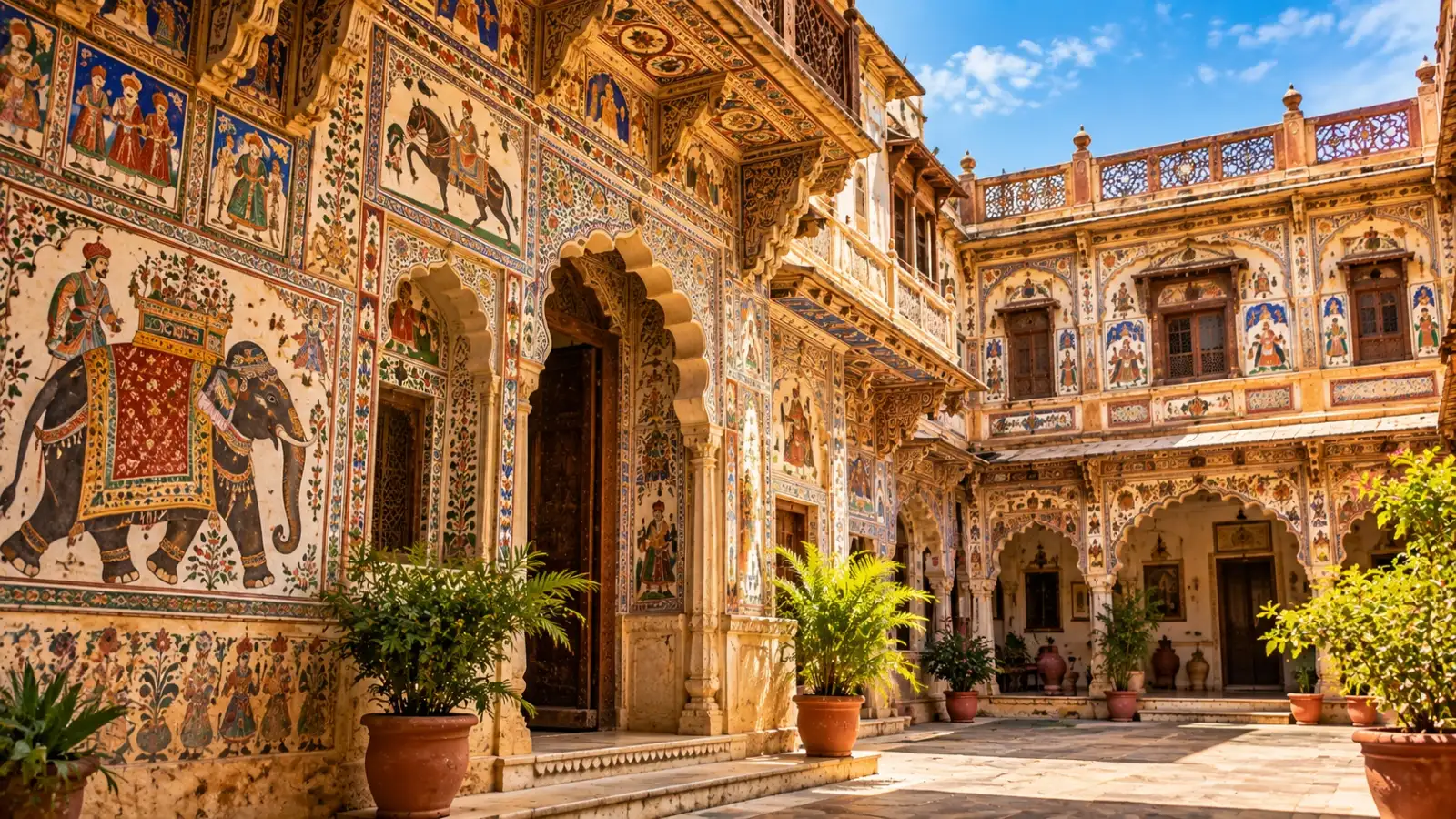
Spread across parts of the Jhunjhunu, Sikar and Churu districts, Shekhawati developed a distinctive architectural identity through the wealth and patronage of merchant communities. From religious paintings and folk stories to depictions of trains, European figures and early technology, the murals reflect a changing world through the eyes of local artists.
The region is often described as Rajasthan's open-air art gallery. Its appeal lies not in one monument alone, but in discovering painted buildings as you walk through historic market streets, quiet lanes and traditional neighbourhoods. Mandawa, Nawalgarh and Fatehpur are among the best-known places to begin exploring this unusual heritage landscape.
Many merchants had connections with long-distance trading networks. As commercial opportunities changed and business families moved to larger centres such as Calcutta and Bombay, some continued investing in their ancestral towns. Their wealth supported the construction and decoration of havelis, temples and other public buildings, leaving behind a remarkable concentration of painted architecture.
These residences were more than impressive facades. They were carefully organised homes, often built around internal courtyards with rooms, balconies and passages arranged around open spaces. The layout provided privacy and helped bring light into the interior, while the painted walls added an artistic dimension to everyday life.
The result was a regional architectural tradition in which art became part of the built environment. Instead of visiting one gallery, travellers can encounter murals on gateways, exterior walls, inner courtyards and ceilings as they explore the towns.
One of the most interesting aspects is the appearance of modern inventions alongside traditional imagery. Some paintings depict trains, motorcars, gramophones and other technologies that became familiar during the colonial period. These scenes show how artists incorporated new developments into an established visual tradition rather than abandoning familiar subjects.
Colour also plays a major role. Depending on the building and period, murals feature combinations of blue, green, red, yellow, pink and earthy tones. Some compositions cover large sections of a facade, while others are arranged in smaller framed panels around windows, doorways and architectural details.
Traditional mural techniques included painting on plaster using mineral, vegetable and other pigments. Different methods were used for different surfaces, and the durability of the paintings depended on materials, craftsmanship and later exposure to weather. Today, some murals remain vivid, while others have faded or suffered damage, adding urgency to conservation efforts.
The town's painted buildings feature decorative entrances, detailed wall paintings and ornate architectural elements. Some murals portray mythological scenes and religious figures, while others reflect the influence of changing lifestyles and technologies. Looking closely at the paintings can reveal details that are easy to miss when viewing an entire facade from a distance.
Mandawa is also a useful base for exploring nearby towns. Travellers can spend time walking through its older neighbourhoods, visiting accessible heritage properties and observing how the havelis fit into the wider townscape. Some buildings have been restored or adapted for hospitality, while others remain private or show signs of deterioration.
The experience is less about following a single route through a formal attraction and more about appreciating the architecture at street level. A leisurely walk allows time to notice carved doorways, painted panels, balconies and courtyards that reveal the character of this historic settlement.
The havelis are known for their painted facades and detailed interiors. Their murals reflect the subjects commonly found throughout the region, including religious narratives, scenes of daily life and representations of changing society. Many buildings also feature decorative windows, carved wooden details and internal courtyards.
Nawalgarh is particularly rewarding for visitors interested in studying the relationship between painting and architecture. Murals often follow the shape of a doorway, frame a window or occupy a defined section of a wall, making the building itself part of the composition.
Some heritage properties have been restored or opened to visitors, providing a clearer view of the original decorative work. Others remain in varying states of preservation. Exploring the town with a knowledgeable local guide can help visitors identify notable buildings and understand the stories behind their paintings.
The town is known for its frescoes, historic mansions and traditional urban layout. Some buildings contain elaborate painted panels, while others preserve traces of decorative schemes that have gradually faded with time. The contrast between restored facades and weathered walls highlights both the artistic richness of the region and the challenges of protecting it.
Fatehpur is worth including in a heritage itinerary for travellers who want to look beyond the most familiar tourist stops. The experience involves observing the town as a whole, including its streets, building entrances and the relationship between havelis and surrounding commercial areas.
As with other towns in Shekhawati, not every historic property is open to the public. Visitors should check access arrangements before entering a building and seek permission before photographing private homes or residents.
Each town offers a slightly different experience. Some have compact historic centres, while others are known for particular havelis, temples, forts or decorative details. Mahansar, for example, is recognised for the richly decorated Sone-Chandi ki Dukan, while Ramgarh contains notable painted merchant buildings and religious structures.
Exploring these lesser-known places can reveal how widely the tradition spread across the region. It also helps visitors understand that Shekhawati's heritage is not restricted to isolated mansions. The historic streets, market areas, water structures and religious buildings form part of the same cultural landscape.
Travellers with additional time can plan a route that combines two or three towns rather than attempting to cover the entire region in one day. This allows for slower exploration and a better appreciation of individual buildings.
Some havelis remain occupied, while others are abandoned, altered or divided into smaller properties. Maintaining a historic building can be expensive, particularly when traditional materials and specialist conservation skills are required. As a result, the condition of the murals varies considerably from one property to another.
Conservation is important because these paintings are more than decoration. They preserve evidence of regional art, religious beliefs, trade, social customs and changing technology. Their subjects offer a visual record of how people understood their surroundings and responded to developments beyond their towns.
Responsible tourism can support local heritage when visitors respect private property, use authorised guides and choose heritage services that value conservation. Avoid touching painted surfaces, writing on walls or entering restricted buildings. Preserving these details helps ensure that future visitors can continue to experience the region's distinctive architecture.
A visit of two to three days can provide time to explore Mandawa and Nawalgarh, with an additional stop such as Fatehpur or Dundlod if transport and timing allow. Travellers arriving from Jaipur should plan their journey according to the towns they want to visit, as distances between heritage sites can add up.
Before visiting individual havelis, check whether they are open, whether an entry fee applies and whether photography is permitted. Some are museums or heritage properties, while others are private residences. Local guides can help identify accessible buildings and explain details that might otherwise go unnoticed.
Allow time to walk slowly through the older streets rather than treating every stop as a quick photograph. The most interesting details may be small painted panels, faded figures above a doorway or a courtyard that reveals how the house was organised. Respect for residents and historic structures is essential throughout the visit.
Spread across parts of the Jhunjhunu, Sikar and Churu districts, Shekhawati developed a distinctive architectural identity through the wealth and patronage of merchant communities. From religious paintings and folk stories to depictions of trains, European figures and early technology, the murals reflect a changing world through the eyes of local artists.
The region is often described as Rajasthan's open-air art gallery. Its appeal lies not in one monument alone, but in discovering painted buildings as you walk through historic market streets, quiet lanes and traditional neighbourhoods. Mandawa, Nawalgarh and Fatehpur are among the best-known places to begin exploring this unusual heritage landscape.
How Shekhawati Became a Region of Painted Havelis
Shekhawati's architectural character developed over several centuries, but the most significant period of haveli construction and mural painting occurred from the nineteenth century into the early twentieth century. Wealthy Marwari merchants commissioned elaborate homes in their native towns, using their buildings to express prosperity, social standing and cultural identity.Many merchants had connections with long-distance trading networks. As commercial opportunities changed and business families moved to larger centres such as Calcutta and Bombay, some continued investing in their ancestral towns. Their wealth supported the construction and decoration of havelis, temples and other public buildings, leaving behind a remarkable concentration of painted architecture.
These residences were more than impressive facades. They were carefully organised homes, often built around internal courtyards with rooms, balconies and passages arranged around open spaces. The layout provided privacy and helped bring light into the interior, while the painted walls added an artistic dimension to everyday life.
The result was a regional architectural tradition in which art became part of the built environment. Instead of visiting one gallery, travellers can encounter murals on gateways, exterior walls, inner courtyards and ceilings as they explore the towns.
What Makes Shekhawati's Frescoes So Distinctive?
The murals of Shekhawati are notable for their variety of subjects. Many feature Hindu deities, mythological episodes, royal processions, animals and scenes from everyday life. Others portray merchants, rulers, religious figures and elements of the natural world.One of the most interesting aspects is the appearance of modern inventions alongside traditional imagery. Some paintings depict trains, motorcars, gramophones and other technologies that became familiar during the colonial period. These scenes show how artists incorporated new developments into an established visual tradition rather than abandoning familiar subjects.
Colour also plays a major role. Depending on the building and period, murals feature combinations of blue, green, red, yellow, pink and earthy tones. Some compositions cover large sections of a facade, while others are arranged in smaller framed panels around windows, doorways and architectural details.
Traditional mural techniques included painting on plaster using mineral, vegetable and other pigments. Different methods were used for different surfaces, and the durability of the paintings depended on materials, craftsmanship and later exposure to weather. Today, some murals remain vivid, while others have faded or suffered damage, adding urgency to conservation efforts.
Mandawa: A Historic Town Filled With Painted Mansions
Mandawa is one of the most familiar starting points for a Shekhawati heritage trip. Developed as a trading town along historic caravan routes, it became known for its merchant havelis, traditional streets and fortified architectural core.The town's painted buildings feature decorative entrances, detailed wall paintings and ornate architectural elements. Some murals portray mythological scenes and religious figures, while others reflect the influence of changing lifestyles and technologies. Looking closely at the paintings can reveal details that are easy to miss when viewing an entire facade from a distance.
Mandawa is also a useful base for exploring nearby towns. Travellers can spend time walking through its older neighbourhoods, visiting accessible heritage properties and observing how the havelis fit into the wider townscape. Some buildings have been restored or adapted for hospitality, while others remain private or show signs of deterioration.
The experience is less about following a single route through a formal attraction and more about appreciating the architecture at street level. A leisurely walk allows time to notice carved doorways, painted panels, balconies and courtyards that reveal the character of this historic settlement.
Nawalgarh: A Rich Collection of Traditional Havelis
Nawalgarh is another important destination for understanding Shekhawati's painted architecture. Founded in the eighteenth century, the town developed into a significant merchant centre and acquired a collection of elaborate havelis, temples and other historic structures.The havelis are known for their painted facades and detailed interiors. Their murals reflect the subjects commonly found throughout the region, including religious narratives, scenes of daily life and representations of changing society. Many buildings also feature decorative windows, carved wooden details and internal courtyards.
Nawalgarh is particularly rewarding for visitors interested in studying the relationship between painting and architecture. Murals often follow the shape of a doorway, frame a window or occupy a defined section of a wall, making the building itself part of the composition.
Some heritage properties have been restored or opened to visitors, providing a clearer view of the original decorative work. Others remain in varying states of preservation. Exploring the town with a knowledgeable local guide can help visitors identify notable buildings and understand the stories behind their paintings.
Fatehpur: Historic Streets and Remarkable Wall Paintings
Fatehpur offers another perspective on the artistic traditions of Shekhawati. Its history as an established settlement predates many of the region's most famous merchant havelis, and it later developed a rich collection of painted buildings.The town is known for its frescoes, historic mansions and traditional urban layout. Some buildings contain elaborate painted panels, while others preserve traces of decorative schemes that have gradually faded with time. The contrast between restored facades and weathered walls highlights both the artistic richness of the region and the challenges of protecting it.
Fatehpur is worth including in a heritage itinerary for travellers who want to look beyond the most familiar tourist stops. The experience involves observing the town as a whole, including its streets, building entrances and the relationship between havelis and surrounding commercial areas.
As with other towns in Shekhawati, not every historic property is open to the public. Visitors should check access arrangements before entering a building and seek permission before photographing private homes or residents.
Beyond the Best-Known Towns
Shekhawati's painted heritage extends beyond Mandawa, Nawalgarh and Fatehpur. Churu, Ramgarh, Dundlod, Mahansar, Bissau and Lakshmangarh also contain historic buildings associated with the region's mural tradition.Each town offers a slightly different experience. Some have compact historic centres, while others are known for particular havelis, temples, forts or decorative details. Mahansar, for example, is recognised for the richly decorated Sone-Chandi ki Dukan, while Ramgarh contains notable painted merchant buildings and religious structures.
Exploring these lesser-known places can reveal how widely the tradition spread across the region. It also helps visitors understand that Shekhawati's heritage is not restricted to isolated mansions. The historic streets, market areas, water structures and religious buildings form part of the same cultural landscape.
Travellers with additional time can plan a route that combines two or three towns rather than attempting to cover the entire region in one day. This allows for slower exploration and a better appreciation of individual buildings.
Why Shekhawati's Painted Havelis Need Conservation
The same features that make Shekhawati's havelis remarkable also make them vulnerable. Many paintings have been exposed to sunlight, rain, dust and fluctuations in temperature for generations. Changes to buildings, neglected maintenance and inappropriate restoration methods can cause further damage.Some havelis remain occupied, while others are abandoned, altered or divided into smaller properties. Maintaining a historic building can be expensive, particularly when traditional materials and specialist conservation skills are required. As a result, the condition of the murals varies considerably from one property to another.
You may also like
- Swadesh Anniversary 2026: Ambani Women Showcase Traditional Elegance and Modern Style
- mental health: IITs Plan Dedicated Cadre for Campus
- Bigg Boss 20 Wild Card Entry: Manish Goel's Career, Popular Shows and More
- Arijit Singh's 'Phir Se' Enters Grammy Consideration Alongside Dhurandhar: The Revenge Soundtrack
- Imran Khan Detained at Mumbai CJP Protest, Kirit Somaiya Demands Investigation
Conservation is important because these paintings are more than decoration. They preserve evidence of regional art, religious beliefs, trade, social customs and changing technology. Their subjects offer a visual record of how people understood their surroundings and responded to developments beyond their towns.
Responsible tourism can support local heritage when visitors respect private property, use authorised guides and choose heritage services that value conservation. Avoid touching painted surfaces, writing on walls or entering restricted buildings. Preserving these details helps ensure that future visitors can continue to experience the region's distinctive architecture.
How to Plan a Visit to Shekhawati
The cooler months, generally from October to March, are often more comfortable for exploring Rajasthan's historic towns on foot. Daytime temperatures can still vary, so check the forecast and carry drinking water, sun protection and comfortable walking shoes.A visit of two to three days can provide time to explore Mandawa and Nawalgarh, with an additional stop such as Fatehpur or Dundlod if transport and timing allow. Travellers arriving from Jaipur should plan their journey according to the towns they want to visit, as distances between heritage sites can add up.
Before visiting individual havelis, check whether they are open, whether an entry fee applies and whether photography is permitted. Some are museums or heritage properties, while others are private residences. Local guides can help identify accessible buildings and explain details that might otherwise go unnoticed.
Allow time to walk slowly through the older streets rather than treating every stop as a quick photograph. The most interesting details may be small painted panels, faded figures above a doorway or a courtyard that reveals how the house was organised. Respect for residents and historic structures is essential throughout the visit.






Loving Newspoint? Download the app now
