
India’s Villages Where the Main Attraction Is the Night Sky

For most people living in large Indian cities, seeing a truly dark night sky has become surprisingly difficult.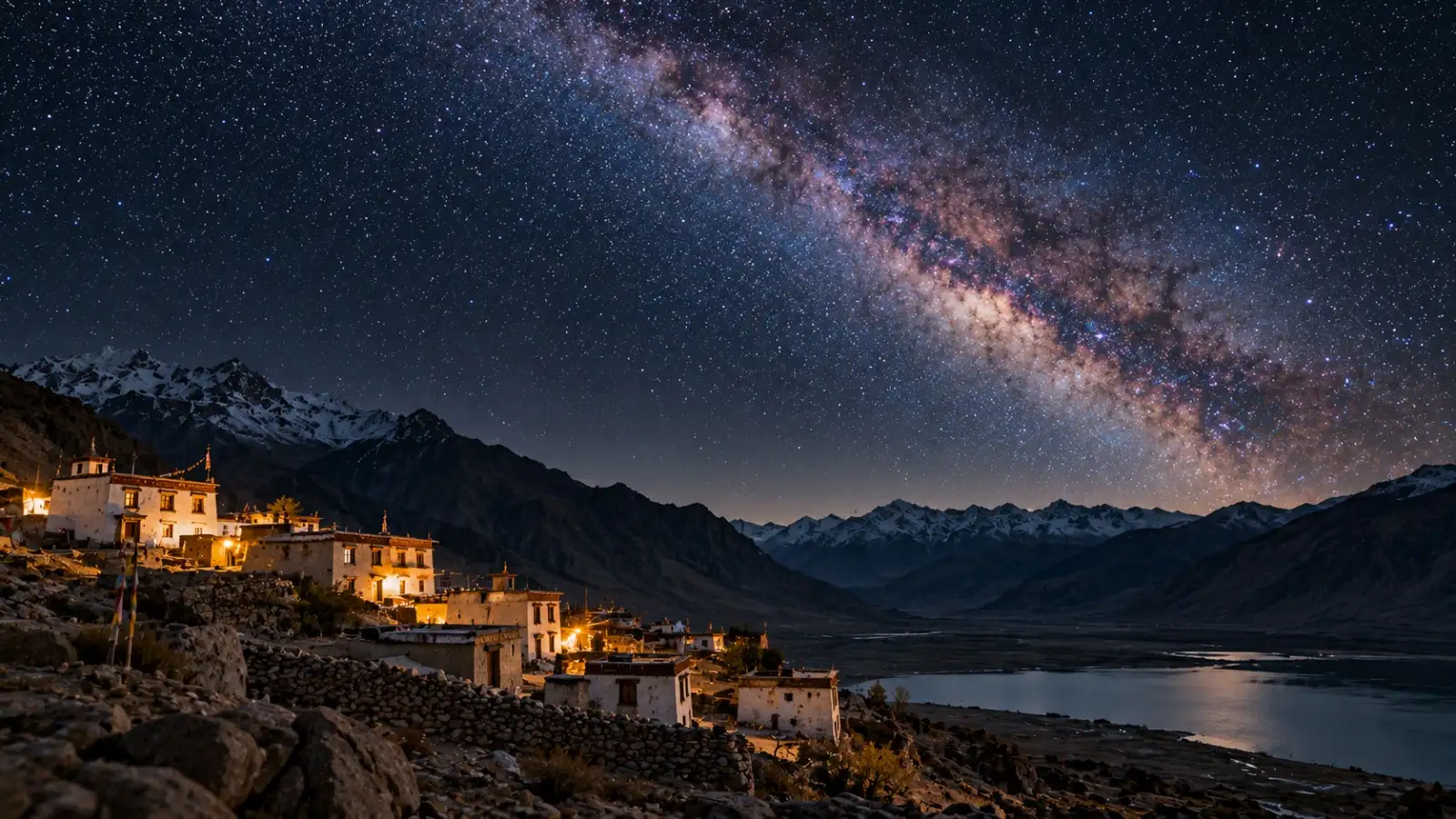
Streetlights, buildings, vehicle headlights and illuminated advertisements can wash out thousands of stars that would otherwise be visible. Even on a clear night, the sky above a city may reveal only the brightest stars and planets.
Then there are India's remote villages .
Far from major urban centres, some settlements experience nights so dark that the Milky Way becomes much easier to see. In a few places, astronomy has even started becoming part of tourism, with local guides, observatories, telescopes and organised stargazing experiences.
These destinations offer a different kind of attraction. There may be a monastery, mountain or lake nearby, but after sunset, the real spectacle begins overhead.
Located in the Changthang region of Ladakh, Hanle is home to the Indian Astronomical Observatory and the Hanle Dark Sky Reserve . The reserve covers an area of roughly 22 km around Hanle and was created to protect the exceptionally dark night sky from artificial light.
The location is particularly suitable for astronomy because of its high altitude, dry conditions and limited light pollution.
Hanle is not simply a place where visitors arrive with cameras and hope to photograph stars.
The local community has become part of the experience. Selected villagers have received telescopes and training to work as astronomy ambassadors and astro-tourism guides.
The destination has also hosted organised star parties involving amateur astronomers from different parts of India. During the first official star party in 2023, participants photographed faint celestial objects that are difficult to see from locations affected by significant light pollution.
For Hanle, the night sky is no longer just scenery.
It is becoming part of the village economy and identity.
Himachal Pradesh Tourism identifies Komic as one of Spiti's highest villages connected by a motorable road. It lies at around 4,400 metres and is associated with the Tangyud Monastery.
The extreme altitude and relatively sparse development create favourable conditions for observing the night sky.
During the day, visitors come for the high-altitude landscape, Buddhist culture and surrounding mountains.
After dark, the absence of large urban settlements becomes the attraction.
The experience here is less about a formal observatory and more about simply being in a landscape where the sky occupies an enormous part of the horizon.
The village sits amid high Himalayan terrain and is known for its large Buddha statue, fossils, traditional houses and views towards the surrounding mountains. Himachal Pradesh Tourism notes that trails from Langza lead towards high-altitude lakes and that Komic lies along the road beyond the village.
Its distance from major urban centres means there are relatively few artificial lights competing with the stars.
The result is a night-time landscape that feels completely different from the village seen during daylight.
The mountains become silhouettes.
The settlements become tiny points of light.
And the sky takes over.
Himachal Pradesh Tourism identifies Hikkim as the highest habitation in the Spiti Valley and places it beyond Komic on the route from Kaza.
The village has become a popular stop for travellers exploring Spiti's high-altitude settlements.
During the day, people often come looking for the landscape and the famous village post office.
At night, however, the same isolation becomes an entirely different attraction.
There is little of the artificial glow that dominates urban India, allowing visitors to experience a much darker Himalayan sky.
Yet its nights are part of its appeal.
Incredible India describes Hunder as a village surrounded by the distinctive landscape of Nubra Valley and specifically notes its star-studded nights and the silence of the village after dark.
That silence matters.
Stargazing is not only about how many stars are visible. The experience also depends on being away from noise, traffic and artificial light.
In Hunder, the combination of desert-like terrain, mountains and a dark sky creates an unusual Himalayan nightscape.
The lake itself sits at roughly 4,595 metres and is surrounded by an exceptionally open landscape.
Incredible India specifically highlights the minimal light pollution around Tso Moriri as an advantage for stargazing. Visitors can camp near the lake and observe stars, planets and constellations against the dark Ladakhi sky.
The setting is particularly striking because there are few visual distractions.
There are mountains.
There is the lake.
There are vast open plains.
And above everything is an enormous night sky.
For photographers, the combination can be especially dramatic.
But its night sky is also part of the experience.
Incredible India highlights camping under the stars in Aru, describing the village as a place where visitors can spend nights surrounded by the Himalayan landscape.
Unlike an organised astronomy destination such as Hanle, Aru's appeal is more about experiencing the stars as part of a quiet mountain stay.
A clear night here can completely change the atmosphere of the valley.
The same mountains that dominate the daytime view become dark silhouettes beneath the stars.
Incredible India describes Kausani as a secluded Himalayan destination with clear skies and extensive views of Himalayan peaks. The village is also home to the Stargate Observatory, where visitors can take part in astronomy activities and astrophotography experiences.
This makes Kausani particularly accessible for travellers who want an introduction to astronomy without travelling to an extremely remote high-altitude settlement.
The experience can combine mountain views during the day with planets, stars and galaxies after sunset.
It is one of the easier ways to turn a conventional Himalayan holiday into an astronomy-focused trip.
Incredible India describes Padampuri as a nearby village with camping opportunities among forests and alongside the Kala River, including nights beneath star-filled skies.
The setting is very different from Hanle.
There is no enormous high-altitude desert.
Instead, visitors get forests, mountain air and a quieter environment away from the brighter parts of the Kumaon region.
It demonstrates that excellent stargazing does not always require travelling to the highest mountains in the country.
Reducing artificial light can be just as important.
The Uttarakhand Tourism Development Board's information for the region specifically describes camping at Didna under a clear mountain sky with visible stars.
Here, the night sky becomes part of the trekking experience.
After a day spent walking through forests and mountain terrain, the absence of city lighting changes the entire atmosphere of the campsite.
There is no need for a planetarium or telescope.
Sometimes the attraction is simply being somewhere dark enough to see what is normally hidden above a city.
Light pollution from cities brightens the lower atmosphere and makes faint stars and other celestial objects harder to see.
Remote villages naturally have fewer sources of artificial light.
Altitude can also help in some Himalayan locations because many high-altitude sites have dry air and relatively low atmospheric moisture.
However, altitude alone does not guarantee excellent stargazing.
Cloud cover, moonlight, atmospheric conditions, haze and nearby artificial lighting all matter.
This is why a remote village can sometimes offer a spectacular sky on one night and a disappointing view on another.
The Hanle Dark Sky Reserve has involved local villagers in astronomy tourism, including the distribution of telescopes and training of local astronomy ambassadors. The administration has also been developing facilities such as a mini planetarium and Astro Globe to support scientific education and tourism.
Ladakh Astro Week 2026 further demonstrated how astronomy, local culture and tourism are being brought together through talks, astrophotography exhibitions and telescope-guided observations.
This model could be significant for remote communities.
Instead of building tourism entirely around large hotels or conventional attractions, villages can use one of their greatest natural assets, darkness.
During daylight, these villages may seem to offer the familiar Himalayan combination of mountains, monasteries, valleys and hiking trails.
Then night arrives.
The artificial lights become fewer.
The landscape becomes darker.
Stars begin appearing one by one.
Eventually, the sky that was almost invisible from a city becomes the most dramatic feature of the entire journey.
India's remote villages show that some of the country's most extraordinary travel experiences are not necessarily found on the ground.
Sometimes, you simply have to look up.
Streetlights, buildings, vehicle headlights and illuminated advertisements can wash out thousands of stars that would otherwise be visible. Even on a clear night, the sky above a city may reveal only the brightest stars and planets.
Then there are India's remote villages .
Far from major urban centres, some settlements experience nights so dark that the Milky Way becomes much easier to see. In a few places, astronomy has even started becoming part of tourism, with local guides, observatories, telescopes and organised stargazing experiences.
These destinations offer a different kind of attraction. There may be a monastery, mountain or lake nearby, but after sunset, the real spectacle begins overhead.
1. Hanle, Ladakh
Hanle is arguably India's most remarkable village for astronomy tourism.Located in the Changthang region of Ladakh, Hanle is home to the Indian Astronomical Observatory and the Hanle Dark Sky Reserve . The reserve covers an area of roughly 22 km around Hanle and was created to protect the exceptionally dark night sky from artificial light.
The location is particularly suitable for astronomy because of its high altitude, dry conditions and limited light pollution.
Hanle is not simply a place where visitors arrive with cameras and hope to photograph stars.
The local community has become part of the experience. Selected villagers have received telescopes and training to work as astronomy ambassadors and astro-tourism guides.
The destination has also hosted organised star parties involving amateur astronomers from different parts of India. During the first official star party in 2023, participants photographed faint celestial objects that are difficult to see from locations affected by significant light pollution.
For Hanle, the night sky is no longer just scenery.
It is becoming part of the village economy and identity.
2. Komic, Spiti Valley
High above the Spiti Valley, Komic is one of those villages where the landscape seems to continue directly into the sky.Himachal Pradesh Tourism identifies Komic as one of Spiti's highest villages connected by a motorable road. It lies at around 4,400 metres and is associated with the Tangyud Monastery.
The extreme altitude and relatively sparse development create favourable conditions for observing the night sky.
During the day, visitors come for the high-altitude landscape, Buddhist culture and surrounding mountains.
After dark, the absence of large urban settlements becomes the attraction.
The experience here is less about a formal observatory and more about simply being in a landscape where the sky occupies an enormous part of the horizon.
3. Langza, Spiti Valley
Langza is another Spiti village where the sense of remoteness becomes particularly powerful after sunset.The village sits amid high Himalayan terrain and is known for its large Buddha statue, fossils, traditional houses and views towards the surrounding mountains. Himachal Pradesh Tourism notes that trails from Langza lead towards high-altitude lakes and that Komic lies along the road beyond the village.
Its distance from major urban centres means there are relatively few artificial lights competing with the stars.
The result is a night-time landscape that feels completely different from the village seen during daylight.
The mountains become silhouettes.
The settlements become tiny points of light.
And the sky takes over.
4. Hikkim, Spiti Valley
Hikkim is famous for its extraordinary altitude and remote setting, but its location also gives it an advantage for night-sky viewing.Himachal Pradesh Tourism identifies Hikkim as the highest habitation in the Spiti Valley and places it beyond Komic on the route from Kaza.
The village has become a popular stop for travellers exploring Spiti's high-altitude settlements.
During the day, people often come looking for the landscape and the famous village post office.
At night, however, the same isolation becomes an entirely different attraction.
There is little of the artificial glow that dominates urban India, allowing visitors to experience a much darker Himalayan sky.
5. Hunder, Nubra Valley
Hunder is better known for its sand dunes, dramatic mountains and Bactrian camels than for astronomy.Yet its nights are part of its appeal.
Incredible India describes Hunder as a village surrounded by the distinctive landscape of Nubra Valley and specifically notes its star-studded nights and the silence of the village after dark.
That silence matters.
Stargazing is not only about how many stars are visible. The experience also depends on being away from noise, traffic and artificial light.
In Hunder, the combination of desert-like terrain, mountains and a dark sky creates an unusual Himalayan nightscape.
6. Korzok, near Tso Moriri
Korzok is one of the settlements associated with Tso Moriri in Ladakh's high-altitude Changthang region.The lake itself sits at roughly 4,595 metres and is surrounded by an exceptionally open landscape.
Incredible India specifically highlights the minimal light pollution around Tso Moriri as an advantage for stargazing. Visitors can camp near the lake and observe stars, planets and constellations against the dark Ladakhi sky.
The setting is particularly striking because there are few visual distractions.
There are mountains.
There is the lake.
There are vast open plains.
And above everything is an enormous night sky.
For photographers, the combination can be especially dramatic.
7. Aru, Kashmir
Aru is a village near Pahalgam in the Lidder Valley and is generally associated with meadows, mountains, trekking and winter landscapes.But its night sky is also part of the experience.
Incredible India highlights camping under the stars in Aru, describing the village as a place where visitors can spend nights surrounded by the Himalayan landscape.
Unlike an organised astronomy destination such as Hanle, Aru's appeal is more about experiencing the stars as part of a quiet mountain stay.
A clear night here can completely change the atmosphere of the valley.
The same mountains that dominate the daytime view become dark silhouettes beneath the stars.
8. Kausani, Uttarakhand
Kausani is technically more developed than the remote Himalayan villages of Ladakh and Spiti, but its relationship with astronomy is unusually strong.Incredible India describes Kausani as a secluded Himalayan destination with clear skies and extensive views of Himalayan peaks. The village is also home to the Stargate Observatory, where visitors can take part in astronomy activities and astrophotography experiences.
This makes Kausani particularly accessible for travellers who want an introduction to astronomy without travelling to an extremely remote high-altitude settlement.
The experience can combine mountain views during the day with planets, stars and galaxies after sunset.
It is one of the easier ways to turn a conventional Himalayan holiday into an astronomy-focused trip.
9. Padampuri, Uttarakhand
Near Bhimtal, the village of Padampuri offers another example of how a relatively quiet Himalayan settlement can become attractive after sunset.Incredible India describes Padampuri as a nearby village with camping opportunities among forests and alongside the Kala River, including nights beneath star-filled skies.
The setting is very different from Hanle.
There is no enormous high-altitude desert.
Instead, visitors get forests, mountain air and a quieter environment away from the brighter parts of the Kumaon region.
It demonstrates that excellent stargazing does not always require travelling to the highest mountains in the country.
Reducing artificial light can be just as important.
10. Didna, Uttarakhand
Didna is a small village associated with trekking routes in the Uttarakhand Himalayas.The Uttarakhand Tourism Development Board's information for the region specifically describes camping at Didna under a clear mountain sky with visible stars.
Here, the night sky becomes part of the trekking experience.
After a day spent walking through forests and mountain terrain, the absence of city lighting changes the entire atmosphere of the campsite.
There is no need for a planetarium or telescope.
Sometimes the attraction is simply being somewhere dark enough to see what is normally hidden above a city.
Why villages are better for stargazing than cities
The most important ingredient is darkness.Light pollution from cities brightens the lower atmosphere and makes faint stars and other celestial objects harder to see.
Remote villages naturally have fewer sources of artificial light.
Altitude can also help in some Himalayan locations because many high-altitude sites have dry air and relatively low atmospheric moisture.
However, altitude alone does not guarantee excellent stargazing.
Cloud cover, moonlight, atmospheric conditions, haze and nearby artificial lighting all matter.
This is why a remote village can sometimes offer a spectacular sky on one night and a disappointing view on another.
The night sky is becoming part of village tourism
Hanle shows how this can develop beyond ordinary sightseeing.The Hanle Dark Sky Reserve has involved local villagers in astronomy tourism, including the distribution of telescopes and training of local astronomy ambassadors. The administration has also been developing facilities such as a mini planetarium and Astro Globe to support scientific education and tourism.
Ladakh Astro Week 2026 further demonstrated how astronomy, local culture and tourism are being brought together through talks, astrophotography exhibitions and telescope-guided observations.
This model could be significant for remote communities.
Instead of building tourism entirely around large hotels or conventional attractions, villages can use one of their greatest natural assets, darkness.
When the sky becomes the destination
There is something unusual about travelling somewhere where the main attraction cannot be photographed properly until the sun has disappeared.During daylight, these villages may seem to offer the familiar Himalayan combination of mountains, monasteries, valleys and hiking trails.
Then night arrives.
The artificial lights become fewer.
The landscape becomes darker.
Stars begin appearing one by one.
Eventually, the sky that was almost invisible from a city becomes the most dramatic feature of the entire journey.
India's remote villages show that some of the country's most extraordinary travel experiences are not necessarily found on the ground.
Sometimes, you simply have to look up.
Next Story