
The African Catfish Is Banned in India. It's Still Spreading Through Our Rivers.


In 2000, the Government of India banned the import and farming of African catfish, Clarias gariepinus, after ecologists flagged what it does to freshwater ecosystems. The fish is still here. It is in the Yamuna, in Kerala's backwaters, in wetlands across Andhra Pradesh and Tamil Nadu, and in farm ponds that connect to open water every monsoon. The ban stopped new imports. It did not stop the fish already in the ground.
Why Indian Fish Farms Wanted It in the First PlaceAfrican catfish grows at a rate that makes native species look inefficient. Under warm conditions, a fingerling can reach market weight in four to six months. It tolerates low oxygen, crowded tanks, and cheap feed. For a fish farmer working on thin margins, those traits look like a solution to every problem at once.
The species was introduced into Indian aquaculture in the 1990s, legally at first, through state fisheries departments and private hatcheries drawn to its productivity. Andhra Pradesh became an early centre of catfish farming, followed by Tamil Nadu and parts of the northeast. The economics were straightforward: faster growth, lower feed conversion ratio, high survival rate in intensive systems.
What the economics did not account for was the fish's other trait. Clarias gariepinus can breathe air. It has a modified gill structure called a suprabranchial organ that lets it survive out of water long enough to walk overland on its pectoral fins to the next water body. It does not need a flood to escape a pond. It needs rain and a few metres of wet ground.
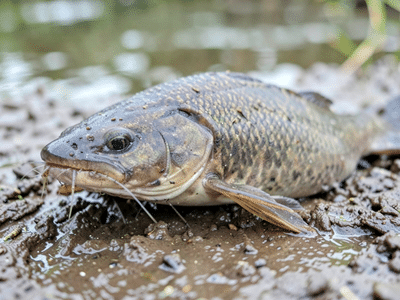 A live grey-brown scaleless catfish rests on a muddy riverbank, showcasing its unique texture. This invasive fish poses a threat to Indian rivers.
How the Escape HappenedThe routes are not mysterious. Monsoon flooding overtops farm pond bunds. Drainage channels connect ponds to canals, which connect to rivers. Fish are sometimes released deliberately by farmers who cannot sell their stock or who believe the fish will grow and be caught later. Fingerlings escape during transport. In some cases, fish were released into open water by people who did not know the species was banned, or who did not know the species at all.
Once Clarias gariepinus enters a river system, removal becomes functionally impossible. The fish breeds prolifically, reaches sexual maturity quickly, and has no natural predator in Indian freshwater large enough to control its numbers. Native predators like the snakehead and the wallago catfish will take juveniles, but adult African catfish grow large enough and aggressive enough to sit outside most predation pressure.
The 2000 ban was reinforced by a 2013 advisory from the National Fisheries Development Board, which explicitly prohibited the culture and sale of Clarias gariepinus along with Suckermouth armoured catfish, another invasive already established in peninsular rivers. Both bans exist on paper. Enforcement at the farm level has been inconsistent, and the fish was openly sold in some wet markets years after the prohibition. What It Does to Native FishAfrican catfish is a generalist predator. It eats whatever fits in its mouth: small fish, frogs, crustaceans, aquatic insects, plant matter, carrion. In its native range across sub-Saharan Africa, this diet is held in check by the ecosystem it evolved inside. In Indian rivers, it faces no such check.
Studies on invasive Clarias populations in Asian river systems, including work from Sri Lanka and parts of Southeast Asia where the species has similarly escaped aquaculture, document sharp declines in small native cyprinids and loaches in stretches where the catfish establishes itself. India's freshwater fish diversity is significant: the Western Ghats alone carry over 200 endemic freshwater species, many of them small-bodied and precisely the size that African catfish prefers.
The competitive pressure is not only predation. African catfish competes directly with native catfish species, including the widely consumed Clarias batrachus, the Indian walking catfish, which shares the same habitat preferences and food sources. Fishers in Kerala and Tamil Nadu have reported declining catches of native catfish in areas where the African species has appeared, though separating the catfish effect from broader overfishing pressure is difficult in practice.
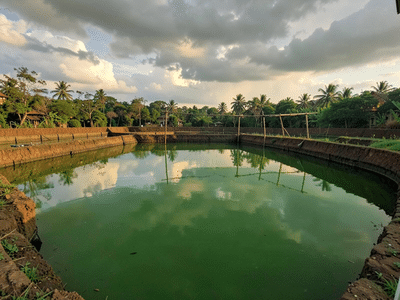 A tranquil fish farm pond in South India, reflecting monsoon clouds. This scene highlights freshwater aquaculture practices.
The Identification ProblemPart of what makes this invasion hard to manage is that most people cannot tell the two catfish apart. Clarias gariepinus and Clarias batrachus look similar to a non-specialist. Both are grey-brown, scaleless, whiskered, and capable of surviving out of water. The African species grows larger and has a broader, flatter head, but a fish in a market basket or a river net does not come labelled.
This confusion has real consequences. African catfish has been sold as Indian walking catfish in wet markets, sometimes knowingly, sometimes because the seller genuinely could not distinguish them. When the fish in a market is indistinguishable to the buyer, the economic incentive to keep farming it does not disappear just because a government notification says it should.
Wildlife researchers and citizen science platforms have begun documenting Clarias gariepinus sightings through freshwater fish surveys, but systematic monitoring of invasive freshwater species in India remains limited compared to the scale of the problem. The data that exists points to a species already too distributed to contain. Where the Responsibility SitsThe African catfish did not arrive in Indian rivers by accident of nature. It arrived because it was imported, farmed at scale, and inadequately contained. The regulatory failure is distributed: across state fisheries departments that licensed farms without assessing escape risk, across the enforcement gap between a national ban and what happens at a rural pond, and across a market that could not or would not distinguish a legal fish from a prohibited one.
What remains is a set of choices about what to do with a species that cannot be recalled. Some ecologists argue for targeted removal in ecologically sensitive stretches, particularly in Western Ghats river systems. Others point out that removal campaigns for established freshwater invasives rarely succeed without sustained, multi-year effort and significant resources that have not been committed. A third position holds that the priority should be preventing further spread through stricter farm inspection and market traceability, accepting that the fish already in open water is beyond retrieval.
None of these positions is comfortable. The African catfish is now part of the system it disrupted, and the native fish it displaced did not wait for the policy debate to conclude.
Why Indian Fish Farms Wanted It in the First PlaceAfrican catfish grows at a rate that makes native species look inefficient. Under warm conditions, a fingerling can reach market weight in four to six months. It tolerates low oxygen, crowded tanks, and cheap feed. For a fish farmer working on thin margins, those traits look like a solution to every problem at once.
The species was introduced into Indian aquaculture in the 1990s, legally at first, through state fisheries departments and private hatcheries drawn to its productivity. Andhra Pradesh became an early centre of catfish farming, followed by Tamil Nadu and parts of the northeast. The economics were straightforward: faster growth, lower feed conversion ratio, high survival rate in intensive systems.
What the economics did not account for was the fish's other trait. Clarias gariepinus can breathe air. It has a modified gill structure called a suprabranchial organ that lets it survive out of water long enough to walk overland on its pectoral fins to the next water body. It does not need a flood to escape a pond. It needs rain and a few metres of wet ground.
Once Clarias gariepinus enters a river system, removal becomes functionally impossible. The fish breeds prolifically, reaches sexual maturity quickly, and has no natural predator in Indian freshwater large enough to control its numbers. Native predators like the snakehead and the wallago catfish will take juveniles, but adult African catfish grow large enough and aggressive enough to sit outside most predation pressure.
The 2000 ban was reinforced by a 2013 advisory from the National Fisheries Development Board, which explicitly prohibited the culture and sale of Clarias gariepinus along with Suckermouth armoured catfish, another invasive already established in peninsular rivers. Both bans exist on paper. Enforcement at the farm level has been inconsistent, and the fish was openly sold in some wet markets years after the prohibition. What It Does to Native FishAfrican catfish is a generalist predator. It eats whatever fits in its mouth: small fish, frogs, crustaceans, aquatic insects, plant matter, carrion. In its native range across sub-Saharan Africa, this diet is held in check by the ecosystem it evolved inside. In Indian rivers, it faces no such check.
Studies on invasive Clarias populations in Asian river systems, including work from Sri Lanka and parts of Southeast Asia where the species has similarly escaped aquaculture, document sharp declines in small native cyprinids and loaches in stretches where the catfish establishes itself. India's freshwater fish diversity is significant: the Western Ghats alone carry over 200 endemic freshwater species, many of them small-bodied and precisely the size that African catfish prefers.
The competitive pressure is not only predation. African catfish competes directly with native catfish species, including the widely consumed Clarias batrachus, the Indian walking catfish, which shares the same habitat preferences and food sources. Fishers in Kerala and Tamil Nadu have reported declining catches of native catfish in areas where the African species has appeared, though separating the catfish effect from broader overfishing pressure is difficult in practice.
The Identification ProblemPart of what makes this invasion hard to manage is that most people cannot tell the two catfish apart. Clarias gariepinus and Clarias batrachus look similar to a non-specialist. Both are grey-brown, scaleless, whiskered, and capable of surviving out of water. The African species grows larger and has a broader, flatter head, but a fish in a market basket or a river net does not come labelled.
This confusion has real consequences. African catfish has been sold as Indian walking catfish in wet markets, sometimes knowingly, sometimes because the seller genuinely could not distinguish them. When the fish in a market is indistinguishable to the buyer, the economic incentive to keep farming it does not disappear just because a government notification says it should.
Wildlife researchers and citizen science platforms have begun documenting Clarias gariepinus sightings through freshwater fish surveys, but systematic monitoring of invasive freshwater species in India remains limited compared to the scale of the problem. The data that exists points to a species already too distributed to contain. Where the Responsibility SitsThe African catfish did not arrive in Indian rivers by accident of nature. It arrived because it was imported, farmed at scale, and inadequately contained. The regulatory failure is distributed: across state fisheries departments that licensed farms without assessing escape risk, across the enforcement gap between a national ban and what happens at a rural pond, and across a market that could not or would not distinguish a legal fish from a prohibited one.
What remains is a set of choices about what to do with a species that cannot be recalled. Some ecologists argue for targeted removal in ecologically sensitive stretches, particularly in Western Ghats river systems. Others point out that removal campaigns for established freshwater invasives rarely succeed without sustained, multi-year effort and significant resources that have not been committed. A third position holds that the priority should be preventing further spread through stricter farm inspection and market traceability, accepting that the fish already in open water is beyond retrieval.
None of these positions is comfortable. The African catfish is now part of the system it disrupted, and the native fish it displaced did not wait for the policy debate to conclude.
Next Story