
The Himalayan Sheepdog Was Never Built for a City Flat


A fully grown Gaddi Kutta can weigh 45 kilograms, patrol 20 kilometres of mountain terrain in a single day, and hold a snow leopard at bay without instruction from anyone. That is not a personality quirk. It is the result of centuries of selection pressure in the Dhauladhar and Pir Panjal ranges, where the Gaddis, a transhumant pastoral community of Himachal Pradesh, bred this dog specifically to think independently, act decisively, and survive at altitudes above 3,000 metres. Bringing one into a city flat is not a lifestyle choice so much as a mismatch between what the animal is and what the environment can offer.
What the Gaddi Kutta Actually IsThe Himalayan Sheepdog, known locally as the Gaddi Kutta or Bhotia in some classifications, belongs to the broader family of livestock guardian dogs found across Central Asia. Unlike herding breeds that move animals on command, livestock guardians bond with the flock itself and make autonomous threat assessments. A Border Collie defers to the shepherd. A Gaddi does not. It was selected to act alone at night on a high-altitude pasture when the shepherd was asleep and a leopard was not.
The breed carries a dense double coat adapted to sub-zero temperatures, a large frame that retains heat, and a territorial drive calibrated to a range measured in square kilometres, not square feet. Studies on livestock guardian dog behaviour, including work referenced by the Snow Leopard Trust in its community livestock protection programmes, consistently show that these dogs require a defined territory and a working role to remain psychologically stable. Without both, the behaviour that made them effective guardians, alertness, independence, low threshold for perceived threat, becomes a liability in a dense residential setting.
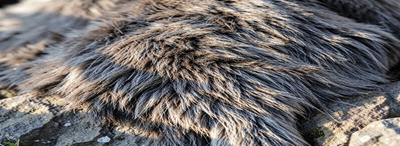
The rich texture of a Himalayan Sheepdog's coat, a testament to its heritage.
The Physical Demands the Mountains Built InThe Gaddi's musculoskeletal structure is built for uneven, high-altitude terrain. Flat urban surfaces, especially polished floors and concrete, place abnormal stress on the joints of large breeds. This is not specific to the Gaddi, veterinary consensus, including guidance from the Indian Veterinary Association, acknowledges that giant and working breeds confined to sedentary urban environments show higher rates of hip dysplasia progression and early-onset arthritis. In a breed that evolved running mountain gradients, the gap between what the body expects and what a city provides is wider than in most.
The coat compounds the problem. The double coat that insulates against Himalayan winters becomes a heat-retention problem in the plains. Cities like Delhi, Pune, and Chennai regularly record summer temperatures between 38 and 45 degrees Celsius. A dog built to thermoregulate at altitude, with a coat designed to trap warmth, faces genuine physiological stress in that heat range. Grooming alone does not solve it; the undercoat is structural, not decorative.
The Behavioural Reality No Breeder Photograph ShowsLivestock guardian dogs are not aggressive in the way a poorly socialised dog is aggressive. Their threat response is measured and deliberate, which in some ways makes it harder to manage in an urban context, not easier. A Gaddi that has assessed a stranger, a delivery worker, or a child as a potential threat will not back down from that assessment because its owner is embarrassed. It was bred to hold a position against a predator that outweighs it. Social pressure from a human it has not accepted as part of its group does not register the same way.
Socialisation from puppyhood reduces this, but does not eliminate the underlying drive. Experienced trainers who work with working-breed dogs in India consistently note that guardian breeds require an owner who understands the difference between obedience and compliance, a Gaddi may comply in a training session and revert entirely in a high-stimulus environment like a market or a crowded street. That is not a training failure. It is the breed functioning as designed.
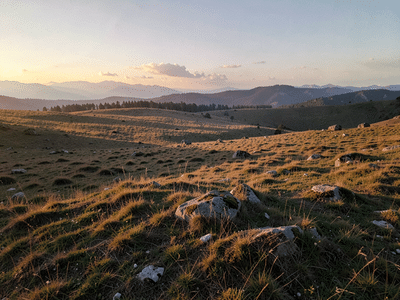 I see the vast Himalayan landscape at dusk, a serene scene with dry grass and boulders. This view reminds me of the hardy Gaddi Kutta, a livestock guardian dog India.
What the Gaddi Needs to ThriveThe Gaddis themselves move between summer pastures above the treeline and winter lowlands in a cycle that mirrors the livestock's needs. The dog's year is structured around movement, purpose, and a defined group to protect. Replicating even a fraction of this in a non-pastoral setting requires land, not just space. A large farmhouse with acreage, livestock or working animals to bond with, and an owner who can provide two to three hours of genuine physical activity daily comes closest.
The breed is not impossible to keep outside a pastoral context, but the bar is specific. Rural properties on the outskirts of hill towns, farms in Uttarakhand or Himachal Pradesh, or large agricultural holdings where the dog has a perimeter to patrol and animals to bond with are realistic environments. A 2BHK in Bengaluru, however well-intentioned the owner, is not.
The Conservation Argument for Leaving This Breed in Its ContextThe Gaddi Kutta is also a working conservation tool. In areas where snow leopards and wolves prey on livestock, a well-placed guardian dog reduces retaliatory killing of predators by herders, a dynamic documented in Snow Leopard Trust field programmes across Ladakh and Spiti. Pulling breeding stock into urban pet markets for novelty value disrupts the supply of working dogs to communities that depend on them, and selects over generations for traits that suit apartment life rather than mountain patrol. The breed's value to its original ecosystem is not sentimental. It is functional, and it is being eroded by the same demand that drove the Saint Bernard and the Tibetan Mastiff into urban living rooms before them.
The Gaddi Kutta is not a difficult dog in the mountains. In the mountains, it is exactly what it should be.
What the Gaddi Kutta Actually IsThe Himalayan Sheepdog, known locally as the Gaddi Kutta or Bhotia in some classifications, belongs to the broader family of livestock guardian dogs found across Central Asia. Unlike herding breeds that move animals on command, livestock guardians bond with the flock itself and make autonomous threat assessments. A Border Collie defers to the shepherd. A Gaddi does not. It was selected to act alone at night on a high-altitude pasture when the shepherd was asleep and a leopard was not.
The breed carries a dense double coat adapted to sub-zero temperatures, a large frame that retains heat, and a territorial drive calibrated to a range measured in square kilometres, not square feet. Studies on livestock guardian dog behaviour, including work referenced by the Snow Leopard Trust in its community livestock protection programmes, consistently show that these dogs require a defined territory and a working role to remain psychologically stable. Without both, the behaviour that made them effective guardians, alertness, independence, low threshold for perceived threat, becomes a liability in a dense residential setting.
The rich texture of a Himalayan Sheepdog's coat, a testament to its heritage.
The Physical Demands the Mountains Built InThe Gaddi's musculoskeletal structure is built for uneven, high-altitude terrain. Flat urban surfaces, especially polished floors and concrete, place abnormal stress on the joints of large breeds. This is not specific to the Gaddi, veterinary consensus, including guidance from the Indian Veterinary Association, acknowledges that giant and working breeds confined to sedentary urban environments show higher rates of hip dysplasia progression and early-onset arthritis. In a breed that evolved running mountain gradients, the gap between what the body expects and what a city provides is wider than in most.
The coat compounds the problem. The double coat that insulates against Himalayan winters becomes a heat-retention problem in the plains. Cities like Delhi, Pune, and Chennai regularly record summer temperatures between 38 and 45 degrees Celsius. A dog built to thermoregulate at altitude, with a coat designed to trap warmth, faces genuine physiological stress in that heat range. Grooming alone does not solve it; the undercoat is structural, not decorative.
The Behavioural Reality No Breeder Photograph ShowsLivestock guardian dogs are not aggressive in the way a poorly socialised dog is aggressive. Their threat response is measured and deliberate, which in some ways makes it harder to manage in an urban context, not easier. A Gaddi that has assessed a stranger, a delivery worker, or a child as a potential threat will not back down from that assessment because its owner is embarrassed. It was bred to hold a position against a predator that outweighs it. Social pressure from a human it has not accepted as part of its group does not register the same way.
Socialisation from puppyhood reduces this, but does not eliminate the underlying drive. Experienced trainers who work with working-breed dogs in India consistently note that guardian breeds require an owner who understands the difference between obedience and compliance, a Gaddi may comply in a training session and revert entirely in a high-stimulus environment like a market or a crowded street. That is not a training failure. It is the breed functioning as designed.
What the Gaddi Needs to ThriveThe Gaddis themselves move between summer pastures above the treeline and winter lowlands in a cycle that mirrors the livestock's needs. The dog's year is structured around movement, purpose, and a defined group to protect. Replicating even a fraction of this in a non-pastoral setting requires land, not just space. A large farmhouse with acreage, livestock or working animals to bond with, and an owner who can provide two to three hours of genuine physical activity daily comes closest.
The breed is not impossible to keep outside a pastoral context, but the bar is specific. Rural properties on the outskirts of hill towns, farms in Uttarakhand or Himachal Pradesh, or large agricultural holdings where the dog has a perimeter to patrol and animals to bond with are realistic environments. A 2BHK in Bengaluru, however well-intentioned the owner, is not.
The Conservation Argument for Leaving This Breed in Its ContextThe Gaddi Kutta is also a working conservation tool. In areas where snow leopards and wolves prey on livestock, a well-placed guardian dog reduces retaliatory killing of predators by herders, a dynamic documented in Snow Leopard Trust field programmes across Ladakh and Spiti. Pulling breeding stock into urban pet markets for novelty value disrupts the supply of working dogs to communities that depend on them, and selects over generations for traits that suit apartment life rather than mountain patrol. The breed's value to its original ecosystem is not sentimental. It is functional, and it is being eroded by the same demand that drove the Saint Bernard and the Tibetan Mastiff into urban living rooms before them.
The Gaddi Kutta is not a difficult dog in the mountains. In the mountains, it is exactly what it should be.
Next Story