
How Blue Pottery Came to Jaipur and Found a Royal Home

Pick up a blue pottery bowl in any Jaipur bazaar and you are holding something that began its journey in the kilns of Persia, passed through Samarkand, arrived in Mughal Delhi, and then found its most devoted patrons in a Rajput court that had every reason to prefer its own traditions. The craft's survival in Jaipur is not an accident of geography. It is the result of deliberate royal patronage at a moment when the art was close to disappearing entirely.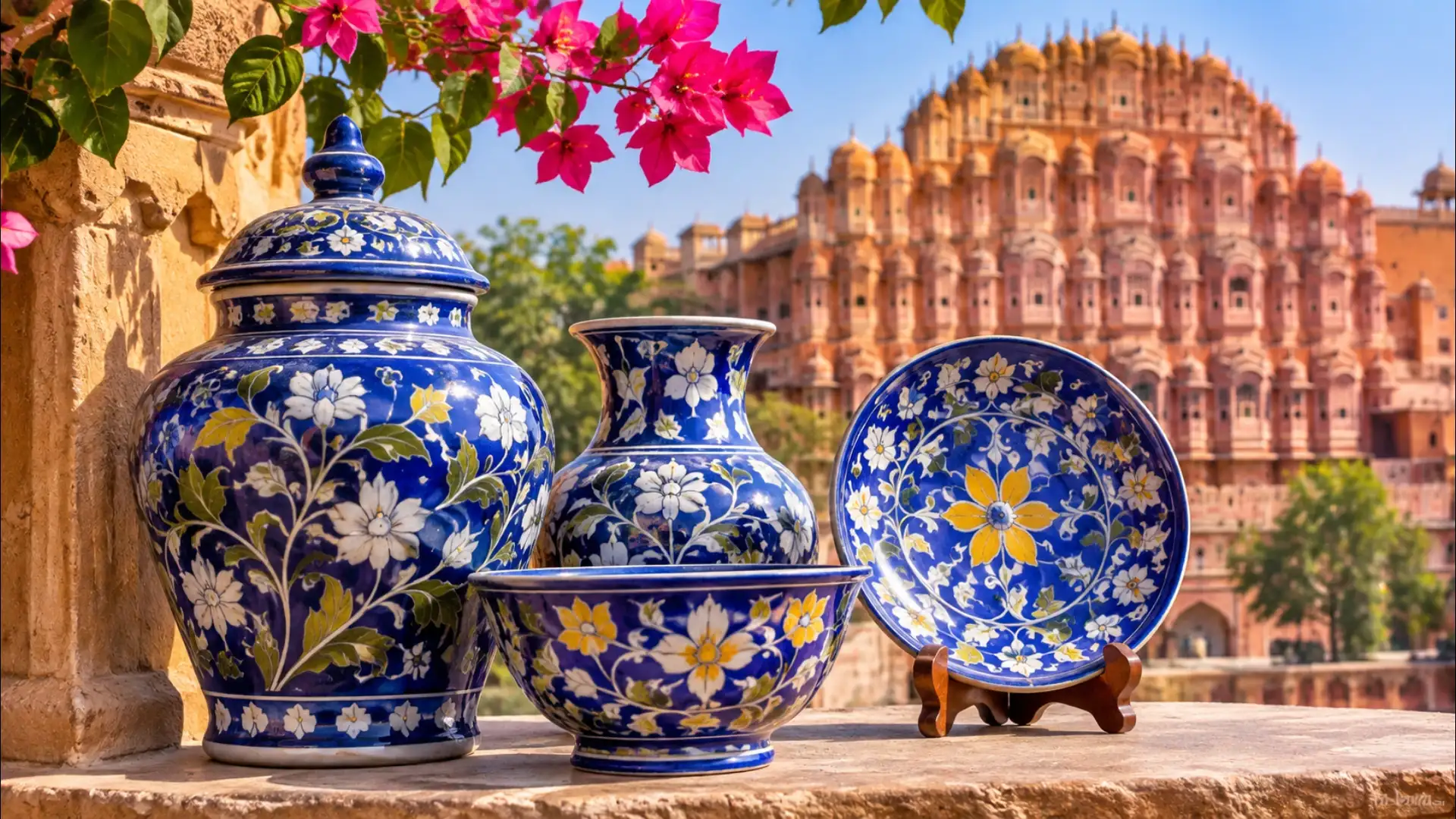
When the Mughal emperors established their empire in the Indian subcontinent, they brought with them a deep appetite for Persian aesthetic culture, in architecture, in miniature painting, in garden design, and in the decorative arts. Craftsmen from Persia and Central Asia followed patronage to Delhi and Agra. The distinctive blue-and-white palette, the floral scrollwork, the stylised birds and fish, all of these entered the visual vocabulary of Mughal court objects. For a time, the craft had a home in the imperial capital.
Ram Singh II, who ruled Jaipur in the nineteenth century, is the figure most consistently credited with actively reviving and anchoring blue pottery in the city. He had a strong interest in the arts and crafts of his state, and he is said to have brought artisans to Jaipur specifically to practise and teach the technique. The Maharaja's School of Art, which he established, became one of the institutional homes where the craft was taught and kept alive. Without that deliberate intervention, the tradition might have thinned out entirely as Mughal patronage declined and the artisans lost their original base of support.
The glaze is applied before the piece is fired, and the cobalt oxide and copper oxide pigments that produce the blue and turquoise colours are painted directly onto the unfired glaze. When the piece goes into the kiln, the glaze melts and the pigments are locked into it permanently. The firing temperature is relatively low compared to stoneware or porcelain, which is why the colours stay bright rather than burning out. The white ground, the fluid brushwork, and the characteristic motifs, lotus flowers, fish, birds, geometric borders, all derive from that Persian and Central Asian inheritance, though Rajasthani craftsmen added local imagery over the generations.
The revival that brought Jaipur blue pottery back to wide visibility is associated with the painter and craft revivalist Kripal Singh Shekhawat, who dedicated decades to learning the technique from its remaining practitioners, refining the recipe and the process, and training a new generation of craftsmen. His workshop became the reference point for the modern form of the craft, and his influence is visible in the work still produced in Jaipur's workshops today. The Kripal Kumbh workshop in the Shiv Nagar area of Jaipur remains one of the places where the tradition he rebuilt is still practised.
What has not changed is the fundamental technique, the quartz body, the tin glaze, the low-fire kiln, the hand-painted cobalt and turquoise. That continuity is what connects a piece made in a Jaipur workshop today to the Persian kilns where the method was first developed. The craft crossed deserts and mountain ranges, survived the collapse of the courts that first supported it, and found its most durable home not in the place it was invented but in a city that chose to keep it.
A Persian Craft That Kept Moving
The technique at the heart of blue pottery is called tin-glazed earthenware, and it is ancient. Persian craftsmen had been coating low-fire clay with an opaque white glaze, painting over it in cobalt blue and turquoise, and firing the whole piece so the pigments fused into the surface. The result was a hard, glass-like finish that did not absorb water and could carry fine decorative detail. This method spread westward into the Islamic world and eventually reached Europe as majolica and Delftware. It moved eastward too, carried by trade, conquest, and the movement of artisans across the courts of Central Asia.When the Mughal emperors established their empire in the Indian subcontinent, they brought with them a deep appetite for Persian aesthetic culture, in architecture, in miniature painting, in garden design, and in the decorative arts. Craftsmen from Persia and Central Asia followed patronage to Delhi and Agra. The distinctive blue-and-white palette, the floral scrollwork, the stylised birds and fish, all of these entered the visual vocabulary of Mughal court objects. For a time, the craft had a home in the imperial capital.
How It Reached Jaipur
The traditional account, repeated by craftsmen and historians of Rajasthani craft alike, holds that blue pottery came to Jaipur through the Mughal connection that the Kachwaha rulers of Amber had cultivated over generations. The rulers of Amber and later Jaipur served as generals and administrators in the Mughal court, and that proximity meant a constant exchange of culture, taste, and skilled labour. Artisans who had worked in Mughal ateliers moved with their patrons or followed the pull of new royal commissions.Ram Singh II, who ruled Jaipur in the nineteenth century, is the figure most consistently credited with actively reviving and anchoring blue pottery in the city. He had a strong interest in the arts and crafts of his state, and he is said to have brought artisans to Jaipur specifically to practise and teach the technique. The Maharaja's School of Art, which he established, became one of the institutional homes where the craft was taught and kept alive. Without that deliberate intervention, the tradition might have thinned out entirely as Mughal patronage declined and the artisans lost their original base of support.
What Makes Jaipur Blue Pottery Different
The clay used in most pottery traditions gives the finished piece its structural strength. Jaipur blue pottery works differently, and that difference is part of what makes it technically unusual. The body of a Jaipur blue pottery piece is not made from the standard red or buff clay of most Indian ceramics. Instead, it is a mixture of quartz stone powder, powdered glass, Multani mitti, the same fuller's earth used in skincare, and a small amount of gum and borax to bind everything together. There is very little actual clay in the mix, which means the material is fragile before firing and requires considerable skill to shape.The glaze is applied before the piece is fired, and the cobalt oxide and copper oxide pigments that produce the blue and turquoise colours are painted directly onto the unfired glaze. When the piece goes into the kiln, the glaze melts and the pigments are locked into it permanently. The firing temperature is relatively low compared to stoneware or porcelain, which is why the colours stay bright rather than burning out. The white ground, the fluid brushwork, and the characteristic motifs, lotus flowers, fish, birds, geometric borders, all derive from that Persian and Central Asian inheritance, though Rajasthani craftsmen added local imagery over the generations.
The Neighbourhood That Kept It Alive
Within Jaipur, the craft concentrated in specific areas of the old walled city and in workshops that passed skills from one generation to the next within families or through the traditional ustad-shagird relationship between a master craftsman and an apprentice. By the mid-twentieth century, blue pottery had contracted significantly. The market for traditional court crafts had collapsed after independence, and many artisans had moved to other work.The revival that brought Jaipur blue pottery back to wide visibility is associated with the painter and craft revivalist Kripal Singh Shekhawat, who dedicated decades to learning the technique from its remaining practitioners, refining the recipe and the process, and training a new generation of craftsmen. His workshop became the reference point for the modern form of the craft, and his influence is visible in the work still produced in Jaipur's workshops today. The Kripal Kumbh workshop in the Shiv Nagar area of Jaipur remains one of the places where the tradition he rebuilt is still practised.
A Craft That Survived by Adapting
Blue pottery has never been a purely static tradition. The Persian originals were functional objects, tiles, water vessels, storage jars. The Mughal court versions moved toward decorative pieces. In Jaipur, the range expanded over time to include objects that had no precedent in the Persian or Mughal repertoire: small decorative tiles, doorknobs, coasters, and objects shaped for contemporary interiors. The motifs have also shifted, with some workshops incorporating local Rajasthani imagery alongside the older floral vocabulary.What has not changed is the fundamental technique, the quartz body, the tin glaze, the low-fire kiln, the hand-painted cobalt and turquoise. That continuity is what connects a piece made in a Jaipur workshop today to the Persian kilns where the method was first developed. The craft crossed deserts and mountain ranges, survived the collapse of the courts that first supported it, and found its most durable home not in the place it was invented but in a city that chose to keep it.