
The Holdall Bedroll That Every Indian Family Carried on the Train

The holdall sat in the corner of every middle-class bedroom like a sleeping animal. Flat most of the year, it came alive a week before a long train journey, filled, rolled tight, and strapped with its own leather buckles until it became a firm cylinder that smelled of naphthalene and old cotton.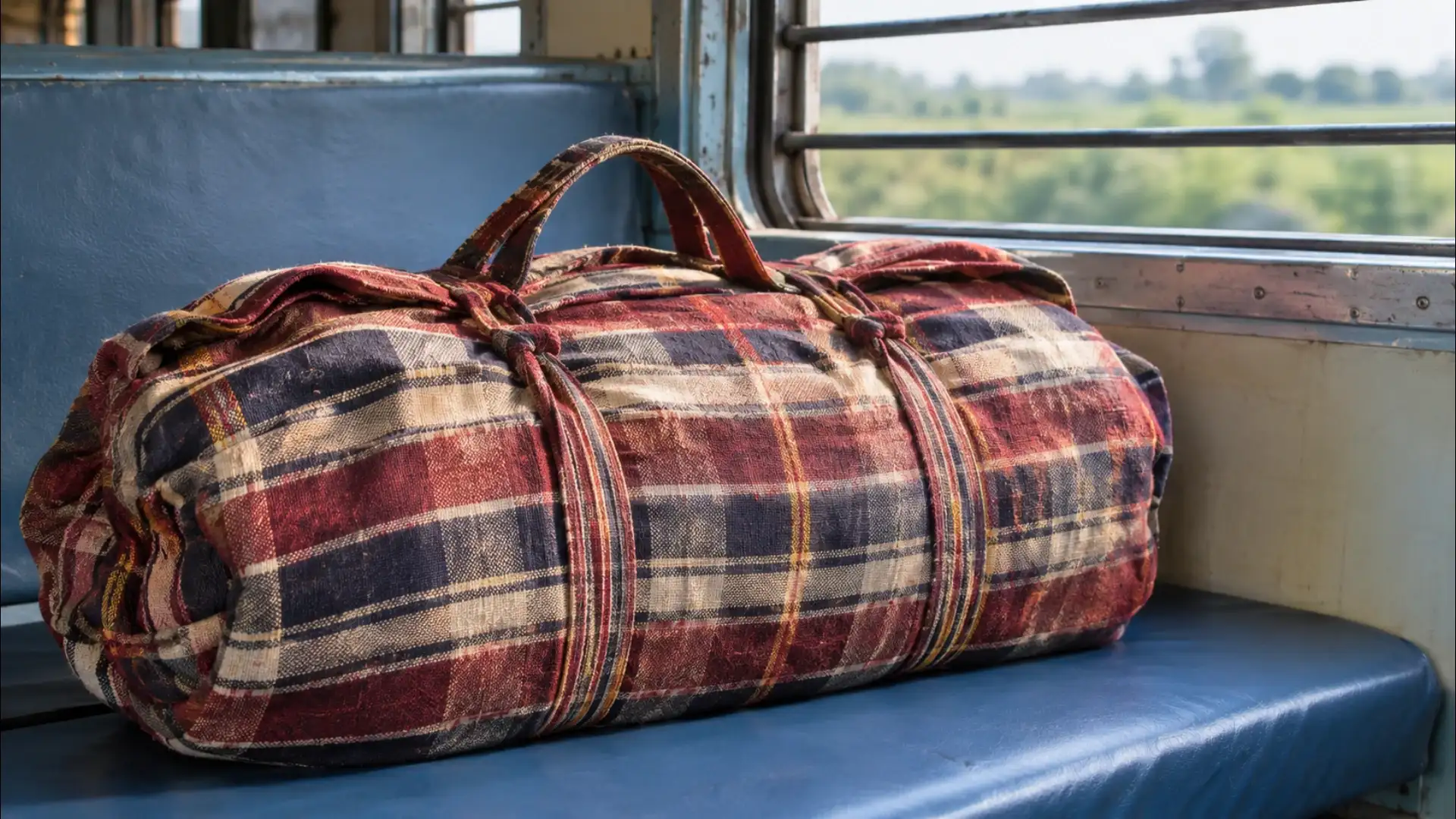
What the Holdall Actually Was
A holdall bedroll was a rectangular piece of heavy canvas, usually khaki or dark green, stitched along three edges to form a shallow sleeve. You laid your bedding flat inside it, two or three cotton sheets, a light razai or quilt depending on the season, a pillow, sometimes a small towel. Then you rolled the whole thing lengthwise, buckled the straps that ran around its girth, and carried it by a central handle or slung it over a shoulder. The finished roll was roughly the size and weight of a sleeping child, about two to three feet long and heavy enough to anchor a luggage rack berth by itself. Families who travelled often had holdalls in two sizes. The large one went on the train. A smaller version, sometimes called a kit bag, went on shorter trips.Why Trains Made It Necessary
Indian Railways ran, and still runs, some of the longest passenger routes in the world. A journey from Delhi to Chennai or from Kolkata to Mumbai could last thirty-six to forty-eight hours. Sleeping on a bare vinyl berth for two nights was not a choice most families would make. The railway did not supply bedding to most classes of travel. Even in first class, the standard for decades was a bedding roll rented from a railway contractor at the station, a service that existed precisely because passengers understood they needed it. Families who travelled more than once a year simply brought their own. The holdall was the answer to a practical problem: how do you carry soft, bulky bedding without it unravelling across a crowded platform?You may also like
- Planning to buy gold this Dhanteras? No hallmarking fees will be charged on these pieces of jewellery—here are the rules..
- Ketu Transit: How It May Impact Zodiac Signs After Diwali
- Neonatal Meningitis: How Complicated Can It Be?
- Why Does Society Think a Girl's Life Begins After Marriage?
- Mount Rushmore was meant to show four US presidents down to the waist, but money ran out and work stopped in 1941, the year sculptor Gutzon Borglum died, leaving just the faces carved into the South Dakota granite
The Ritual of Packing It
Packing the holdall was its own ceremony, usually managed by the oldest woman in the household the evening before departure. The sheets went in first, folded to the width of the canvas. The pillow was placed at one end. The quilt was layered last, because it determined the final diameter of the roll. If a tiffin carrier or a small thermos could be tucked into the fold without making the roll lumpy, it was tucked in. The straps were tightened in a particular order, middle first, then ends, so the roll kept its shape under the weight of other luggage stacked on top. Children were sometimes assigned to sit on the roll while an adult cinched the buckles. This was considered a good job.What It Meant on the Journey
On the train, the holdall did more than carry bedding. It marked territory. Placed on a berth the moment the family boarded, it announced that this berth was taken, occupied, lived in for the next two days. Unrolled, it transformed a bare vinyl surface into something that felt like home, your own sheets, your own smell, the familiar weight of your own quilt. Fellow passengers recognised the holdall as a sign that a family had prepared, had thought ahead, had done this before. Stations along the route had vendors who sold chai and samosas through the window bars. The holdall was the surface those cups rested on between sips.Where It Went
Air-conditioned coaches began supplying bedding rolls as a standard amenity from the 1980s onward, and the practice spread gradually across more classes through the following decades. As the supply of clean linen on board became reliable, the reason to carry your own disappeared. Synthetic luggage with wheels replaced canvas holdalls in most households through the 1990s. The holdall did not vanish, it retreated. Old ones still live in the upper shelves of almirahs in homes where someone's grandmother has not yet agreed to throw it out. A few canvas goods shops in older city markets still stock them, mostly for institutional buyers: army cantonments, boarding schools, the occasional family that simply prefers the old system. The smell of naphthalene from a half-unrolled holdall is, for a certain generation, the precise smell of a journey about to begin. That is not nostalgia. That is what smell memory does, it stores the feeling of a thing more accurately than any photograph.





Loving Newspoint? Download the app now
