The Strangest Survival Tricks Found in Rainforest Plants: Nature's Wildest Inventions

Tropical rainforests are often portrayed as peaceful, lush paradises bursting with vibrant life. However, beneath the dense green canopy lies one of the most competitive and unforgiving environments on the planet. Millions of species constantly fight for three essential resources: sunlight, physical space, and vital soil nutrients. While animals can run, fly, or hunt to secure food, stationary vegetation must rely on extraordinary evolutionary adaptations to survive. To overcome dim light on the forest floor, nutrient-poor soil, and hungry plant-eating animals, rainforest flora has developed mind-bending strategies. Exploring the strangest survival tricks found in rainforest plants reveals a fascinating world of carnivorous traps, chemical warfare, deceptive trickery, and unexpected partnerships with the animal kingdom.
Carnivorous pitchers that trap and digest unsuspecting insects
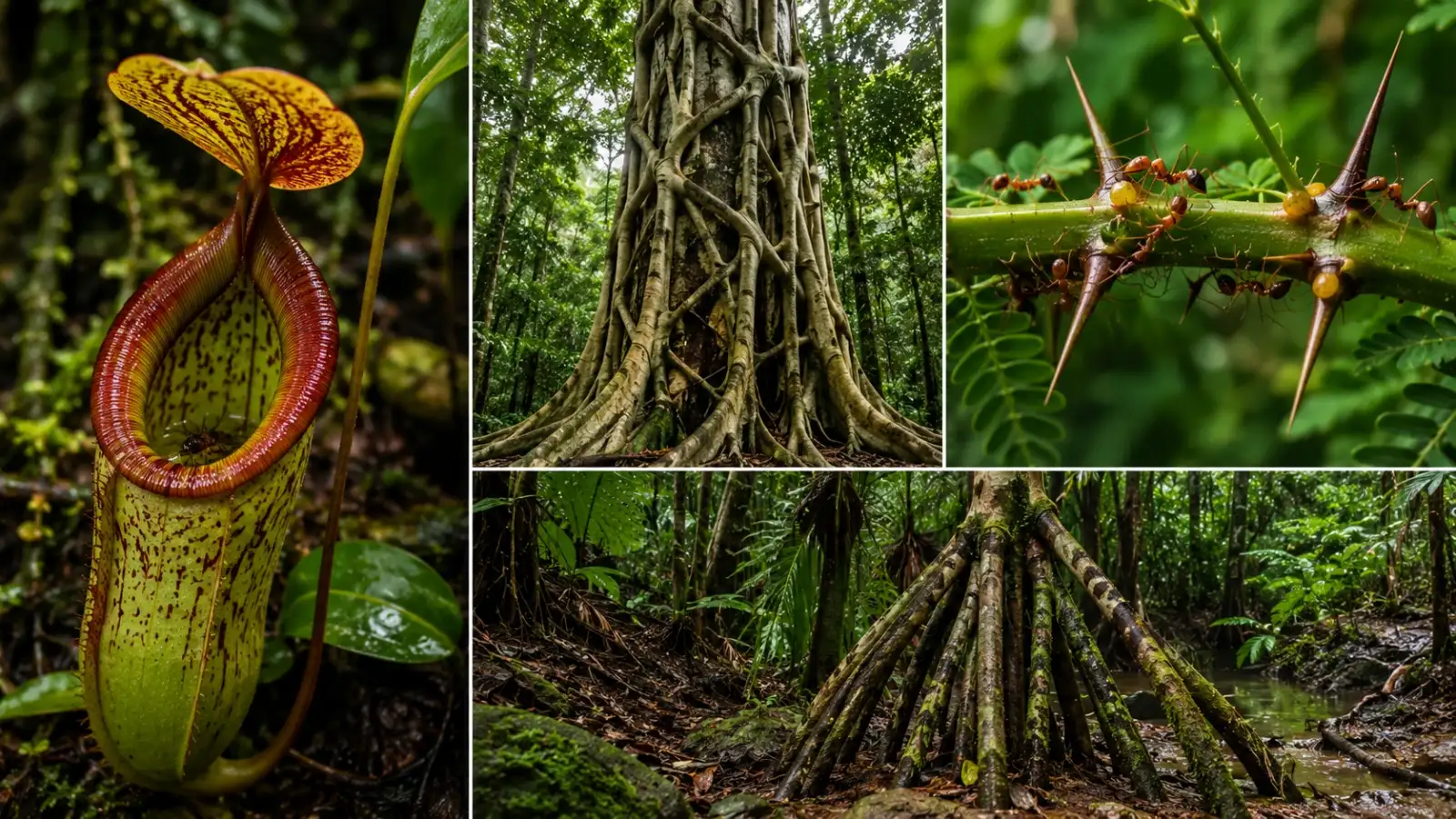
In many tropical jungles, heavy downpours continuously wash away essential soil nutrients like nitrogen and phosphorus. To survive in these nutrient-poor soils, species like the pitcher plant have abandoned traditional root-feeding tactics altogether. These clever plants grow modified, cup-shaped leaves filled with a watery cocktail of digestive enzymes. The rim of the pitcher is slippery and coated in sweet, irresistible nectar. When inquisitive insects land on the slippery edge to sip the sweet liquid, they lose their footing and plunge directly into the fluid below. Waxy inner walls prevent the trapped prey from climbing out, allowing the plant to slowly dissolve the insects and absorb crucial nutrients directly through its leaves.Strangler figs that steal sunlight from giant forest trees
The battle for sunlight on the dark forest floor is exceptionally fierce, with only two percent of sunlight reaching the ground. The strangler fig uses an ingenious yet ruthless strategy to skip the difficult growth stage in the shade. Its journey begins high in the upper canopy, where birds deposit seeds onto the branches of tall, mature trees. The young fig sprouts as an epiphyte, absorbing moisture from the humid air. As it grows, it sends long aerial roots downward toward the forest floor. Once these roots touch the ground and tap into soil nutrients, the strangler fig thickens rapidly, wrapping a wooden lattice around its host tree. Over time, it steals all the sunlight and crushes the host tree from the outside, eventually leaving behind a hollow, self-supporting tree tower.Mutualistic relationships that turn aggressive ants into bodyguards
Plants face constant threats from hungry caterpillars, beetles, and large herbivores. The bullhorn acacia tree defends itself by forming a remarkable alliance with aggressive stinging ants. The tree provides the ant colony with hollow thorn structures for safe housing, along with sweet nectar secreted from special leaf glands. In exchange for free room and board, the ants act as a fierce standing army. Whenever a herbivore touches the tree branches or a climbing vine tries to choke its leaves, thousands of ants swarm out to deliver painful stings and bite the invader. This bodyguard system keeps the tree completely clear of pests and competing vegetation.Walking palm trees that move physical locations over time
Perhaps one of the most unbelievable botanical phenomena in tropical regions is the walking palm tree. Unlike standard trees with a single central taproot, this palm features an unusual stilt-like root system raised high above the soil. If a neighbouring tree falls and blocks out sunlight, or if the soil beneath it erodes during a landslide, the walking palm grows new stilt roots toward sunny, stable patches of ground. As the new roots anchor firmly into the soil, the old roots on the dark side wither away and rot. Over many years, this process allows the tree to physically shift its location by several centimetres, effectively walking toward better light and nutrients.Redefining botanical intelligence in extreme environments
Uncovering the strangest survival tricks found in rainforest plants shows how dynamic and adaptable nature can be. These extraordinary strategies prove that vegetation is far from passive. Through millions of years of evolution, jungle flora has mastered the art of survival, turning the harsh rainforest into a display of living wonders.Next Story