
7 Indian Cities That Will Transform How You Decorate Your Home

India does not have one design tradition. It has dozens, each rooted in a specific place, a specific material, and a specific way of living. The cities below are not shopping guides, they are living archives of craft logic that home decorators keep returning to, not because the objects are pretty, but because the thinking behind them is sound.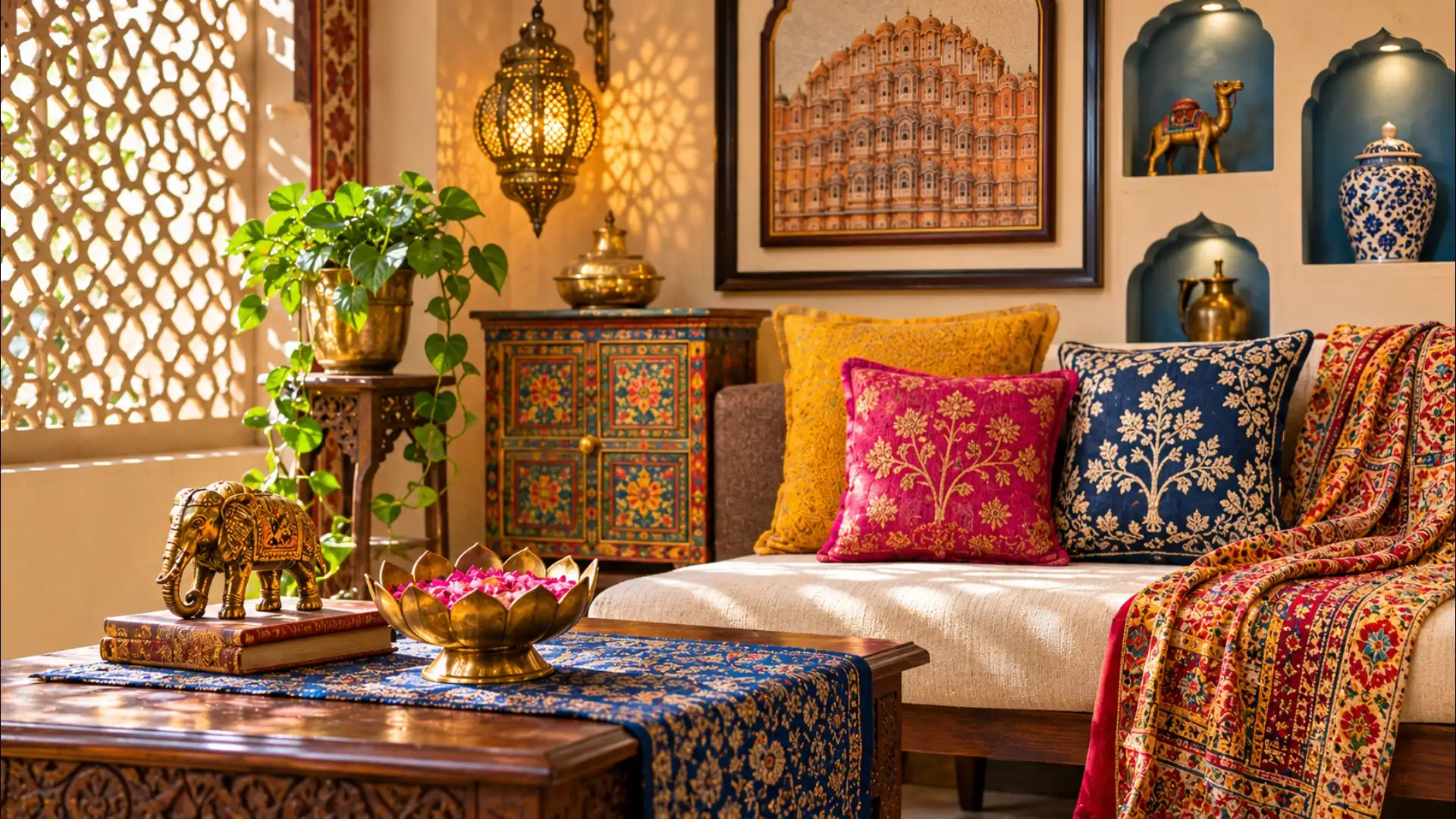
These seven cities share one underlying principle: their craft traditions were not invented for aesthetics. They were invented to solve problems of climate, trade, material availability, and social ritual. When you bring those objects into a home, you bring the problem-solving with them, and that is what makes them last.
Jaipur, The Grammar of Colour
Jaipur teaches restraint through excess. The old city's blue pottery, a Persian-influenced craft that uses no actual clay from the earth, only quartz powder and glass, produces a white base that takes colour in a way terracotta never does. The turquoise and cobalt pieces that line Johari Bazaar are not decorative accidents. The palette was engineered for desert light, where the sun is harsh and walls need to push back. Bring that logic home: in rooms with strong afternoon light, cool blues and whites hold their own where warmer tones wash out. Beyond pottery, Jaipur's block-printed textiles carry a repeat-pattern discipline worth studying. The motifs are dense but never chaotic, because each block is hand-carved to leave breathing room between prints.Ahmedabad, Wood, Light, and the Pol House
The old pols of Ahmedabad, dense, interlocking neighbourhood clusters built over centuries, solved a ventilation problem that air conditioning now sidesteps. Carved wooden facades with jharokhas, the projecting bay windows, caught cross-breezes and filtered harsh light into something golden and diffuse. The carving itself is not decorative in origin; the depth of the lattice determined how much air moved through. For home decoration, the lesson is structural: a screen or a partition earns its place when it does two things at once. Ahmedabad's craft tradition also produces a distinctive furniture timber work, often in teak, where joints are visible and celebrated rather than hidden.Kolkata, Cast Iron and the Long Afternoon
Kolkata's colonial-era architecture left behind a vocabulary of cast iron that the city absorbed and made its own. The railings on North Kolkata's crumbling mansions, the grilles on old apothecary windows, the gates of the Marble Palace, all of them demonstrate how metal can carry ornament without weight. The city also has a strong tradition of kantha embroidery, running stitch on layered cotton that produces a subtle texture visible only up close. In a room, kantha works the way a good rug works, it rewards the person who sits near it without demanding attention from across the room.Varanasi, Silk, Geometry, and the Logic of Brocade
Banarasi silk weaving is one of the most technically demanding textile traditions in the world. The zari work, real silver or gold thread woven into the fabric, follows geometric rules that have been refined over several hundred years. For home decoration, the relevant insight is not the silk itself but the proportion logic embedded in the weave: a heavy border against a quiet field. Curtains, cushion covers, and table runners that follow this structure, rich at the edge, calm at the centre, hold a room together in a way that all-over pattern rarely does. Varanasi also produces a distinctive brass and bell-metal work, used in temple lamps, that translates well into domestic lighting.Mysuru, Inlay, Ivory-Work Substitutes, and the Palace Palette
Mysuru's design inheritance comes largely from the Wadiyar-era palace complex, whose interiors mixed European structural ambition with South Indian ornamental instinct. The result is a palette, deep greens, ochres, and gold, that reads as both formal and warm. The city's rosewood inlay craft, now practised with alternative materials as rosewood supply has tightened, produces furniture with a surface geometry that photographs poorly but rewards touch. Mysuru also carries a strong agarbatti and incense culture that bleeds into home ritual: the way fragrance is used in a room, and from which corner, is a decorative decision as much as a sensory one.Kutch, White Ground, Mirror Work, and Negative Space
The Rann of Kutch produces one of India's most distinctive craft clusters. The white ground of the landscape appears to have shaped the white-ground textile tradition: embroidery here uses mirrors and coloured thread against undyed cotton or wool, so the light source becomes part of the decoration. In a room, mirror-work textiles do something that painted surfaces cannot, they change with the time of day and with where you stand. Kutch also has a strong mud-work tradition, lippan kaam, where geometric relief patterns are applied to walls using a mix of mud and camel dung, then inlaid with mirrors. The technique is specific to the region, but the principle, a textured wall surface that catches light differently at different hours, is transferable.Chettinad, Stone, Dark Wood, and the Architecture of Arrival
The Chettinad mansions of Tamil Nadu's Sivaganga district were built by a merchant community that traded across Southeast Asia and brought materials back with them: Burmese teak, Italian marble, Belgian glass, Athangudi clay tiles in geometric patterns. The result is an interior logic where the entrance hall is the most elaborate room, and the living spaces become progressively quieter as you move inward. That sequencing, loud at the threshold, calm at the centre, is worth borrowing. Athangudi tiles, still made by hand in the region using a cold-press process, have a surface depth that machine-made cement tiles do not replicate. The colour comes from oxide pigments mixed into the concrete before pressing, which means the colour runs through the tile rather than sitting on its surface.These seven cities share one underlying principle: their craft traditions were not invented for aesthetics. They were invented to solve problems of climate, trade, material availability, and social ritual. When you bring those objects into a home, you bring the problem-solving with them, and that is what makes them last.
Next Story