
Vada Pav: How a Snack Outside Dadar Station Became Mumbai's Own

Mumbai has given India a great many things, Bollywood, the dabbawalas, the local train. But nothing travels as light or lands as hard as vada pav. It costs next to nothing, takes thirty seconds to eat, and carries the particular flavour of a city that has always been in a hurry. The story of how it got there is the story of Mumbai itself: migration, mills, and a man with a tawa outside Dadar station.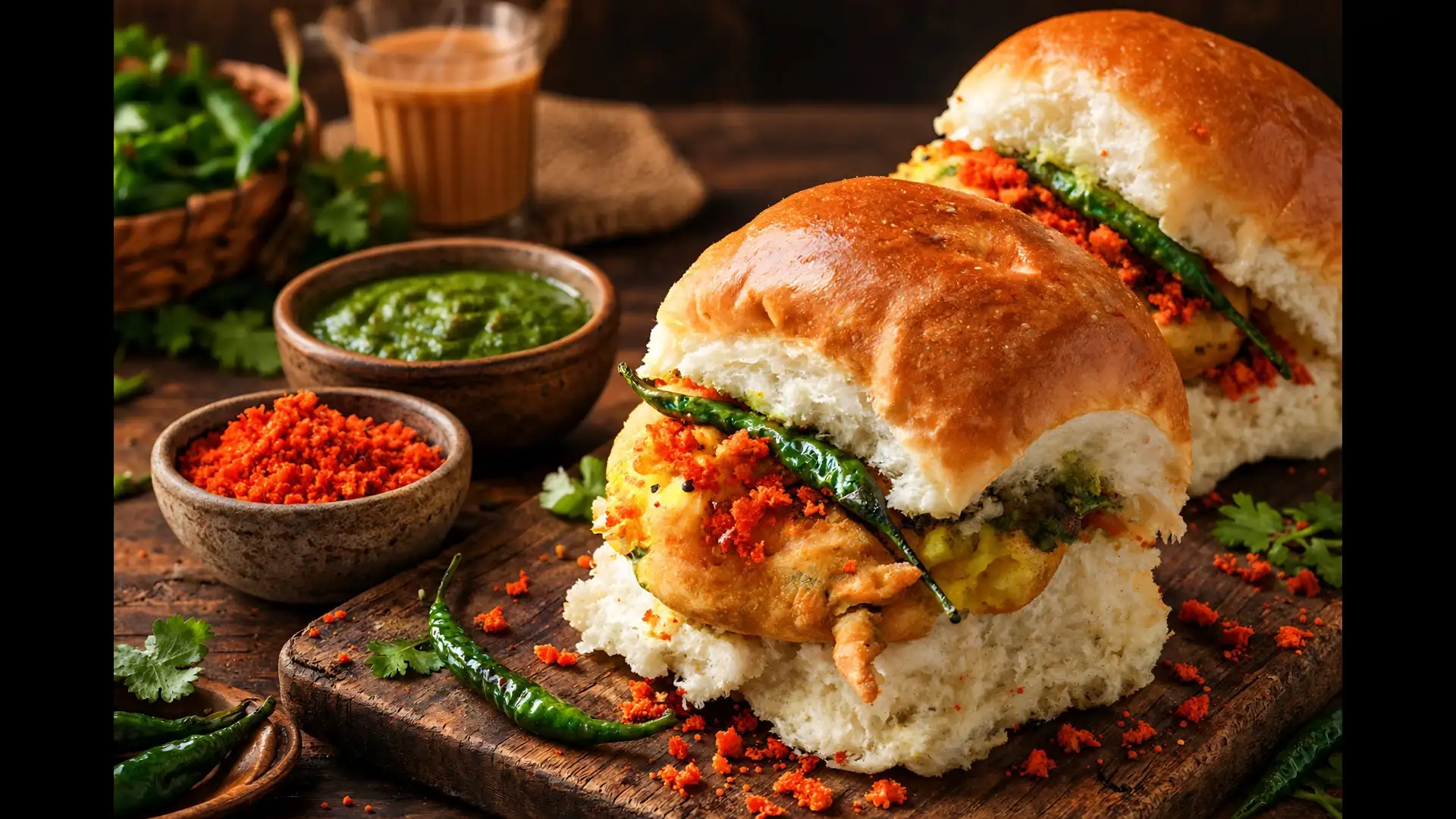
The Man and the Stall
Ashok Vaidya is credited with selling the first vada pav in 1966 from a stall just outside Dadar railway station. The details are modest: a portable setup, a kadai of hot oil, freshly made batata vada tucked into a pav bun, and a dry red chutney made from dried coconut and garlic. Vaidya was a Maharashtrian from Pune who saw a gap, mill workers and commuters needed something they could eat standing up, with one hand, between shifts. The pav was already present in Mumbai because of the Portuguese, who introduced bread baking to the city's western coast centuries earlier. The batata vada was already a Maharashtrian snack. Vaidya simply put them together and priced them low enough that a textile worker on a daily wage could afford several.Why Dadar, and Why Then
Dadar in the 1960s was not the busy interchange it is today in name alone, it was the beating heart of Mumbai's Marathi-speaking working class. The textile mills of central Mumbai employed hundreds of thousands of workers, most of them migrants from the Konkan coast and from Maharashtra's interior districts. They arrived at Dadar by the thousands every morning, and they left the same way every evening. They needed food that cost little, filled fast, and did not require sitting down. Vada pav answered all three. It spread from mill gate to mill gate the way good cheap food always does: by word of mouth, by proximity, by the fact that the next man eating one looked satisfied. By the time the mills began to close in the 1980s and 1990s, a slow collapse that remade the city's economy and its geography, vada pav had already escaped its origins. It no longer needed the mills to survive. The city had absorbed it.You may also like
- Ramayana Box Office Collection Day 5: Ranbir Kapoor's Film Makes History With Rs 107.50 Crore Monday Earnings
- Gold and Silver Prices Drop on Govardhan Puja; Check the Latest Rates in Your City
- After losing their husbands, two Pune mothers took up professional driving to support their daughters; a local training programme has now helped around 75 women find jobs paying Rs 25,000 to Rs 50,000 a month
- Can't Stop Thinking at Night? Why Your Mind Becomes Active at Bedtime and How to Sleep Better
- Feeling Tired After Waking Up? 5 Warning Signs of Low Cortisol You Should Know
What Goes Into It, and Why It Works
The batata vada is a boiled potato mixture, mashed with mustard seeds, green chilli, turmeric, and curry leaves, shaped into a ball and dipped in a besan batter before being deep-fried. The pav is a soft, slightly sweet white bread roll, closer to a dinner roll than a baguette, baked in the Portuguese tradition that took root in Goa and then in Mumbai. The dry garlic chutney, lasan chutney, is the thing that makes the combination more than the sum of its parts. It is coarse, sharp, and hot, and it sits between the vada and the pav rather than being spread like a condiment. A green chutney of coriander and chilli is often added alongside. The whole thing is pressed together and handed over wrapped in a piece of newspaper or a small sheet of brown paper. There is no plate. There is no cutlery. The architecture of the snack is inseparable from the life it was designed for.From Dadar to Every Corner
The geography of vada pav in Mumbai is a kind of map of the city's commuter arteries. It clusters around railway stations, Dadar, Kurla, Thane, Borivali, Andheri, because that is where people are moving fast and need to eat. It appears outside colleges, at bus depots, near construction sites, and at the edge of every market. The price has always been part of the identity. When a city goes through decades of inflation and the vada pav seller absorbs as much of it as he can before reluctantly raising the price by one rupee, that restraint is noticed. Mumbaikars talk about it the way people talk about a civic institution holding the line. Chains and restaurants have tried to formalise it, to put it in a clean box, give it a logo, sell it with a loyalty card. Some have survived. But the version that defines the snack is still the one made at a cart, eaten standing up, finished in four bites.What the Snack Carries
Food historians who write about Mumbai street food often note that vada pav is unusual because its origin is documented and its inventor is named. Most street foods dissolve into anonymity over generations. Vada pav did not, partly because Mumbai's food writers and journalists took an interest early, and partly because Ashok Vaidya's family continued the stall at Dadar long after the snack had become city-wide. The stall at Dadar is still pointed to as the original. That specificity matters. It means vada pav is not just a type of food, it is a place, a moment, and a man who looked at a city of workers and asked what they needed. The answer was simple and it turned out to be permanent.





Loving Newspoint? Download the app now
