
What Kabir Meant When He Said He Found God in His Own Breath


Kabir was a weaver who lived in Varanasi, probably in the fifteenth century, and he spent a considerable portion of his life annoying everyone. He annoyed the priests by saying the Vedas were not the whole story. He annoyed the mullahs by saying the Quran was not the whole story either. He annoyed the devout by suggesting that pilgrimage, fasting, and ritual were elaborate ways of avoiding the one thing that actually mattered. What he kept pointing back to, in doha after doha, was something so close it had no address: the breath moving in and out of the body, right now, without being asked.
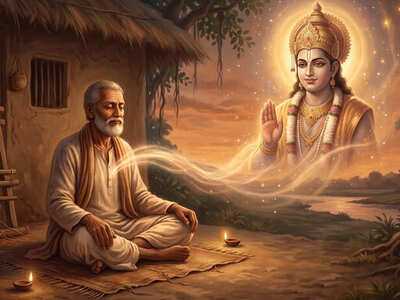
The Verse That Started the Argument
 Ancient manuscript pages, hinting at Sant tradition and finding God within.
One of Kabir's most repeated lines, found across several oral and manuscript traditions, runs roughly: "Jab main tha tab Hari nahin, ab Hari hai main nahin." When I was, God was not. Now God is, and I am not. The line sounds like a riddle, and it is, but it is a riddle with a very specific answer. What Kabir means by "when I was" is the state of being absorbed in the self, in its wants, its grievances, its performance of piety. That absorption, he says, is exactly what blocks the thing it claims to be seeking. The moment the self quiets, something else becomes audible. He calls that something Hari, Ram, Sahib, names he uses not as theology but as placeholders for an experience that resists naming.
Why He Chose the BreathKabir was not a philosopher who wrote treatises. He was a poet who worked in images a weaver or a dyer or a market-goer could hold. The breath was the most democratic image available to him. It required no learning, no caste standing, no access to a text. Every person in his audience was already doing it. In several of his verses he calls the breath "the unstruck sound", a reference to the concept of anahat nada in the yogic and Sant traditions, the vibration that exists before any instrument is struck, before any word is spoken. The breath, for Kabir, was not a metaphor for the divine. It was the place where the divine was actually operating, continuously, whether or not the person carrying the body had noticed.
What He Was Arguing Against
To understand what Kabir meant, it helps to understand what he was pushing back on. In his time, as in any time, organised religion offered a geography of the sacred: certain places were holier than others, certain texts held more power, certain intermediaries had better access. Kabir's argument was not that these things were worthless. It was that they had become a way of exporting the search, of locating God at a distance that required travel, expertise, or money to close. His verses are full of gentle mockery of this: the pilgrim who walks five hundred miles and misses the thing sitting in his own chest, the pundit who can recite every verse and has never once been still enough to hear what the verses are pointing at. The breath was his counter-argument. You cannot outsource it. You cannot hire someone to breathe for you. Whatever is happening in the breath is happening to you, only to you, right now.
The Sant Tradition He Was Part Of
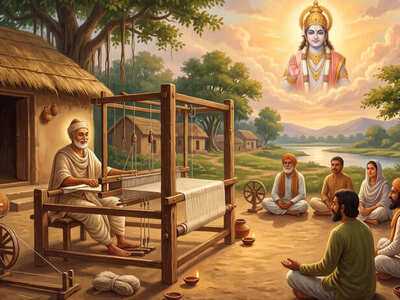 He is considered one of the central figures in the Nirgun Sant tradition, poets and mystics who wrote about a God without form or attribute, a divine that could not be painted, sculpted
Kabir did not arrive at this alone. He is considered one of the central figures in the Nirgun Sant tradition, poets and mystics who wrote about a God without form or attribute, a divine that could not be painted, sculpted, or confined to a single faith. The tradition includes Ravidas, Namdev, Mirabai, and later Guru Nanak, whose own teachings carry strong echoes of Kabir's insistence on direct inner experience over inherited ritual. What the Sants shared was a suspicion of mediation. Not a rejection of devotion, Kabir's verses are soaked in longing, but a rejection of the idea that devotion required a specialist. In this tradition, the breath as a site of encounter with the divine is not a metaphor. It is a practice. Several of Kabir's dohas read as instructions: be still, listen, the thing you are looking for is making a sound right now.
What Changes When You Take Him SeriouslyReading Kabir as philosophy is one thing. Taking him seriously as a practical claim is another. His assertion is not that God is a feeling of peace, or that meditation is relaxing, or that mindfulness is good for you. His assertion is harder than that: that the ordinary fact of being alive and breathing is already the encounter, and that most people spend their lives elaborating reasons not to notice it. The implications are uncomfortable. If he is right, no amount of additional ritual, pilgrimage, or learning closes the gap, because the gap was never spatial or doctrinal. It was attentional. What Kabir offers is not comfort. He offers a direction: inward, and then quieter.
Five centuries after his death, his verses are still sung at dawns in Varanasi, still quoted in arguments about faith, still capable of irritating people who would prefer a simpler answer. That persistence is probably the best evidence for what he was pointing at. The breath kept moving. The argument kept arriving.
Unlock insightful tips and inspiration on personal growth, productivity, and well-being. Stay motivated and updated with the latest at My Life XP.
The Verse That Started the Argument
One of Kabir's most repeated lines, found across several oral and manuscript traditions, runs roughly: "Jab main tha tab Hari nahin, ab Hari hai main nahin." When I was, God was not. Now God is, and I am not. The line sounds like a riddle, and it is, but it is a riddle with a very specific answer. What Kabir means by "when I was" is the state of being absorbed in the self, in its wants, its grievances, its performance of piety. That absorption, he says, is exactly what blocks the thing it claims to be seeking. The moment the self quiets, something else becomes audible. He calls that something Hari, Ram, Sahib, names he uses not as theology but as placeholders for an experience that resists naming.
Why He Chose the BreathKabir was not a philosopher who wrote treatises. He was a poet who worked in images a weaver or a dyer or a market-goer could hold. The breath was the most democratic image available to him. It required no learning, no caste standing, no access to a text. Every person in his audience was already doing it. In several of his verses he calls the breath "the unstruck sound", a reference to the concept of anahat nada in the yogic and Sant traditions, the vibration that exists before any instrument is struck, before any word is spoken. The breath, for Kabir, was not a metaphor for the divine. It was the place where the divine was actually operating, continuously, whether or not the person carrying the body had noticed.
What He Was Arguing Against
To understand what Kabir meant, it helps to understand what he was pushing back on. In his time, as in any time, organised religion offered a geography of the sacred: certain places were holier than others, certain texts held more power, certain intermediaries had better access. Kabir's argument was not that these things were worthless. It was that they had become a way of exporting the search, of locating God at a distance that required travel, expertise, or money to close. His verses are full of gentle mockery of this: the pilgrim who walks five hundred miles and misses the thing sitting in his own chest, the pundit who can recite every verse and has never once been still enough to hear what the verses are pointing at. The breath was his counter-argument. You cannot outsource it. You cannot hire someone to breathe for you. Whatever is happening in the breath is happening to you, only to you, right now.
The Sant Tradition He Was Part Of
Kabir did not arrive at this alone. He is considered one of the central figures in the Nirgun Sant tradition, poets and mystics who wrote about a God without form or attribute, a divine that could not be painted, sculpted, or confined to a single faith. The tradition includes Ravidas, Namdev, Mirabai, and later Guru Nanak, whose own teachings carry strong echoes of Kabir's insistence on direct inner experience over inherited ritual. What the Sants shared was a suspicion of mediation. Not a rejection of devotion, Kabir's verses are soaked in longing, but a rejection of the idea that devotion required a specialist. In this tradition, the breath as a site of encounter with the divine is not a metaphor. It is a practice. Several of Kabir's dohas read as instructions: be still, listen, the thing you are looking for is making a sound right now.
What Changes When You Take Him SeriouslyReading Kabir as philosophy is one thing. Taking him seriously as a practical claim is another. His assertion is not that God is a feeling of peace, or that meditation is relaxing, or that mindfulness is good for you. His assertion is harder than that: that the ordinary fact of being alive and breathing is already the encounter, and that most people spend their lives elaborating reasons not to notice it. The implications are uncomfortable. If he is right, no amount of additional ritual, pilgrimage, or learning closes the gap, because the gap was never spatial or doctrinal. It was attentional. What Kabir offers is not comfort. He offers a direction: inward, and then quieter.
Five centuries after his death, his verses are still sung at dawns in Varanasi, still quoted in arguments about faith, still capable of irritating people who would prefer a simpler answer. That persistence is probably the best evidence for what he was pointing at. The breath kept moving. The argument kept arriving.
Unlock insightful tips and inspiration on personal growth, productivity, and well-being. Stay motivated and updated with the latest at My Life XP.
Next Story