
What the Vedic Ritual of Yajna Actually Encodes About Giving Away What You Most Want to Keep


The fire has always known the differenceThere is a reason the Rigveda specifies what goes into the yajna kund and what does not. Ghee, not water. Grain at its peak, not the chaff. The animal, if offered, had to be without blemish. The ancient priests were not being ceremonially fussy. They were encoding a psychological law that most of us spend our lives evading: the offering is only an offering if it costs you something real.
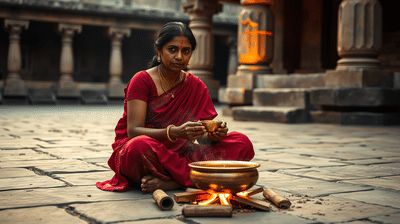 Bhagavad Gita 4.24 states that Brahman is the oblation, Brahman is the fire, Brahman is the one who offers. Commentators have read this as a statement of cosmic unity. It is also a statement about the structure of genuine giving. When the giver, the gift, and the fire collapse into one, there is no safe distance from which to donate. You cannot give from the overflow and call it yajna. The ritual refuses that transaction.
What you most want to keep is the pointThe Vedic tradition did not ask for your second-best cow. It asked for the one you had named. This is the part that gets softened in modern retellings of sacrifice, the specificity of the loss. We prefer to think of giving as generous abundance flowing outward, a surplus that wants to move. But yajna is structured around the opposite premise. The offering gains its power precisely because the giver wanted it.
This is not cruelty dressed as spirituality. It is a precise diagnosis of how attachment works. What you most want to keep is the thing that is most keeping you. The fire does not need your ghee. The fire needs you to find out what you are holding so tightly that your hand has gone numb around it.
Bhagavad Gita 3.9 draws the line clearly: action performed as yajna liberates; action performed for oneself binds. The distinction is not between action and inaction. It is between giving from the self and giving the self. The ritual form of yajna makes this concrete, physical, irreversible. Once the offering enters the fire, there is no retrieving it. That irreversibility is the teaching. Surrender is not the same as lossThe Sanskrit word for what yajna produces is not shunya, emptiness. It is prasad, grace, what returns. This is the part of the logic that the ritual holds together and that the psychological reading of sacrifice tends to miss. Giving the thing you most want to keep does not leave a void. It leaves a different kind of space.
But this cannot be used as a bargain. The moment you give in order to receive prasad, you have not performed yajna, you have performed a transaction. The Bhagavad Gita 17.11 identifies this distinction explicitly, calling the yajna performed without desire for fruit as sattvic, and the one performed with expectation as rajasic. The fire knows the difference. Or rather: you know the difference, and the fire is the witness to what you actually did.
Surrender, in this frame, is not the same as loss because the self that was gripping the object is not the self that remains after the offering. What you thought you were protecting turns out to have been protecting you from something larger. The ritual is designed to make that moment of recognition unavoidable. What this means when there is no fireMost people will never perform a formal yajna. The question the ritual poses does not require one. The encoding survives the ceremony.
What are you holding that you have already decided you cannot give? A version of yourself that no longer fits. A relationship you have outgrown but cannot release because releasing it means admitting you chose wrong. A grievance that has become so familiar it functions as identity. An ambition you have carried so long that surrendering it feels like surrendering the person who carried it.
These are the offerings the tradition was pointing at. Not because letting them go is easy, the ritual never pretended it was, but because the grip itself is the problem. Dharma, in the Bhagavad Gita's framing, is not a moral rulebook. It is the right action for the moment you are actually in, not the moment you wish you were in. Yajna is the practice of finding out which one you are confusing for the other.
The thing you most want to keep is almost always the thing that is keeping you from finding out what you are without it. That is not a reason to give it away carelessly. It is a reason to look at it honestly, in the light of whatever fire you have available to you.
Bhagavad Gita 3.9 draws the line clearly: action performed as yajna liberates; action performed for oneself binds. The distinction is not between action and inaction. It is between giving from the self and giving the self. The ritual form of yajna makes this concrete, physical, irreversible. Once the offering enters the fire, there is no retrieving it. That irreversibility is the teaching. Surrender is not the same as lossThe Sanskrit word for what yajna produces is not shunya, emptiness. It is prasad, grace, what returns. This is the part of the logic that the ritual holds together and that the psychological reading of sacrifice tends to miss. Giving the thing you most want to keep does not leave a void. It leaves a different kind of space.
Next Story