
Why are school buses almost always painted in yellow?


A school bus is a vehicle used only to carry children to and from school, and in India the standard version is painted a shade called golden yellow that most parents and drivers can spot from a long way off. This post explains why Indian school buses are yellow, which rules say so, and what the colour is meant to do for children and for everyone else sharing the road. AIS-063 is the Indian Automotive Industry Standard that sets specialised safety and design requirements for school buses, built upon the foundation of the AIS-052 Code of practice for bus body design and approval. It applies to M2 and M3 category vehicles with a seating capacity of 13 passengers or more (excluding the driver) used for school transportation.
Why did school buses need a standard colour at all?
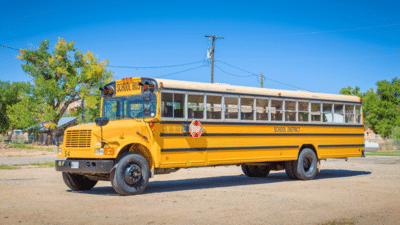
Before 1939, children in the United States rode to school in trucks and buses of every colour. The American education expert Frank Cyr gathered transport officials at Columbia University in New York , where they chose one orange-tinged yellow for every school bus so that children’s vehicles would be easy to recognise and cheaper to build, and much of the world has followed that convention since. AIS-063 does not explain its own choice of colour and states only a general aim of maximising safety and minimising the severity of injuries, so the reasons usually offered for India’s yellow buses are the visibility reasons that came out of that 1939 meeting.
How was this particular yellow colour chosen?
The education expert recalled that he hung strips of paint in fifty shades, running from lemon yellow to deep orange-red, on the conference room wall, and that a small group chosen from the delegates then made the final selection. Some districts had already adopted yellow by then, while others wanted red, white and blue. The chosen shade is not a pure spectral yellow but is halfway between the wavelengths that excite the red and green cones in the eye, so it stimulates both at once and sends a stronger signal to the brain.
Does Indian law say school buses must be yellow?
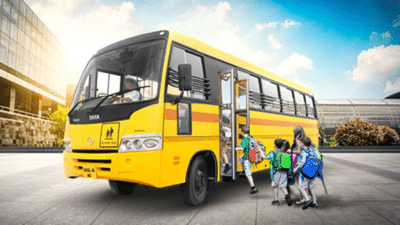
Yes, and the central standard is specific about it, because AIS-063 says every school bus must have an external colour of golden yellow, with the exact shade defined by reference to the Indian Standard IS 5. The standard allows an optional band in golden brown, 150 mm wide, on all sides of the bus below window level, but it makes clear that the band is not compulsory.
Why does this matter to everyone on the road?
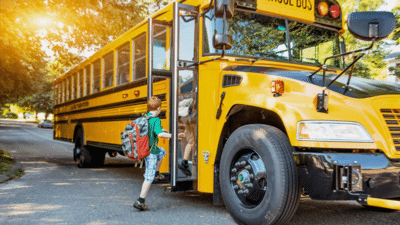
Drivers are told to watch the area around a slowing or stopped bus as well as the bus itself, because children wait several feet away from it and often cross the street while boarding or getting off. Flashing yellow lights mean the bus is preparing to stop to load or unload children, so a driver who sees them should slow down and get ready to stop rather than speeding past. Flashing red lights with an extended stop arm mean the bus has stopped and children are getting on or off, and the driver must stay put until the lights stop flashing, the arm is withdrawn and the bus moves again. Passing a bus while its stop arm is out and its red lights are flashing is illegal in every state, and the agency calls illegal passing a serious threat to children and other people on the road.
Large buses protect children through strong, closely spaced seats with energy-absorbing backs instead of seat belts, while small buses weighing 10,000 pounds or less must have lap or lap and shoulder belts. Parents can help too by teaching children to wait at least ten feet from the curb, to stay away from the back of the bus, and to make eye contact with the driver before crossing in front of it.
Almost every school bus is yellow because a group of officials in 1939 decided that one highly visible shade would make children safer and buses cheaper to build, and the choice has lasted because drivers have learned to read it as a warning. So when you next see a bus flashing yellow, slow down and be ready to stop, and when the red lights come on, stay where you are until the arm folds in and the bus starts moving again.
Why did school buses need a standard colour at all?
Before 1939, children in the United States rode to school in trucks and buses of every colour. The American education expert Frank Cyr gathered transport officials at Columbia University in New York , where they chose one orange-tinged yellow for every school bus so that children’s vehicles would be easy to recognise and cheaper to build, and much of the world has followed that convention since. AIS-063 does not explain its own choice of colour and states only a general aim of maximising safety and minimising the severity of injuries, so the reasons usually offered for India’s yellow buses are the visibility reasons that came out of that 1939 meeting.
How was this particular yellow colour chosen?
The education expert recalled that he hung strips of paint in fifty shades, running from lemon yellow to deep orange-red, on the conference room wall, and that a small group chosen from the delegates then made the final selection. Some districts had already adopted yellow by then, while others wanted red, white and blue. The chosen shade is not a pure spectral yellow but is halfway between the wavelengths that excite the red and green cones in the eye, so it stimulates both at once and sends a stronger signal to the brain.
Does Indian law say school buses must be yellow?
Yes, and the central standard is specific about it, because AIS-063 says every school bus must have an external colour of golden yellow, with the exact shade defined by reference to the Indian Standard IS 5. The standard allows an optional band in golden brown, 150 mm wide, on all sides of the bus below window level, but it makes clear that the band is not compulsory.
Why does this matter to everyone on the road?
Drivers are told to watch the area around a slowing or stopped bus as well as the bus itself, because children wait several feet away from it and often cross the street while boarding or getting off. Flashing yellow lights mean the bus is preparing to stop to load or unload children, so a driver who sees them should slow down and get ready to stop rather than speeding past. Flashing red lights with an extended stop arm mean the bus has stopped and children are getting on or off, and the driver must stay put until the lights stop flashing, the arm is withdrawn and the bus moves again. Passing a bus while its stop arm is out and its red lights are flashing is illegal in every state, and the agency calls illegal passing a serious threat to children and other people on the road.
Large buses protect children through strong, closely spaced seats with energy-absorbing backs instead of seat belts, while small buses weighing 10,000 pounds or less must have lap or lap and shoulder belts. Parents can help too by teaching children to wait at least ten feet from the curb, to stay away from the back of the bus, and to make eye contact with the driver before crossing in front of it.
Almost every school bus is yellow because a group of officials in 1939 decided that one highly visible shade would make children safer and buses cheaper to build, and the choice has lasted because drivers have learned to read it as a warning. So when you next see a bus flashing yellow, slow down and be ready to stop, and when the red lights come on, stay where you are until the arm folds in and the bus starts moving again.
Next Story