
Why Clothes Take So Long to Dry in the Monsoon, and What Actually Helps

Hang a wet shirt on a clear summer afternoon and it's dry in an hour. Hang the same shirt on a humid monsoon morning and it's still damp by evening, carrying that faint sour smell that means you'll have to wash it again. The difference isn't the temperature, it's the air's appetite for water.
Relative humidity during the Indian monsoon regularly sits above 80 percent, and in coastal cities or during heavy spells it climbs higher. At that level, evaporation slows to a crawl. The clothes aren't wet because something is wrong with them. The air around them simply cannot accept more moisture.
A ceiling fan running directly over hanging clothes makes a measurable difference. Moving air carries away the thin layer of humid air sitting against the fabric surface and replaces it with air that can still accept some moisture. Even in a humid room, a fan shortens drying time noticeably.
A room with cross-ventilation, windows or doors open on opposite sides, works better than a sealed room with a fan, because it brings in whatever drier air is available outside and pushes the humid indoor air out. On days when outside air is drier than inside, this matters.
An air conditioner set to its regular cooling mode dehumidifies the room as a side effect of cooling. The coils condense moisture out of the air and drain it away. Clothes hung in a room where the AC is running dry faster than in a humid room with a fan alone. This is not about the cold, it is about the lower humidity the machine creates.
Spacing matters more than most people realise. Clothes packed tightly on a rack trap humid air between them. Each piece needs enough space that air can move freely around all its surfaces. Folded sections, a collar turned in, a sleeve doubled over, stay wet longest. Shake each garment out flat before hanging.
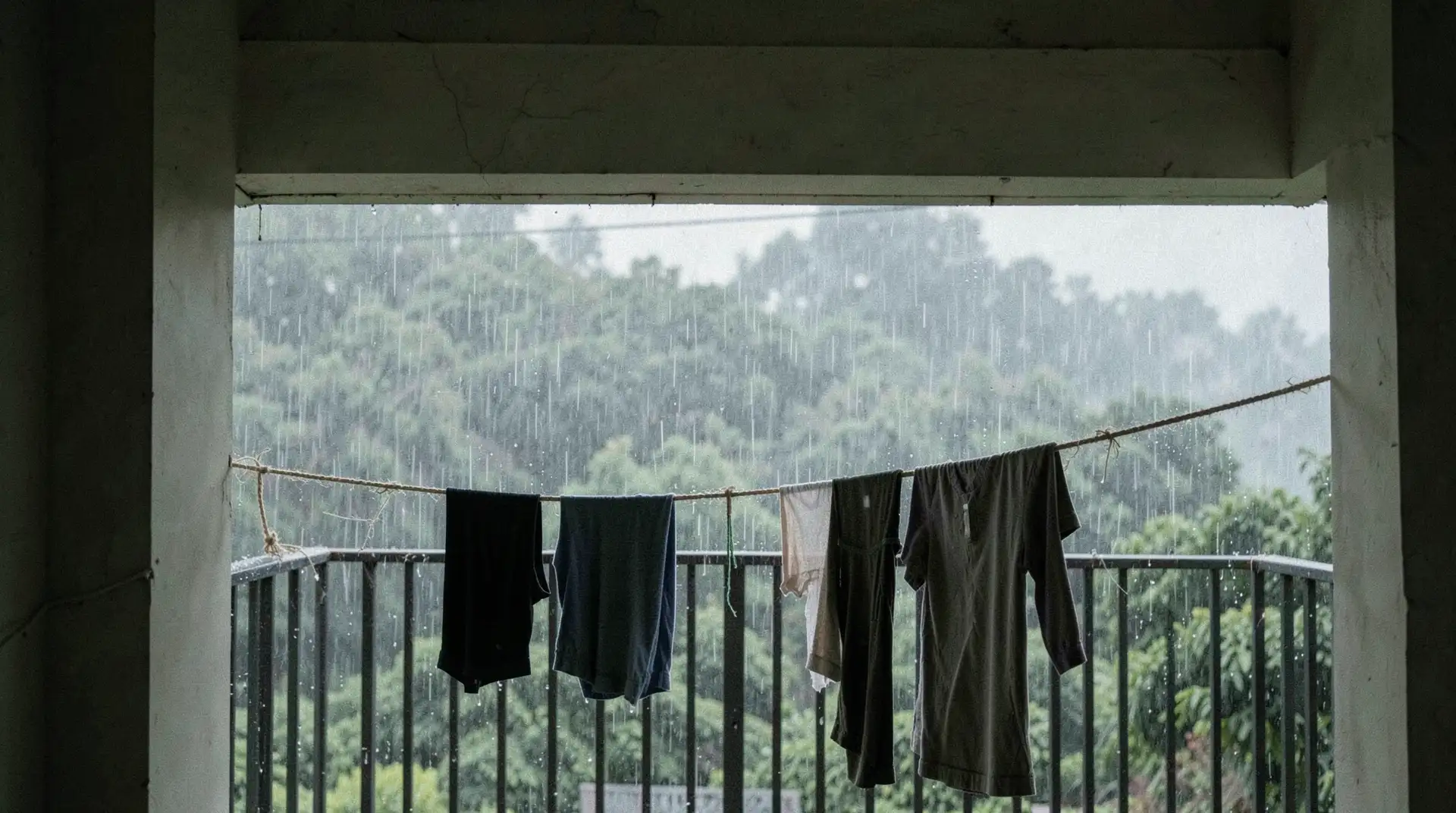
A covered balcony or a verandah with open sides gives some of the benefit of outdoor airflow without the rain risk. Rain rarely blows perfectly horizontal, so a metre of overhang protects most of a hanging line.
Monsoon laundry is a physics problem dressed up as a household annoyance. The air is full, the fabric is wet, and the gap between them is small. Anything that widens that gap, moving air, drier air, better spacing, less water at the start, shortens the time between the wash and the wardrobe.
What Humidity Does to Drying
Clothes dry through evaporation. Water molecules at the surface of wet fabric escape into the surrounding air. The speed of that escape depends almost entirely on how much water the air already holds. Dry air is hungry, it pulls moisture off fabric quickly. Air that is already saturated with water vapour, the way monsoon air is, has almost no room left. The water in your clothes has nowhere to go, so it stays.Relative humidity during the Indian monsoon regularly sits above 80 percent, and in coastal cities or during heavy spells it climbs higher. At that level, evaporation slows to a crawl. The clothes aren't wet because something is wrong with them. The air around them simply cannot accept more moisture.
Why the Sour Smell Arrives
Damp fabric is a hospitable place for bacteria and mildew. Both are always present on fabric in small numbers, they become a problem only when conditions favour them. Warmth and sustained moisture are exactly those conditions. When clothes stay wet for many hours, microbial activity accelerates and produces the compounds responsible for that musty, sour odour. Drying faster is the only real fix. Masking the smell with a fragrance spray leaves the underlying problem in place.What Actually Speeds Drying Indoors
Since the problem is saturated air, the solutions are about moving or replacing that air.You may also like
- High jewellery maisons are increasingly embracing ornamental stones
- Why Do People Jump Over Burning Sticks in Bihar on Diwali?
- LIC Health Shield Plan 2026: Hospital Cash Benefits and Financial Support for Critical Illnesses and Surgeries
- 'Mogging' is Collins Dictionary's Word of the Year. But what does it mean, and 5 other words that made it to the list?
- Losing Belly Fat Last? Here's Why Your Body Chooses Where Fat Goes First
A ceiling fan running directly over hanging clothes makes a measurable difference. Moving air carries away the thin layer of humid air sitting against the fabric surface and replaces it with air that can still accept some moisture. Even in a humid room, a fan shortens drying time noticeably.
A room with cross-ventilation, windows or doors open on opposite sides, works better than a sealed room with a fan, because it brings in whatever drier air is available outside and pushes the humid indoor air out. On days when outside air is drier than inside, this matters.
An air conditioner set to its regular cooling mode dehumidifies the room as a side effect of cooling. The coils condense moisture out of the air and drain it away. Clothes hung in a room where the AC is running dry faster than in a humid room with a fan alone. This is not about the cold, it is about the lower humidity the machine creates.
Spacing matters more than most people realise. Clothes packed tightly on a rack trap humid air between them. Each piece needs enough space that air can move freely around all its surfaces. Folded sections, a collar turned in, a sleeve doubled over, stay wet longest. Shake each garment out flat before hanging.
The Roof and the Balcony
Drying outside during the monsoon seems counterintuitive, but a dry spell between showers, even a short one, with a breeze moving, will dry clothes faster than a still indoor room. The open sky allows air to move in three dimensions around the fabric. The risk is obvious, a sudden shower undoes the progress. Watching the sky and bringing clothes in at the first sign of rain is the trade-off.A covered balcony or a verandah with open sides gives some of the benefit of outdoor airflow without the rain risk. Rain rarely blows perfectly horizontal, so a metre of overhang protects most of a hanging line.
Wringing and Spinning
The drier clothes go onto the line, the less work the air has to do. A second spin cycle in a washing machine removes significantly more water than one. Wringing by hand before hanging, especially for thick cotton or denim, removes water that evaporation would otherwise have to handle. Starting drier means finishing faster, the air's limited capacity goes further when there is less to remove.Monsoon laundry is a physics problem dressed up as a household annoyance. The air is full, the fabric is wet, and the gap between them is small. Anything that widens that gap, moving air, drier air, better spacing, less water at the start, shortens the time between the wash and the wardrobe.






Loving Newspoint? Download the app now
