
Why India Has One of the World's Most Diverse Ecosystems

Few countries can match the sheer variety of landscapes found across India. Within one national boundary are some of the world's highest mountains, vast deserts, tropical rainforests, mangroves, grasslands, wetlands and coral reefs. This extraordinary range is not simply a matter of scenery. Each environment supports its own communities of plants, animals and microorganisms. India's location, geological history, climate and enormous variation in altitude have combined to create an unusually rich natural world. The country contains four of the world's recognised biodiversity hotspots, while its ecosystems stretch from the Himalayas in the north to tropical islands and coral reefs in the Indian Ocean.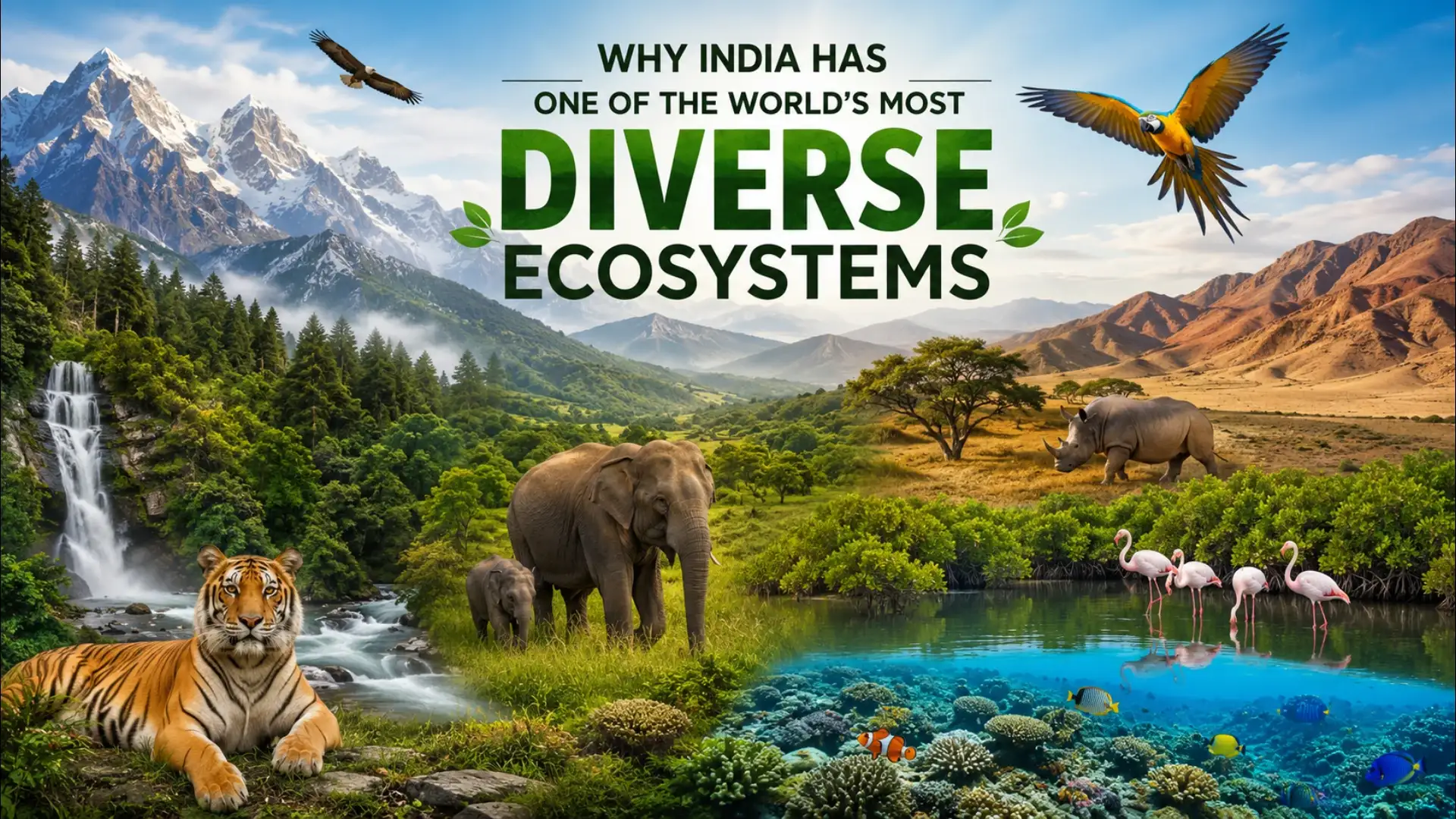
The difference in altitude alone creates striking ecological changes. A journey from the Himalayan foothills towards high-altitude regions can take you through forests, alpine meadows and eventually extremely cold landscapes where vegetation becomes sparse.
Further south, the climate changes dramatically. Parts of the Western Ghats receive heavy rainfall and support dense evergreen forests, while the Deccan Plateau contains drier landscapes adapted to seasonal rainfall.
Biodiversity hotspots are areas recognised for exceptionally high numbers of endemic species that are also under significant threat. This means India contains several regions where species can be found nowhere else on Earth.
The Western Ghats are particularly significant. UNESCO describes the mountain chain as an area with exceptional biological diversity and high levels of endemic species.
The Sundarbans, shared by India and Bangladesh, contain one of the world's largest mangrove ecosystems. These forests are adapted to salty, tidal conditions and provide important habitats for fish, reptiles, birds and mammals.
Around the Andaman and Nicobar Islands, coral reefs create another very different ecosystem. Their shallow tropical waters support an extraordinary range of marine life.
Yet this diversity also makes conservation particularly challenging. Forest loss, habitat fragmentation, pollution, climate change and pressure on natural resources can affect ecosystems that may contain species found nowhere else.
India's extraordinary biodiversity is therefore both a natural advantage and a responsibility. Its deserts, forests, mountains, wetlands and reefs may look unrelated, but together they form one of the country's greatest ecological assets.
The remarkable part is that travelling across India can feel like crossing several different worlds without ever leaving the country.
A Country Built Around Extraordinary Geography
India's biodiversity begins with its geography. The Himalayas rise dramatically in the north, while the Western Ghats run along the western side of the peninsula. Between and around these major formations are river plains, plateaus, forests, deserts and coastal landscapes.The difference in altitude alone creates striking ecological changes. A journey from the Himalayan foothills towards high-altitude regions can take you through forests, alpine meadows and eventually extremely cold landscapes where vegetation becomes sparse.
Further south, the climate changes dramatically. Parts of the Western Ghats receive heavy rainfall and support dense evergreen forests, while the Deccan Plateau contains drier landscapes adapted to seasonal rainfall.
India Contains Four Biodiversity Hotspots
One of the most remarkable facts about India's natural environment is its connection to four global biodiversity hotspots: the Himalaya, Western Ghats, Indo-Burma region and Sundaland, the last represented in India's Nicobar Islands.You may also like
- Raksha Bandhan 2026: Why August 28 Matters More Than August 27 2026
- AI is changing more than technology: Why the TOI AI Quotient Awards 2026 are also about the leaders behind the change
- The fire that witnessed Shiva and Parvati's wedding still burns in Uttarakhand: Couples are now choosing this sacred temple for getting married in place of fancy hotels
- When 'I'm fine' means anything but fine
- Why Mild Low Platelets Are Common in Late Pregnancy
Biodiversity hotspots are areas recognised for exceptionally high numbers of endemic species that are also under significant threat. This means India contains several regions where species can be found nowhere else on Earth.
The Western Ghats are particularly significant. UNESCO describes the mountain chain as an area with exceptional biological diversity and high levels of endemic species.
From Mangroves to Coral Reefs
India's ecological diversity does not stop on land. Its coastline supports mangrove forests, estuaries, mudflats, seagrass habitats and coral reefs.The Sundarbans, shared by India and Bangladesh, contain one of the world's largest mangrove ecosystems. These forests are adapted to salty, tidal conditions and provide important habitats for fish, reptiles, birds and mammals.
Around the Andaman and Nicobar Islands, coral reefs create another very different ecosystem. Their shallow tropical waters support an extraordinary range of marine life.
Why This Diversity Matters Today
India's ecosystems are not merely wildlife destinations. They provide services people depend on every day, including freshwater, pollination, soil protection, fisheries and climate regulation.Yet this diversity also makes conservation particularly challenging. Forest loss, habitat fragmentation, pollution, climate change and pressure on natural resources can affect ecosystems that may contain species found nowhere else.
India's extraordinary biodiversity is therefore both a natural advantage and a responsibility. Its deserts, forests, mountains, wetlands and reefs may look unrelated, but together they form one of the country's greatest ecological assets.
The remarkable part is that travelling across India can feel like crossing several different worlds without ever leaving the country.






Loving Newspoint? Download the app now
