
Why Indian Bullfrog Males Turn Bright Yellow in the Monsoon, and What That Colour Costs Them


The change happens fastFor most of the year, the Indian bullfrog (Hoplobatrachus tigerinus) is a forgettable shade of olive-green or brown, blending into the muddy margins of ponds and rice paddies across the subcontinent. Then the first monsoon rains arrive, and the males change within days. The dorsal skin shifts to a bright, almost aggressive yellow. The vocal sacs, the paired pouches that inflate when a male calls, turn a striking blue-violet. No other Indian amphibian undergoes a colour shift this dramatic or this fast.
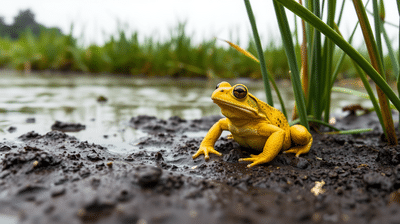 The trigger is hormonal. Rising temperatures and the sensory cue of rainfall spike androgen levels in males, particularly testosterone. These androgens act on pigment-producing cells in the skin called chromatophores. Xanthophores, which contain yellow pigment, expand and become more visible. The blue-violet of the vocal sacs comes from structural colouration in a separate cell layer, the iridophores, interacting with light in a different way than the yellow. The two effects together produce the breeding male's unmistakable look. Females do not undergo this change, their chromatophores are far less responsive to the same hormonal signals, which is itself a clue to how mate selection works in this species. What the colour is actually doingThe yellow is not camouflage. If anything, it is the opposite. A bright yellow frog sitting on a dark monsoon mudbank is visible to every predator in the area, egrets, water snakes, monitor lizards, all of which are active during the same season. The colouration is a sexual signal directed at females and rival males simultaneously. Females of Hoplobatrachus tigerinus have been observed in field studies to preferentially approach more intensely coloured males when call quality is held roughly equal. The yellow is an honest signal of androgen titre: a male whose immune system and body condition are strong enough to sustain high testosterone can afford to be conspicuous. A male in poor condition cannot maintain the same intensity of colour, so the signal carries real information.
Rival males read it too. Colour intensity correlates with body size in this species, and larger males win physical contests for calling sites near the water's edge. A deeply yellow male signals fighting capacity before any contact happens. This reduces costly physical confrontation, most smaller males simply avoid the brightest ones. The predation cost is not theoreticalHerpetologists working in agricultural wetlands in Punjab and Uttar Pradesh have documented significantly higher predation rates on breeding males during peak monsoon calling than on non-breeding individuals of either sex observed in the same habitat at the same time. The bright yellow males are easier to spot, and they are further exposed because they call repeatedly from fixed positions at the water's edge rather than retreating into vegetation. They cannot do both, a male that stops calling loses his position to a rival within minutes.
This is the core trade-off. The colour that attracts females also attracts predators. The calling behaviour that secures a breeding site also pins a male in one visible location. The males that survive long enough to breed successfully are not the ones who minimise risk, they are the ones whose condition is good enough to absorb it. The yellow is not a decoration. It is a wager. After the monsoon, it goesOnce breeding season ends, typically by August or September depending on rainfall patterns, androgen levels drop, and the yellow fades. The males return to the same olive-brown colouration as the females and juveniles around them. The chromatophores contract. The signal is switched off because it is no longer useful and the cost of maintaining it without a reproductive payoff would be pure loss.
This reversibility is itself biologically significant. Unlike species where colouration is fixed at maturity, the Indian bullfrog's breeding colours are a seasonal investment, switched on and off by endocrine changes tied to environmental cues. The same male may cycle through this transformation multiple times across his adult life, each monsoon season reasserting his condition to a new cohort of females.
The Indian bullfrog is listed as Least Concern by the IUCN, but its populations are under pressure from habitat loss in wetlands, collection for the frog-legs export trade (which was banned in India in 1987 but has not entirely stopped), and pesticide runoff in agricultural areas that disrupts amphibian endocrine systems. A frog whose breeding signal depends on precise hormonal timing is particularly vulnerable to endocrine-disrupting chemicals, the same compounds that make rice paddies more productive are capable of interfering with the androgen spike that turns a male yellow in the first place.
The colour lasts six to eight weeks. In that window, every bright yellow male is simultaneously advertising his fitness, defending his calling site, and making himself easier to kill. The ones who make it through are, by definition, the ones worth breeding with. That is the logic the monsoon runs on.
Next Story