
Why Indian Cuisine Changes Completely Every Few Hundred Kilometres

Travel across India and you quickly discover that the idea of a single “Indian cuisine” is almost misleading. A few hundred kilometres can be enough to transform what appears on a dinner plate, from wheat rotis and mustard-based curries in the north to rice, coconut and seafood further south. This remarkable change is not simply about people having different tastes. India’s food traditions have been shaped by mountains, deserts, coastlines, rainfall, crops, migration, religion and centuries of trade. Researchers studying Indian cuisines have found clear differences in ingredients and cooking patterns across regions, reflecting this complex mix of geography and culture.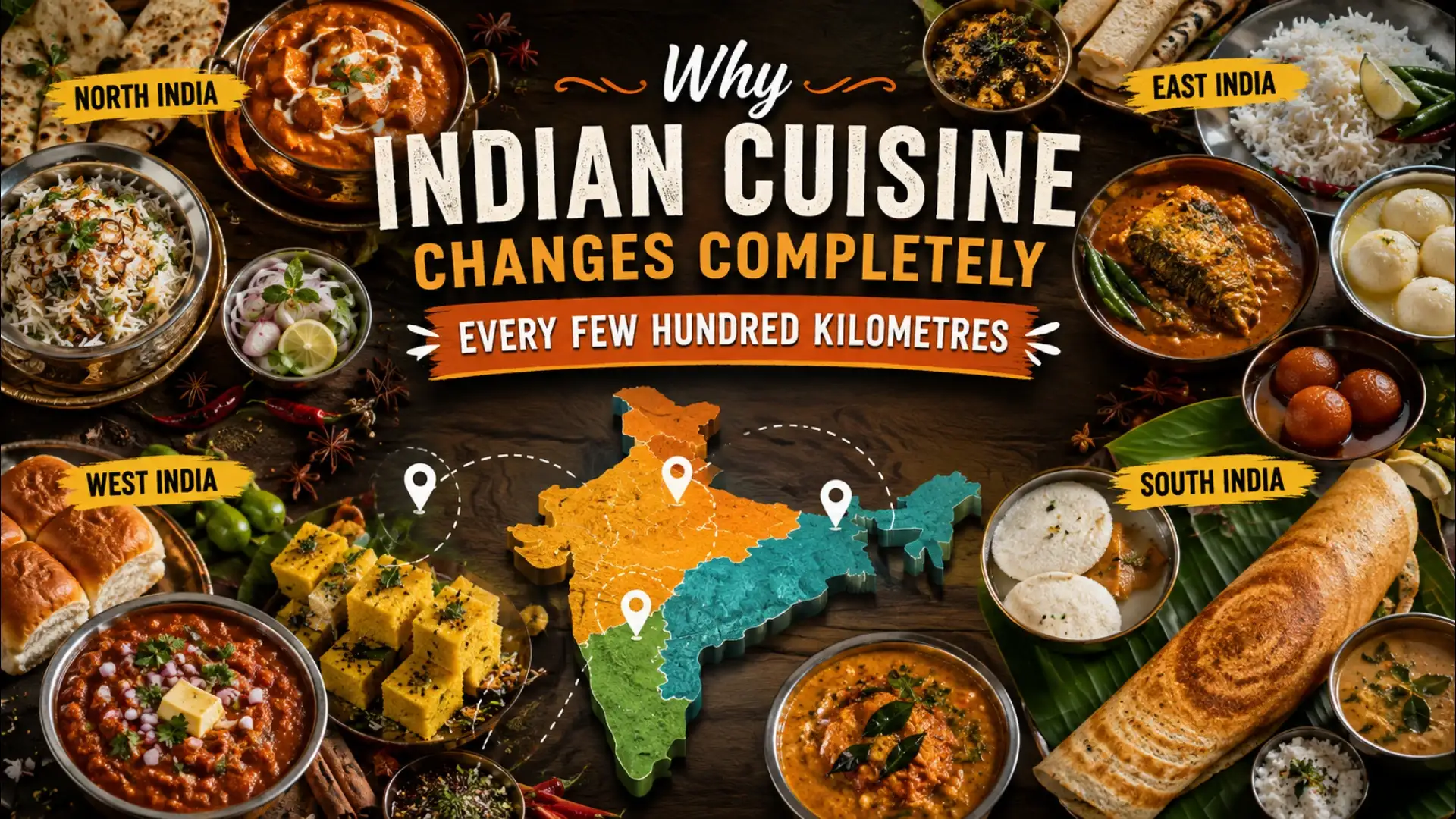
In areas with abundant water, rice became a major staple. Coastal communities have traditionally had easier access to fish and coconut, while wheat became especially important across many parts of northern India. The Central Board of Secondary Education also identifies geographical location, climate and availability of local produce as major influences on regional eating habits.
This explains why a meal in Kerala can feel completely different from one in Rajasthan. One grows around rice, coconut and seafood, while the other developed ingenious ways of cooking with ingredients suited to a much drier environment.
In hot and humid regions, fermentation, pickling and drying have historically helped extend the life of ingredients. In drier areas, foods that store well, including pulses, millets and dried vegetables, have played a greater role.
A 2025 study examining Indian food traditions found that climate, soil, relief and water availability interact with agriculture and culinary practices, creating distinct regional food cultures.
That is why Indian cuisine cannot be understood simply as a collection of isolated local traditions. Researchers studying eight regional Indian cuisines found that each has its own distinctive ingredient patterns and culinary “fingerprint”. Spices and dairy, in particular, play important roles in differentiating regional food combinations.
Today, supermarkets, restaurants and food delivery apps are making ingredients available almost everywhere. Yet local preferences remain remarkably strong.
So the next time a dish tastes completely different after a few hours on the road, it is not merely a change of recipe. It is a reminder that in India, geography, history and everyday life have been cooking together for centuries.
Geography Decides What Goes Into the Pot
India stretches from the Himalayas to tropical coastlines and from the Thar Desert to fertile river plains. These environments naturally produce very different ingredients.In areas with abundant water, rice became a major staple. Coastal communities have traditionally had easier access to fish and coconut, while wheat became especially important across many parts of northern India. The Central Board of Secondary Education also identifies geographical location, climate and availability of local produce as major influences on regional eating habits.
This explains why a meal in Kerala can feel completely different from one in Rajasthan. One grows around rice, coconut and seafood, while the other developed ingenious ways of cooking with ingredients suited to a much drier environment.
Climate Has Quietly Shaped Indian Food
Climate does more than determine which crops grow. It also influences how people preserve and prepare food.You may also like
- Raksha Bandhan 2026: Why August 28 Matters More Than August 27 2026
- AI is changing more than technology: Why the TOI AI Quotient Awards 2026 are also about the leaders behind the change
- The fire that witnessed Shiva and Parvati's wedding still burns in Uttarakhand: Couples are now choosing this sacred temple for getting married in place of fancy hotels
- When 'I'm fine' means anything but fine
- Why Mild Low Platelets Are Common in Late Pregnancy
In hot and humid regions, fermentation, pickling and drying have historically helped extend the life of ingredients. In drier areas, foods that store well, including pulses, millets and dried vegetables, have played a greater role.
A 2025 study examining Indian food traditions found that climate, soil, relief and water availability interact with agriculture and culinary practices, creating distinct regional food cultures.
History Added Another Layer
Geography created the foundation, but history kept changing the recipe. Traders, migrants, empires and communities carried ingredients and cooking techniques across the subcontinent.That is why Indian cuisine cannot be understood simply as a collection of isolated local traditions. Researchers studying eight regional Indian cuisines found that each has its own distinctive ingredient patterns and culinary “fingerprint”. Spices and dairy, in particular, play important roles in differentiating regional food combinations.
Why Every Region Tells a Different Food Story
Perhaps the most fascinating part is that Indian cuisine is not really one cuisine at all. It is a vast network of regional food traditions that constantly overlap, borrow and evolve.Today, supermarkets, restaurants and food delivery apps are making ingredients available almost everywhere. Yet local preferences remain remarkably strong.
So the next time a dish tastes completely different after a few hours on the road, it is not merely a change of recipe. It is a reminder that in India, geography, history and everyday life have been cooking together for centuries.






Loving Newspoint? Download the app now
