
Why Indian Railways Has So Many Different Types of Trains

Look at a railway station in India and the variety can be surprising. A slow passenger train may share the tracks with a high-speed Vande Bharat service, while an express train races through a station and a long freight rake quietly carries coal or grain in the opposite direction. This is not accidental. Indian Railways operates one of the world's largest railway networks, serving an enormous country with very different geography, passenger needs and economic requirements. Its many train categories have developed because one type of train simply cannot do everything. Speed, distance, capacity, comfort and cargo all demand different solutions.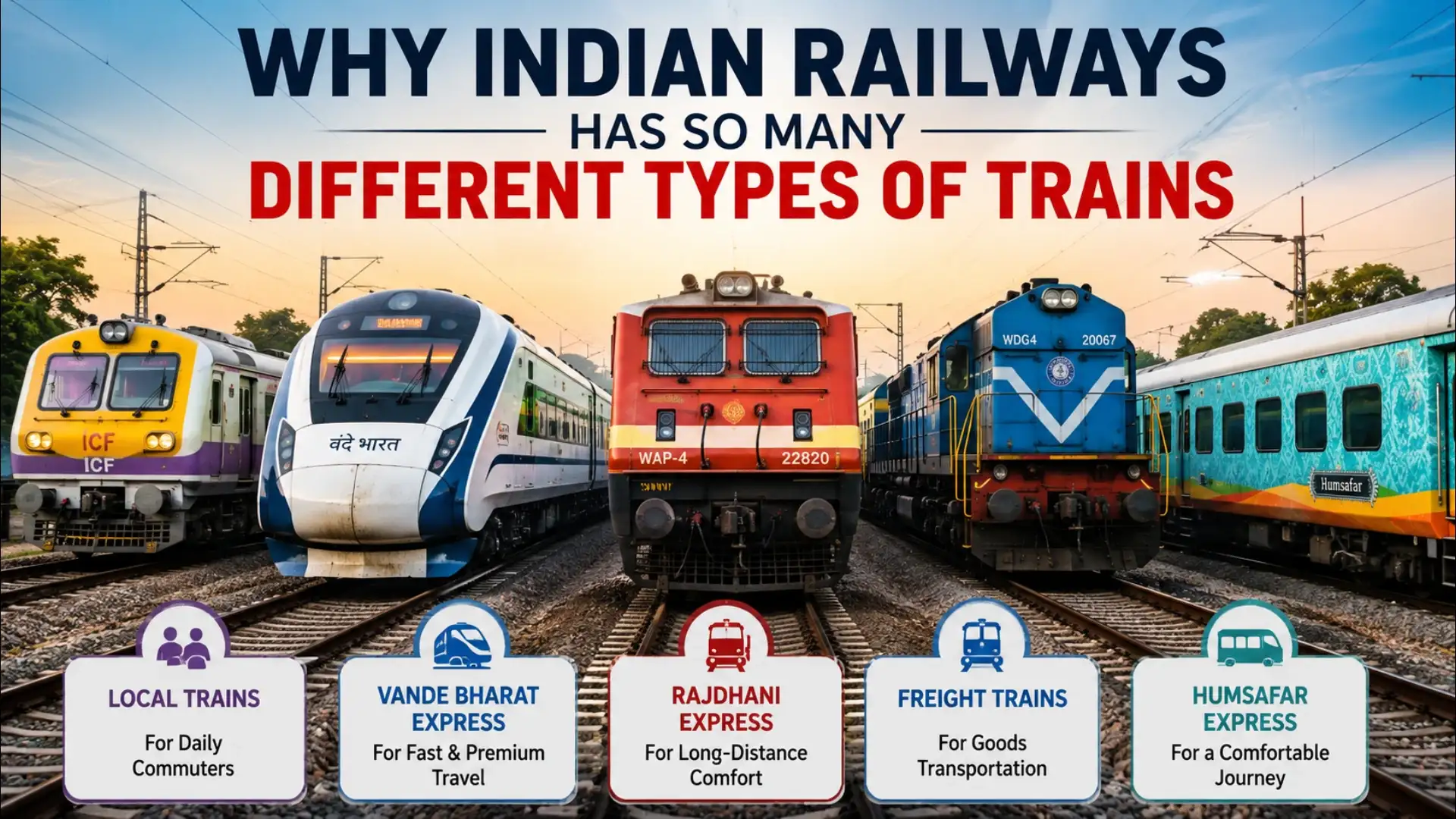
Someone travelling between two major cities may prioritise speed, while passengers in smaller towns may depend on trains that stop frequently. This is why local and passenger services operate alongside longer-distance express trains.
Express and superfast services reduce journey times by making fewer stops. Passenger services, on the other hand, are designed around accessibility, stopping at more stations along the route.
The differences are therefore closely connected to how people actually travel.
Meanwhile, Rajdhani and Shatabdi services were introduced decades earlier with specific purposes. Rajdhani trains were designed to connect Delhi with major cities, while Shatabdi services focused on faster daytime journeys between important urban centres.
Each category emerged to solve a particular transportation problem.
Coal, food grains, cement, fertilisers, petroleum products and other goods move across the country by rail. Freight trains are designed around carrying heavy loads efficiently rather than providing a comfortable passenger journey.
The difference becomes obvious when you see the length and configuration of a freight rake. Its purpose is to move enormous quantities of material while using relatively little energy per tonne compared with many road-based alternatives.
A train designed for one route may not be ideal for another. Track conditions, gradients, station infrastructure, electrification and traffic density all influence what services can operate effectively.
This is why the apparent complexity of Indian Railways is actually a reflection of the country's complexity.
High-speed and premium trains can serve time-sensitive travellers, conventional services can maintain broad connectivity, and freight trains can support industry and agriculture.
So the next time several very different trains pass through the same station, remember that they are not simply different versions of the same idea. Each exists because India's railway network has to solve a different problem, often at the same time.
India Needs Trains for Very Different Journeys
A railway network covering thousands of kilometres has to serve cities, small towns, industrial centres and remote communities.Someone travelling between two major cities may prioritise speed, while passengers in smaller towns may depend on trains that stop frequently. This is why local and passenger services operate alongside longer-distance express trains.
Express and superfast services reduce journey times by making fewer stops. Passenger services, on the other hand, are designed around accessibility, stopping at more stations along the route.
The differences are therefore closely connected to how people actually travel.
Speed Is Only One Part of the Equation
Modern services such as Vande Bharat have been designed around faster inter-city travel and improved passenger amenities. They represent a very different railway philosophy from conventional passenger services that have historically focused heavily on affordability and widespread connectivity.Meanwhile, Rajdhani and Shatabdi services were introduced decades earlier with specific purposes. Rajdhani trains were designed to connect Delhi with major cities, while Shatabdi services focused on faster daytime journeys between important urban centres.
Each category emerged to solve a particular transportation problem.
Freight Trains Have a Completely Different Job
Not every train exists to carry passengers. Freight is fundamental to India's railway system.You may also like
- Raksha Bandhan 2026: Why August 28 Matters More Than August 27 2026
- AI is changing more than technology: Why the TOI AI Quotient Awards 2026 are also about the leaders behind the change
- The fire that witnessed Shiva and Parvati's wedding still burns in Uttarakhand: Couples are now choosing this sacred temple for getting married in place of fancy hotels
- When 'I'm fine' means anything but fine
- Why Mild Low Platelets Are Common in Late Pregnancy
Coal, food grains, cement, fertilisers, petroleum products and other goods move across the country by rail. Freight trains are designed around carrying heavy loads efficiently rather than providing a comfortable passenger journey.
The difference becomes obvious when you see the length and configuration of a freight rake. Its purpose is to move enormous quantities of material while using relatively little energy per tonne compared with many road-based alternatives.
Geography Makes the Network Even More Complicated
India's railway routes cross plains, deserts, mountains, coastal regions and densely populated urban areas. Different routes have different operational challenges.A train designed for one route may not be ideal for another. Track conditions, gradients, station infrastructure, electrification and traffic density all influence what services can operate effectively.
This is why the apparent complexity of Indian Railways is actually a reflection of the country's complexity.
Why This Variety Matters Today
India is increasingly looking for faster, cleaner and more efficient transport while still maintaining affordable connectivity. That means the railway system has to perform several jobs simultaneously.High-speed and premium trains can serve time-sensitive travellers, conventional services can maintain broad connectivity, and freight trains can support industry and agriculture.
So the next time several very different trains pass through the same station, remember that they are not simply different versions of the same idea. Each exists because India's railway network has to solve a different problem, often at the same time.






Loving Newspoint? Download the app now
