
Why Is Lord Rama Called Maryada Purushottam?


We have heard the name Maryada Purushottam Shri Ram countless times. But have we ever stopped to ask what these two words actually mean? Why was Rama given this powerful title, and what does it reveal about his place in Hindu tradition? The answer goes deeper than simply calling him an ideal king or son. Maryada points toward righteous order and boundaries, while Purushottam refers to the supreme or highest Purusha. Together, the title presents Rama as an embodiment of dharma, self-restraint and the highest ideal of righteous conduct.
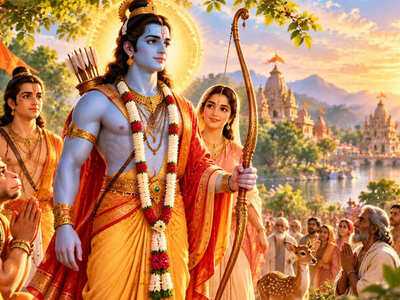
What Does Maryada Really Mean?
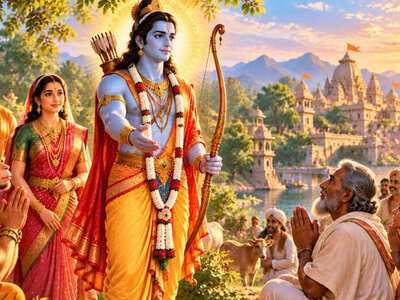 Maryada represents righteous boundaries, conduct and the order that sustains life.
The word maryada is often translated as a boundary, limit or code of conduct. In the context of Rama, however, it carries a deeper spiritual meaning. It represents living within the principles of dharma, even when doing so is difficult. Rama is remembered for accepting responsibility, respecting relationships and placing duty above personal comfort. The Valmiki Ramayana also presents Rama in relation to the natural and cosmic order, including imagery involving the ocean and its limits.
Rama Did Not Just Preach Dharma
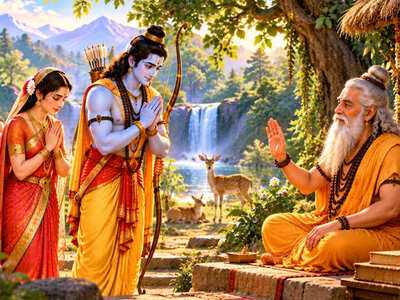 Lord Rama receives a warm welcome from Sage Agastya in the forest.
The power of Lord Rama lies not simply in what he taught, but in how his life is remembered as an example of dharma. When circumstances became difficult, he repeatedly faced choices between personal desire and responsibility. His exile is one of the clearest examples. Rather than treating his own comfort as the highest priority, Rama accepted the consequences of his father's promise. This is one reason Rama as Maryada Purushottam continues to represent discipline, responsibility and commitment to one's principles.
The Deeper Meaning of PurushottamThe second half of the title is equally important. Purushottam combines Purusha, meaning the cosmic or supreme person in philosophical and Vedic contexts, with uttama, meaning highest or supreme. The Rigveda's Purusha Sukta describes Purusha in cosmic terms, presenting the Purusha as encompassing the universe. In the Rama tradition, this idea becomes connected with Rama, who is understood by devotees as an earthly manifestation of the divine ideal. Thus, Purushottam points beyond Rama's royal identity toward his spiritual significance.
Why Boundaries Matter in Rama’s StoryOne of the most striking examples comes from Rama's encounter with the ocean before the journey to Lanka. The Valmiki Ramayana describes Rama confronting the ocean and later shows the ocean deity appearing before him. The episode highlights an important idea: maryada does not mean weakness or passive acceptance. It can also mean knowing when patience ends and decisive action becomes necessary. Rama's character therefore combines compassion with firmness, responsibility with courage, and restraint with action.
Rama’s Greatness Was Tested by ChoicesIt is easy to follow principles when life is comfortable. Rama's story becomes meaningful because his dharma is repeatedly tested by difficult circumstances. Exile, separation, conflict and the responsibilities of kingship all force him to make painful decisions. This is why the idea of Maryada Purushottam remains powerful in Hindu tradition. It presents greatness not simply as having strength or divine power, but as maintaining one's principles when emotions, circumstances and personal interests pull in another direction.
The Title Goes Beyond Being a Perfect HeroCalling Rama Maryada Purushottam is not merely about describing him as a powerful warrior or successful king. The title connects his story with a larger idea of righteous living. His strength is repeatedly shown alongside restraint, his authority alongside responsibility and his courage alongside compassion. For devotees, Rama is therefore not simply a character from the Ramayana. He represents an ideal through which questions of duty, relationships, leadership and self-control can be understood.
Why Maryada Purushottam Still MattersThe lasting meaning of Maryada Purushottam Shri Ram may lie in the reminder that greatness is not only about what we can achieve. It is also about the boundaries we choose to respect. In a world where personal desire often comes first, Rama's traditional image asks a different question: Can strength exist with restraint, and can power remain connected to dharma? That is why the title continues to carry spiritual meaning for devotees. It turns Rama's story into a reflection on how one chooses to live.
Unlock insightful tips and inspiration on personal growth, productivity, and well-being. Stay motivated and updated with the latest at My Life XP
What Does Maryada Really Mean?
The word maryada is often translated as a boundary, limit or code of conduct. In the context of Rama, however, it carries a deeper spiritual meaning. It represents living within the principles of dharma, even when doing so is difficult. Rama is remembered for accepting responsibility, respecting relationships and placing duty above personal comfort. The Valmiki Ramayana also presents Rama in relation to the natural and cosmic order, including imagery involving the ocean and its limits.
Rama Did Not Just Preach Dharma
The power of Lord Rama lies not simply in what he taught, but in how his life is remembered as an example of dharma. When circumstances became difficult, he repeatedly faced choices between personal desire and responsibility. His exile is one of the clearest examples. Rather than treating his own comfort as the highest priority, Rama accepted the consequences of his father's promise. This is one reason Rama as Maryada Purushottam continues to represent discipline, responsibility and commitment to one's principles.
The Deeper Meaning of PurushottamThe second half of the title is equally important. Purushottam combines Purusha, meaning the cosmic or supreme person in philosophical and Vedic contexts, with uttama, meaning highest or supreme. The Rigveda's Purusha Sukta describes Purusha in cosmic terms, presenting the Purusha as encompassing the universe. In the Rama tradition, this idea becomes connected with Rama, who is understood by devotees as an earthly manifestation of the divine ideal. Thus, Purushottam points beyond Rama's royal identity toward his spiritual significance.
Why Boundaries Matter in Rama’s StoryOne of the most striking examples comes from Rama's encounter with the ocean before the journey to Lanka. The Valmiki Ramayana describes Rama confronting the ocean and later shows the ocean deity appearing before him. The episode highlights an important idea: maryada does not mean weakness or passive acceptance. It can also mean knowing when patience ends and decisive action becomes necessary. Rama's character therefore combines compassion with firmness, responsibility with courage, and restraint with action.
Rama’s Greatness Was Tested by ChoicesIt is easy to follow principles when life is comfortable. Rama's story becomes meaningful because his dharma is repeatedly tested by difficult circumstances. Exile, separation, conflict and the responsibilities of kingship all force him to make painful decisions. This is why the idea of Maryada Purushottam remains powerful in Hindu tradition. It presents greatness not simply as having strength or divine power, but as maintaining one's principles when emotions, circumstances and personal interests pull in another direction.
The Title Goes Beyond Being a Perfect HeroCalling Rama Maryada Purushottam is not merely about describing him as a powerful warrior or successful king. The title connects his story with a larger idea of righteous living. His strength is repeatedly shown alongside restraint, his authority alongside responsibility and his courage alongside compassion. For devotees, Rama is therefore not simply a character from the Ramayana. He represents an ideal through which questions of duty, relationships, leadership and self-control can be understood.
Why Maryada Purushottam Still MattersThe lasting meaning of Maryada Purushottam Shri Ram may lie in the reminder that greatness is not only about what we can achieve. It is also about the boundaries we choose to respect. In a world where personal desire often comes first, Rama's traditional image asks a different question: Can strength exist with restraint, and can power remain connected to dharma? That is why the title continues to carry spiritual meaning for devotees. It turns Rama's story into a reflection on how one chooses to live.
Unlock insightful tips and inspiration on personal growth, productivity, and well-being. Stay motivated and updated with the latest at My Life XP
Next Story