
Why Does Your Suitcase Have Wheels Only On Certain Sides?

Rolling a suitcase through an airport feels wonderfully easy when everything is going well. Then you hit a rough patch of pavement or try to pull it sideways, and suddenly you become very aware of where those wheels are actually positioned.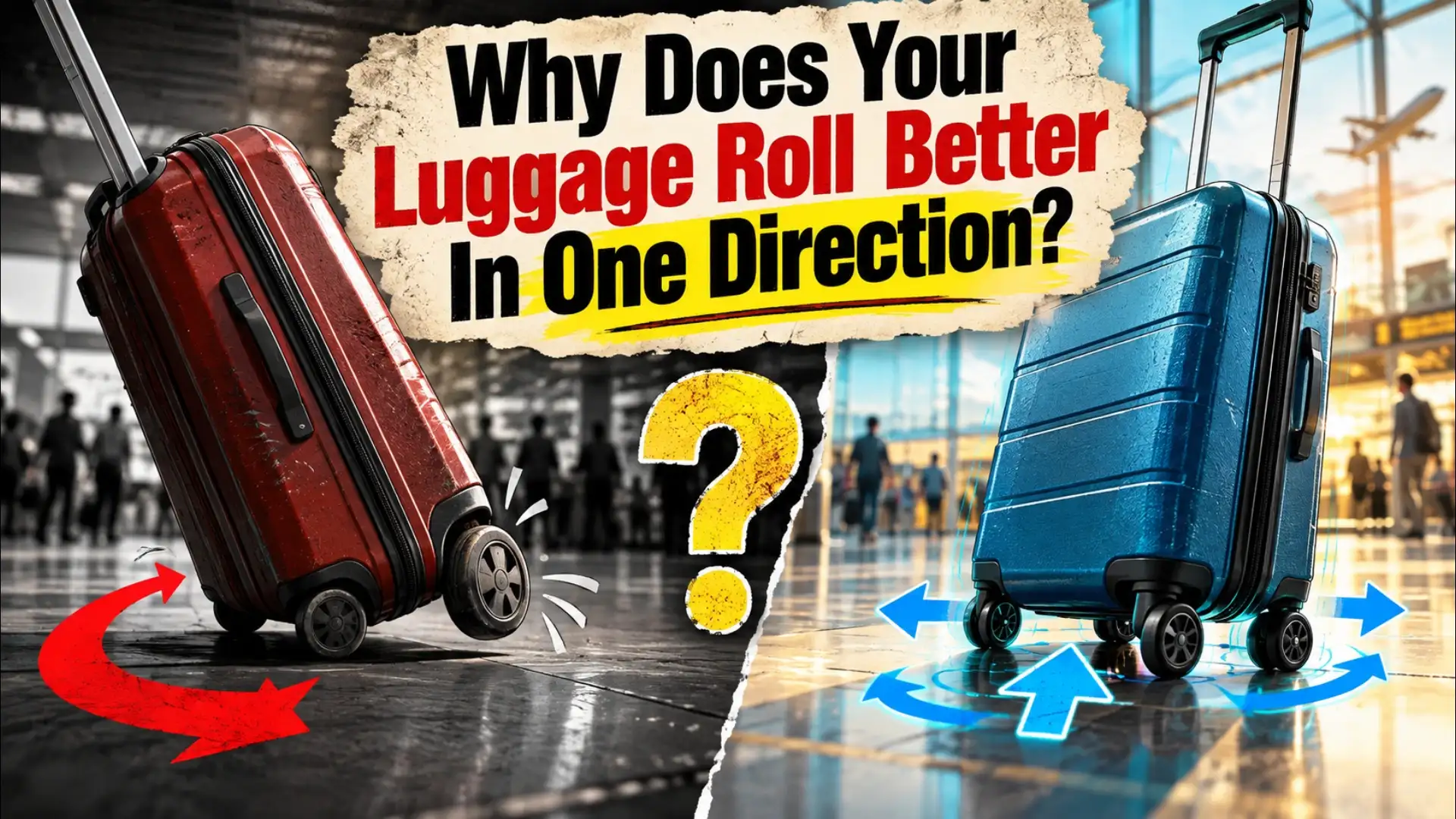
That means the suitcase is not really designed to roll freely in every direction. It follows the direction in which you are pulling it, with the wheels guiding its movement along a fairly predictable path.
There is a practical reason for this design. Two-wheel luggage can be relatively simple and sturdy because its wheels do not have to swivel in every direction. The wheel housing can also be tucked more neatly into the case, leaving less hardware sticking out.
The downside becomes obvious when you are navigating a crowded airport. Want to make a sharp sideways turn? You usually have to tilt, pull and swing the entire suitcase around with you.
This becomes particularly useful when you are weaving through crowds, standing in a queue or trying to squeeze your luggage into a tight space. Instead of making a wide turn, you can simply change the direction of the case. But that freedom comes with a trade-off.
Spinner wheels usually need additional mounting hardware underneath the suitcase, and the wheels themselves tend to sit more exposed. Those parts can take more knocks when luggage is dragged over uneven surfaces or handled roughly during travel.
A suitcase has to do more than roll smoothly. It needs to survive being lifted into car boots, squeezed into luggage compartments, dragged across rough surfaces and, in the case of checked luggage, handled by airport baggage systems. That is why suitcase design is essentially a balancing act.
Two-wheel luggage prioritises a straightforward pulling motion and a relatively protected wheel setup. Four-wheel spinners prioritise flexibility and easy manoeuvring on smooth surfaces. So the next time your suitcase refuses to move sideways, it is not necessarily badly designed. Its wheels are simply doing exactly what they were designed to do.
Traditional luggage is designed to be pulled.
Older two-wheel suitcases have a fairly simple setup. The wheels sit at one end, while the extendable handle sits at the other. To move the case, you tilt it back and pull it behind you.That means the suitcase is not really designed to roll freely in every direction. It follows the direction in which you are pulling it, with the wheels guiding its movement along a fairly predictable path.
There is a practical reason for this design. Two-wheel luggage can be relatively simple and sturdy because its wheels do not have to swivel in every direction. The wheel housing can also be tucked more neatly into the case, leaving less hardware sticking out.
The downside becomes obvious when you are navigating a crowded airport. Want to make a sharp sideways turn? You usually have to tilt, pull and swing the entire suitcase around with you.
Spinner Wheels Changed the Game
Four-wheel spinner luggage approaches the problem differently. Instead of relying on two fixed wheels, spinner cases use wheels that can rotate and swivel, allowing the suitcase to move forwards, backwards and sideways. That is why a spinner can feel almost effortless on a smooth airport floor. You can push it beside you, pull it behind you or move it sideways without constantly tilting the case.This becomes particularly useful when you are weaving through crowds, standing in a queue or trying to squeeze your luggage into a tight space. Instead of making a wide turn, you can simply change the direction of the case. But that freedom comes with a trade-off.
Spinner wheels usually need additional mounting hardware underneath the suitcase, and the wheels themselves tend to sit more exposed. Those parts can take more knocks when luggage is dragged over uneven surfaces or handled roughly during travel.
So Why Not Just Add More Wheels?
It sounds logical. If two wheels work, and four wheels are even easier to manoeuvre, why not add six or eight? Because every extra wheel needs hardware, space and weight. More moving parts also mean more components that can potentially become damaged or wear out.A suitcase has to do more than roll smoothly. It needs to survive being lifted into car boots, squeezed into luggage compartments, dragged across rough surfaces and, in the case of checked luggage, handled by airport baggage systems. That is why suitcase design is essentially a balancing act.
Two-wheel luggage prioritises a straightforward pulling motion and a relatively protected wheel setup. Four-wheel spinners prioritise flexibility and easy manoeuvring on smooth surfaces. So the next time your suitcase refuses to move sideways, it is not necessarily badly designed. Its wheels are simply doing exactly what they were designed to do.
Next Story