
Barefoot and in white: Brahmacharini's tapasya, unbroken, this Sharad Navratri


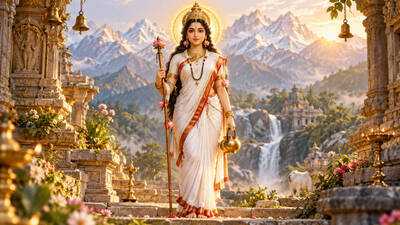
Look at her feet first. Goddess Brahmacharini wears no sandals, no anklets, and no ornaments of any kind. She is clad only in a plain white cloth, with her face turned inward in contemplation. On Monday, 12 October 2026, which falls on the Dwitiya tithi (the second lunar day), devotees will worship her in pandals and home shrines. It is a fitting day to honour her. This year’s Sharad Navratri spans ten days, and she arrives early in the festival as the Goddess who teaches us how to persevere.
A thousand years of one decisionGoddess Brahmacharini represents dedication to a higher cause and the determination to keep moving forward, regardless of the obstacles in one’s path. This single idea runs through her entire story, which is not about a loud, sudden victory. It is about a long journey across difficult terrain.
Born as Shailputri, the daughter of the Himalayas, the Goddess became aware of her destiny to reunite with Lord Shiva, her divine consort in a previous birth. Knowing her destination did not make the journey any easier. Obstacles stood in her way, and traditional accounts do not conceal these challenges. Destiny, after all, still demands effort.
So she undertook tapasya , or penance, which tradition says lasted a thousand years. The duration itself carries meaning. Over time, she gave up even the leaves she had been living on, earning the name Aparna, meaning “one who does not eat even a leaf.” She grew extremely thin, and her emaciated form became a testament to the extent of her austerities.
She is also known as Uma. The names may change, but her purpose remains the same. Witnessing her extraordinary dedication, the gods appeared before her and granted her the boon that Lord Shiva would become her consort. In this telling, the boon is not arbitrary; it is the culmination of a commitment that never faltered. This is a popular Puranic and folk tradition, although the details vary across regions, and not every element can be traced to a single verse.
What she carries in her handsNothing about her traditional form is ornamental. She is depicted barefoot, without jewellery or other adornments, wearing simple white clothing. Her appearance is a statement in itself, reflecting the discipline and austerity of her spiritual practice .
In her right hand, she holds a rosary, symbolising her continuous chanting of Shiva mantras . The key word is continuous. The rosary is not merely an accessory; it represents a rhythm, bead after bead, as the mind returns to Shiva again and again. When obstacles arise, this unwavering practice becomes a source of strength.
In her left hand, she holds a kamandalu, a water pot traditionally made from a gourd or coconut shell. Simple and natural, it reflects the austerity of her appearance. It also suggests that her path is not about accumulating more but about carrying only what sustains us, with humility.
Mars and a chakra low in the bodyIn some astrological traditions, Goddess Brahmacharini is associated with Mars, the planet linked to energy, action, and forward movement. In her story, however, movement is disciplined and directed towards a higher purpose. Her journey embodies steady effort over time. Astrological associations vary across schools, so this should be understood as one widely held interpretation rather than a universal doctrine.
In certain Yoga and Tantra traditions, she is associated with the Swadhisthana Chakra, an energy centre located above the Mooladhara Chakra, or root centre, near the base of the spine. The Swadhisthana Chakra is traditionally placed in the lower abdominal or pelvic region, near the reproductive organs. Worship of the Goddess is believed by practitioners to strengthen this chakra and help address associated physical or energetic imbalances. Within these traditions, her tapasya is understood as a force that helps overcome deficiencies and restore inner balance.
Bringing her teachings into an ordinary weekDwitiya is a meaningful day to choose a cause and remain committed to it, even when obstacles arise. Keep your approach simple, just as her white clothing is simple. If you have an established spiritual practice, chant Shiva mantras with consistency, following the spirit of the rosary in her hand. Carry only what supports your purpose, as symbolised by the humble gourd or coconut kamandalu she holds.
Notice what her story leaves out: there is no dramatic beginning and no shortcut to success. There is only a practice repeated faithfully until the boon is granted. Desire alone cannot carry anyone to their destination; patience and perseverance do the heavy lifting.
If you wish to make a resolution on this day, consider saying it aloud:
“No matter what the circumstances may be, I will not stray from the righteous path.”
Then, when the week grows tiring, remember the rosary in her hand. Moving forward one bead at a time is still moving forward.
A thousand years of one decisionGoddess Brahmacharini represents dedication to a higher cause and the determination to keep moving forward, regardless of the obstacles in one’s path. This single idea runs through her entire story, which is not about a loud, sudden victory. It is about a long journey across difficult terrain.
Born as Shailputri, the daughter of the Himalayas, the Goddess became aware of her destiny to reunite with Lord Shiva, her divine consort in a previous birth. Knowing her destination did not make the journey any easier. Obstacles stood in her way, and traditional accounts do not conceal these challenges. Destiny, after all, still demands effort.
So she undertook tapasya , or penance, which tradition says lasted a thousand years. The duration itself carries meaning. Over time, she gave up even the leaves she had been living on, earning the name Aparna, meaning “one who does not eat even a leaf.” She grew extremely thin, and her emaciated form became a testament to the extent of her austerities.
She is also known as Uma. The names may change, but her purpose remains the same. Witnessing her extraordinary dedication, the gods appeared before her and granted her the boon that Lord Shiva would become her consort. In this telling, the boon is not arbitrary; it is the culmination of a commitment that never faltered. This is a popular Puranic and folk tradition, although the details vary across regions, and not every element can be traced to a single verse.
What she carries in her handsNothing about her traditional form is ornamental. She is depicted barefoot, without jewellery or other adornments, wearing simple white clothing. Her appearance is a statement in itself, reflecting the discipline and austerity of her spiritual practice .
In her right hand, she holds a rosary, symbolising her continuous chanting of Shiva mantras . The key word is continuous. The rosary is not merely an accessory; it represents a rhythm, bead after bead, as the mind returns to Shiva again and again. When obstacles arise, this unwavering practice becomes a source of strength.
In her left hand, she holds a kamandalu, a water pot traditionally made from a gourd or coconut shell. Simple and natural, it reflects the austerity of her appearance. It also suggests that her path is not about accumulating more but about carrying only what sustains us, with humility.
Mars and a chakra low in the bodyIn some astrological traditions, Goddess Brahmacharini is associated with Mars, the planet linked to energy, action, and forward movement. In her story, however, movement is disciplined and directed towards a higher purpose. Her journey embodies steady effort over time. Astrological associations vary across schools, so this should be understood as one widely held interpretation rather than a universal doctrine.
In certain Yoga and Tantra traditions, she is associated with the Swadhisthana Chakra, an energy centre located above the Mooladhara Chakra, or root centre, near the base of the spine. The Swadhisthana Chakra is traditionally placed in the lower abdominal or pelvic region, near the reproductive organs. Worship of the Goddess is believed by practitioners to strengthen this chakra and help address associated physical or energetic imbalances. Within these traditions, her tapasya is understood as a force that helps overcome deficiencies and restore inner balance.
Bringing her teachings into an ordinary weekDwitiya is a meaningful day to choose a cause and remain committed to it, even when obstacles arise. Keep your approach simple, just as her white clothing is simple. If you have an established spiritual practice, chant Shiva mantras with consistency, following the spirit of the rosary in her hand. Carry only what supports your purpose, as symbolised by the humble gourd or coconut kamandalu she holds.
Notice what her story leaves out: there is no dramatic beginning and no shortcut to success. There is only a practice repeated faithfully until the boon is granted. Desire alone cannot carry anyone to their destination; patience and perseverance do the heavy lifting.
If you wish to make a resolution on this day, consider saying it aloud:
“No matter what the circumstances may be, I will not stray from the righteous path.”
Then, when the week grows tiring, remember the rosary in her hand. Moving forward one bead at a time is still moving forward.
Next Story