
Kaalratri in Sharad Navratri 2026: The dark goddess who crosses time


“Kaal” means death, and in Sanskrit, it also means time. “Ratri” means night. Put them together, and you get Kaalratri , a name that sounds terrifying and a form that can feel just as fearsome.
Yet devotees also call her Shubhkari, “the one who brings auspiciousness.” She is worshipped on Saturday, 17 October, this year. Saptami tithi, the lunar day, is still present at sunrise on Sunday, 18 October, so her worship extends into that morning. This overlap is why Sharad Navratri 2026 spans ten days. The timings mentioned here are for Delhi, so check your local panchang, the Hindu almanac.
Why the fierce one is called auspiciousShe is born where the limits of time and the sky end. Her kindness is not random, though. It extends to those who live by nature’s rules, practise restraint, and respect women. That is a hard truth placed right at the heart of her tenderness.
Later on 18 October, Ashtami begins, and the night turns to Ashtami Tantra Puja, worship performed through Tantric methods.
Raktabeej and the desires that multiplyHer battles are often interpreted as inner struggles. The demons represent bodily tendencies and emotions, while Raktabeej, the demon who could multiply, symbolises endless desire. The havoc caused by Chand, Mund, Shumbh, and Nishumbh mirrors what happens within us when our tendencies become forces that refuse to listen.
Raktabeej is the most relentless of them all. Every drop of his blood that touched the ground produced another Raktabeej.
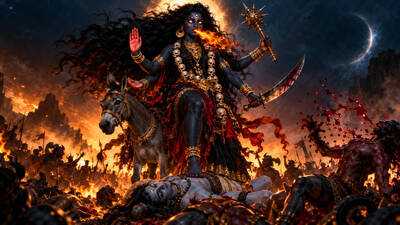
What her four hands sayShe is dark-complexioned and rides a donkey. Her hair is unkempt, her three eyes blaze, and flames issue from her nostrils. In her upper left hand, she holds a vajra, a thunderbolt weapon studded with iron spikes, and in her lower left hand, a large sword. Her right hands display the Var Mudra, the gesture of blessing, and the Abhay Mudra, the gesture of fearlessness.
Her left hands symbolise the destruction of evil and those who violate the moral order. Her right hands bless devotees who live by righteous principles. Fierce on one side, protective on the other—both aspects are true at once.
Mahakaal under her feetThe story draws on the Devi Mahatmya, the account of the Goddess found in the Markandeya Purana, though details vary across different tellings. When Chand, Mund, Shumbh, and Nishumbh wreaked havoc that even Brahma, Vishnu, and Shiva could not stop, Kali emerged from Parvati’s body. In her dark form as Kaalratri, she killed Chand and Mund, earning the name Chamunda, and later slew Shumbh and Nishumbh.
Raktabeej appeared in the midst of the battle. She absorbed every drop of his blood before it could reach the ground, bringing an end to his multiplying power. She is also depicted standing with her feet on Shiva in his form as Mahakaal, the Lord of Time, symbolising her power to transcend even the ultimate limits of time.
According to Bengali almanacs, Maha Saptami falls on Sunday, 18 October.
The darkness that came to teachDevotees are encouraged to live by nature’s rules, respect women, and confront their desires before they multiply. But the teaching of Saptami goes further: do not fear the darkness in your life. Sometimes, the very thing we run from is where we discover our deepest strength.
So, carry one question into Saturday night: What has the situation I fear come into my life to teach me?
Yet devotees also call her Shubhkari, “the one who brings auspiciousness.” She is worshipped on Saturday, 17 October, this year. Saptami tithi, the lunar day, is still present at sunrise on Sunday, 18 October, so her worship extends into that morning. This overlap is why Sharad Navratri 2026 spans ten days. The timings mentioned here are for Delhi, so check your local panchang, the Hindu almanac.
Awaken the 9 Divine Forms of Durga Within You & Embrace Your Power | A Revelation by Geeta Sharma
Why the fierce one is called auspiciousShe is born where the limits of time and the sky end. Her kindness is not random, though. It extends to those who live by nature’s rules, practise restraint, and respect women. That is a hard truth placed right at the heart of her tenderness.
Later on 18 October, Ashtami begins, and the night turns to Ashtami Tantra Puja, worship performed through Tantric methods.
Raktabeej and the desires that multiplyHer battles are often interpreted as inner struggles. The demons represent bodily tendencies and emotions, while Raktabeej, the demon who could multiply, symbolises endless desire. The havoc caused by Chand, Mund, Shumbh, and Nishumbh mirrors what happens within us when our tendencies become forces that refuse to listen.
Raktabeej is the most relentless of them all. Every drop of his blood that touched the ground produced another Raktabeej.
What her four hands sayShe is dark-complexioned and rides a donkey. Her hair is unkempt, her three eyes blaze, and flames issue from her nostrils. In her upper left hand, she holds a vajra, a thunderbolt weapon studded with iron spikes, and in her lower left hand, a large sword. Her right hands display the Var Mudra, the gesture of blessing, and the Abhay Mudra, the gesture of fearlessness.
Her left hands symbolise the destruction of evil and those who violate the moral order. Her right hands bless devotees who live by righteous principles. Fierce on one side, protective on the other—both aspects are true at once.
Mahakaal under her feetThe story draws on the Devi Mahatmya, the account of the Goddess found in the Markandeya Purana, though details vary across different tellings. When Chand, Mund, Shumbh, and Nishumbh wreaked havoc that even Brahma, Vishnu, and Shiva could not stop, Kali emerged from Parvati’s body. In her dark form as Kaalratri, she killed Chand and Mund, earning the name Chamunda, and later slew Shumbh and Nishumbh.
Raktabeej appeared in the midst of the battle. She absorbed every drop of his blood before it could reach the ground, bringing an end to his multiplying power. She is also depicted standing with her feet on Shiva in his form as Mahakaal, the Lord of Time, symbolising her power to transcend even the ultimate limits of time.
According to Bengali almanacs, Maha Saptami falls on Sunday, 18 October.
The darkness that came to teachDevotees are encouraged to live by nature’s rules, respect women, and confront their desires before they multiply. But the teaching of Saptami goes further: do not fear the darkness in your life. Sometimes, the very thing we run from is where we discover our deepest strength.
So, carry one question into Saturday night: What has the situation I fear come into my life to teach me?
Next Story